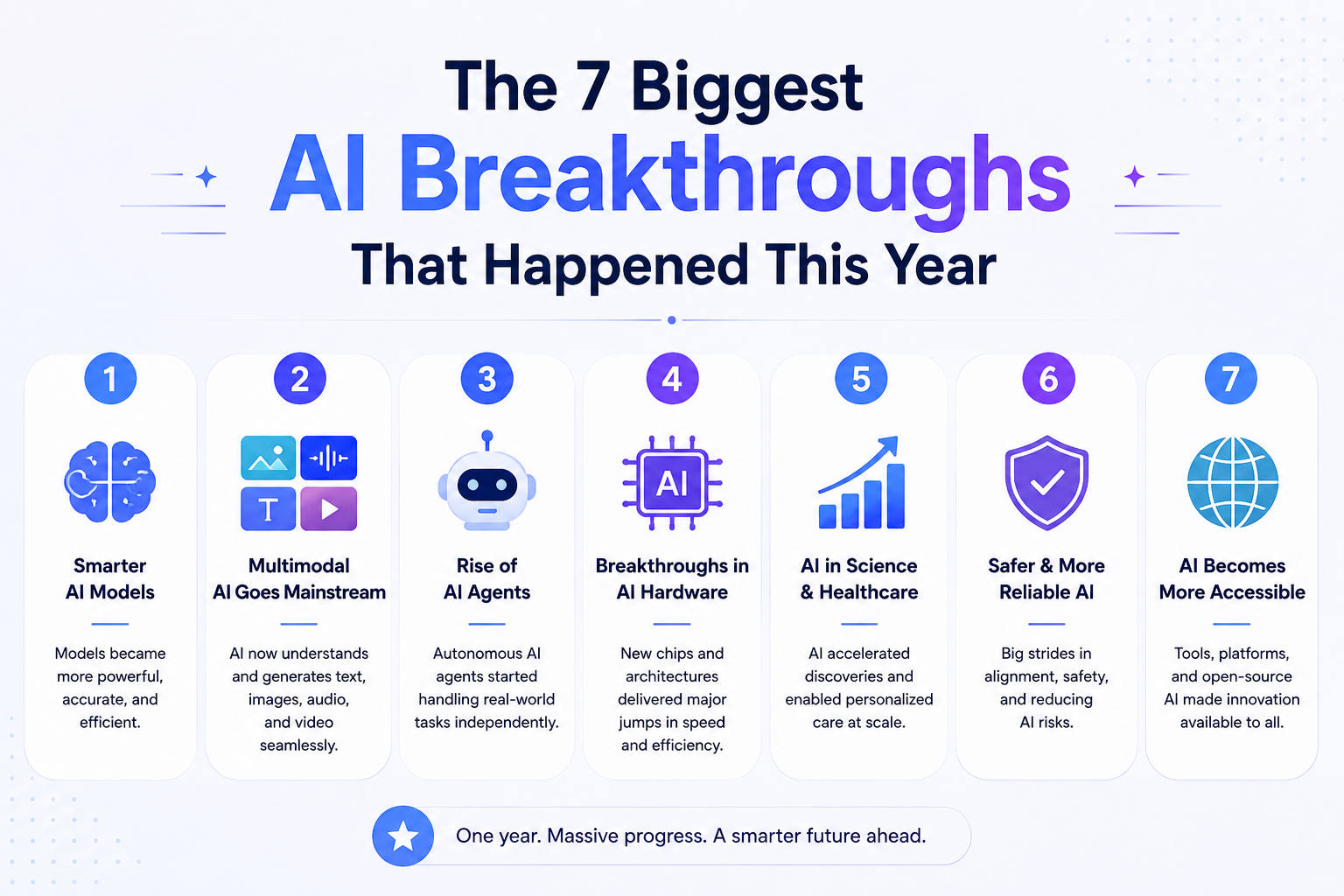
The 7 Biggest AI Breakthroughs That Happened This Year
The year 2026 has officially rewritten the playbook for what artificial intelligence can achieve. We have graduated from the era of conversational chatbots to a reality where AI operates as an active, independent layer of global business infrastructure.
Instead of chasing raw model size, the industry spent the year breaking through the practical limits of integration, memory, and specialized performance. For business leaders and professionals, these seven breakthroughs defined the technological landscape this year.
1. The Rise of Multi-Agent Systems
This year, AI evolved from isolated, single-prompt tools into collaborative networks. Rather than a human worker executing a task step-by-step with an AI assistant, organizations began deploying multi-agent systems.
In these ecosystems, multiple specialized AI agents communicate and work collectively to manage massive, end-to-end workflows—such as handling full software development lifecycles or coordinating complex logistics operations. This shift moved human labor firmly away from routine execution and into the role of strategic oversight.
2. Autonomously Self-Verifying Agents
The single greatest hurdle to scaling AI workflows in the past was error accumulation. If an AI agent made a tiny mistake early in a multi-step process, the entire project collapsed.
This year, the industry solved this bottleneck with autonomous self-verification. Modern enterprise agents are now integrated into workflows where specialized sub-agents act as validators. These specialized validation agents can autonomously audit the accuracy of another agent's work, flag anomalies, and handle execution failures mid-workflow without waiting for a human manager to step in.
3. Paradigm-Shifting Cognitive Density
For years, the tech sector operated under the assumption that bigger models were always better. This year proved that deploying massive models for simple, everyday business tasks is computationally wasteful and economically unviable.
The breakthrough of the year was cognitive density—the ability to pack immense reasoning capabilities into compact, hyper-efficient architectures. Highly optimized, smaller models and sparse expert architectures gained immense popularity. They run with significantly less memory, making robust AI reasoning accessible for mobile applications, low-power edge devices, and localized enterprise deployments at a fraction of the cost.
4. Universal Interoperability Protocols
Before this year, connecting an AI model to internal database tools and software applications was fragmented and complex. If you switched AI vendors, you often had to rewrite your entire integration infrastructure.
This year, the industry established true agent interoperability by rallying around open communication standards. Acting like a universal communication language, open-source protocols now create a common standard for AI systems, databases, APIs, and enterprise SaaS tools. This allows agents to securely interact across platforms without custom integrations for every single workflow.
5. Persistent Context Windows and Working Memory
Early generative AI tools suffered from extreme short-term memory loss, requiring users to constantly re-upload documents or rewrite foundational guidelines in new chat sessions.
Major improvements in model post-training and architectural memory sharing this year delivered persistent working memory. AI agents can now retain contextual memory and maintain continuous states across weeks and months of long-running projects. They learn from their past corporate actions, understand long-term organizational goals, and provide continuous, reliable partnership rather than single-session responses.
6. Native Multimodality as the Default Standard
The artificial divide between text, image, audio, and video processing completely dissolved this year. The new standard for foundational models is native multimodality, meaning systems are built from inception to handle multiple data types seamlessly without separate, bolt-on modules.
An AI can now simultaneously ingest hours of raw video footage, cross-reference it with text-heavy regulatory documents, and generate actionable insights in seconds. This breakthrough is revolutionizing fields ranging from creative industries to advanced diagnostics, where AI can analyze records and visual imaging at the exact same time.
7. Globally Interconnected Computing Networks
As AI workloads scaled exponentially, the old method of building isolated, underutilized data centers became an environmental and economic bottleneck.
This year marked a massive migration toward globally interconnected, high-performance computing grids. Designed as a coordinated ecosystem of efficient, scalable production lines, these platforms leverage cloud networks to intelligently distribute massive computational workloads to optimal resources worldwide. This grid-style system drastically slashes operational costs and minimizes energy consumption, making true enterprise automation sustainable.
Tags
#AI #AIBreakthroughs #AIInnovation #ArtificialIntelligence #AITrends #TechBreakthroughs #GenerativeAI #AgenticAI #MachineLearning #EnterpriseAI #TechnologyNews #FutureOfAI #DigitalTransformation #AIAutomation #Innovation #EmergingTechnology #AIResearch #TechTrends #BusinessTechnology #AIUpdates #TechnologyInnovation #FutureOfWork #AIHighlights