Persistent AI Agents Are the New Enterprise Runtime
For the first wave of generative AI, the interface was the chatbot. You typed a question, the model answered, and the interaction ended. That was useful, but it was also limited. Most enterprise work does not begin and end in a single chat window. It stretches across systems, approvals, documents, tickets, customer records, code repositories, calendars, and business rules.
The next wave of AI is not just better chat. It is persistent AI agents: long-running software workers that can remember context, operate inside cloud workspaces, use tools, follow permissions, and complete work over time.
This is why persistent AI agents are becoming the new enterprise runtime.
From chatbot to runtime
A chatbot is reactive. It waits for a prompt.
A persistent agent is operational. It can be assigned a goal, monitor changes, call tools, use files, update systems, ask for approval, and continue working across multiple steps.
That difference matters. A chatbot can summarize a sales call. A persistent agent can monitor the account, draft follow-ups, update the CRM, check open support cases, prepare renewal risks, and notify the account team before the next meeting.
A chatbot can answer a question about an invoice. A persistent agent can detect the invoice, compare it with purchase orders, flag exceptions, route approvals, update the ERP, and leave an audit trail.
The enterprise value is not in the conversation. It is in the execution layer around the conversation.
What makes an AI agent “persistent”?
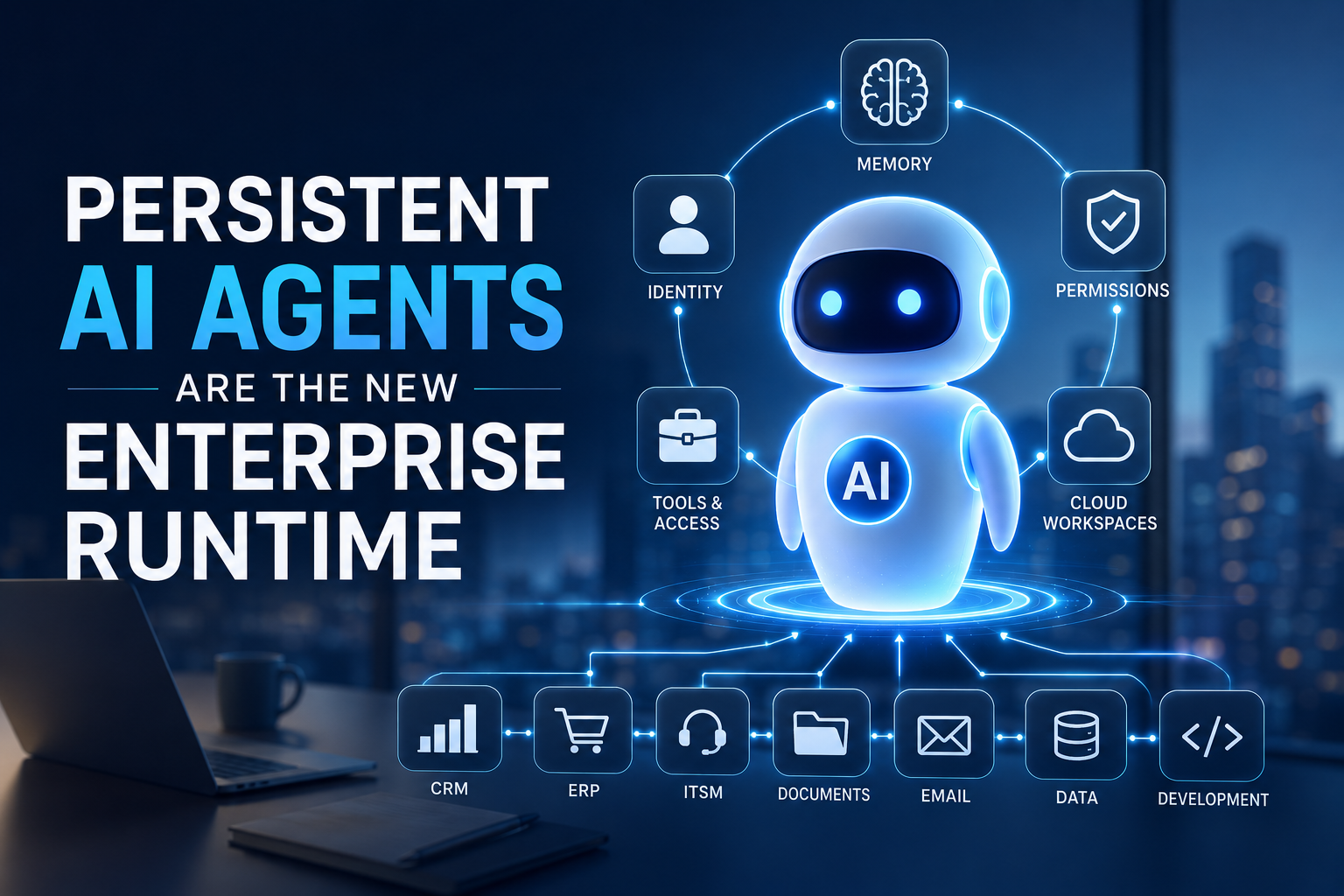
A persistent AI agent needs more than a large language model. It needs a runtime environment around the model.
That runtime usually includes five things.
First, memory and state. The agent needs to know what has already happened, what it is trying to accomplish, what decisions were made, and what still needs to be done.
Second, identity. The enterprise must know which agent acted, on behalf of whom, and under what authority. Without identity, agents become invisible automation.
Third, permissions. Agents should not have broad access just because they are useful. They need scoped access to the systems, data, and actions required for a specific job.
Fourth, tools and connectors. Agents become valuable when they can work across business systems: CRM, ERP, HR, ITSM, data warehouses, documents, email, code, and collaboration tools.
Fifth, cloud workspaces and execution environments. Agents need somewhere to store files, run code, call APIs, process data, and create durable outputs.
This is why the industry is moving from “AI assistant” to “AI worker,” and from “chat window” to “agent runtime.”
OpenAI: agents as applications, not just conversations
OpenAI’s product direction shows this shift clearly. Its Agents SDK describes agents as applications that can plan, call tools, collaborate across specialists, and keep enough state to complete multi-step work. Its Responses API includes built-in tools such as web search, file search, computer use, code interpreter, and remote MCP connections, which move the model closer to real work rather than simple text generation.
OpenAI is also pushing toward workspace-based agents for teams. ChatGPT workspace agents can be created for repeatable workflows, connected to apps and tools, shared with teammates, used in Slack, scheduled, or triggered through an API. That is not a chatbot pattern. That is an enterprise workflow pattern.
The important idea is that OpenAI is not only selling intelligence. It is building the operating layer around intelligence: tools, state, approvals, connectors, computer use, and workspace execution. OpenAI’s enterprise positioning also includes agent identity and access management, so agents can act with scoped permissions rather than unlimited access.
Microsoft: governance becomes the control plane
Microsoft’s role is different but just as important. Microsoft is approaching agents through the lens of enterprise control: identity, security, compliance, observability, and administration.
Microsoft Agent 365 is positioned as a control plane for observing, securing, and governing AI agents across an organization. It connects agent management with Microsoft 365 admin tools, Microsoft Entra for identity and access, Microsoft Defender for security, and Microsoft Purview for data protection and compliance.
This matters because enterprises will not run thousands of AI agents without governance. They will need to answer basic operational questions: Which agents exist? Who owns them? What systems can they access? What data did they use? What actions did they take? Can we revoke them? Can we audit them?
Microsoft is also treating agent identity as a first-class enterprise concept. Microsoft Entra’s agent identity documentation frames agent access rights as part of the same governance lifecycle used for human identities.
That may sound administrative, but it is central to adoption. The more powerful agents become, the more they need to look like managed enterprise actors, not random scripts with a prompt attached.
NVIDIA: the infrastructure behind agent workloads
NVIDIA’s role is the infrastructure layer. If OpenAI focuses on agent intelligence and Microsoft focuses on enterprise control, NVIDIA is focused on the compute, model deployment, optimization, and tooling needed to run agents at scale.
NVIDIA NIM helps developers move from experimentation to deployment with pre-optimized models and standard APIs for building agents, copilots, chatbots, and assistants. NVIDIA NeMo Agent Toolkit is designed to connect enterprise agents to data sources and tools across different frameworks, which is important because most enterprises will not standardize on a single agent framework overnight.
This is a critical part of the new runtime. Persistent agents will not run as occasional demos. They will run continuously, across departments, with different models, retrieval systems, tools, and security constraints. That requires infrastructure for performance, monitoring, optimization, and deployment.
In other words, agents are not just a user experience. They are a workload.
Enterprise SaaS vendors: agents move into the systems of work
The biggest long-term impact may come from enterprise SaaS vendors, because they already own the business context.
Salesforce is building around Agentforce, its platform for building, deploying, managing, and orchestrating AI agents across customer, supplier, and employee experiences. Salesforce’s positioning is not simply “ask your CRM a question.” It is about agents working inside the CRM and business process layer.
ServiceNow is taking a similar workflow-first approach. Its AI agents are tied to the Now Platform, where data, workflows, AI, and security sit together. ServiceNow also emphasizes building agents, ranking use cases, testing against real data, and unifying third-party agents and tools through its platform.
SAP is embedding agents into business processes through Joule Agents. SAP describes Joule Agents as ready-to-use agents for decision support and task automation that can choose tools, use other agents, interact with third-party applications, and reflect on results. That is especially relevant in complex enterprise functions like finance, procurement, supply chain, and HR.
Workday is approaching the problem from the workforce-management angle. Its Agent System of Record is designed to bring AI agents into the same environment where companies manage people, with visibility, accountability, analytics, lifecycle control, and governance.
Together, these vendors show where the market is heading. Agents will not live only in standalone AI products. They will live inside the systems where work already happens.
Why “runtime” is the right word
A runtime is the environment that lets software execute reliably. It provides the rules, resources, state, permissions, and interfaces needed for software to do useful work.
Persistent agents need the same thing.
They need model access, but also memory.
They need reasoning, but also permissions.
They need tool use, but also audit logs.
They need autonomy, but also human approval.
They need cloud execution, but also data boundaries.
They need flexibility, but also governance.
This is why the winning enterprise AI platforms will not be judged only by model benchmarks. They will be judged by how safely and reliably agents can operate inside real business environments.
The new enterprise stack
The emerging agent stack looks something like this:
The model layer provides reasoning, language, planning, and multimodal understanding.
The orchestration layer decides which model, tool, workflow, or specialist agent should handle each step.
The memory layer preserves context across long-running work.
The tool layer connects agents to applications, APIs, files, databases, browsers, and cloud systems.
The identity layer gives each agent a managed role, owner, and permission boundary.
The governance layer provides monitoring, approvals, auditability, policy enforcement, and lifecycle management.
The workspace layer gives agents a safe place to execute tasks, store artifacts, and produce durable outputs.
This is much bigger than chat. It is the foundation for digital labor inside the enterprise.
What changes for business leaders?
Business leaders should stop asking only, “Where can we add a chatbot?”
The better question is, “Which workflows need a persistent agent?”
Good candidates are processes that are repetitive, multi-step, data-heavy, and spread across systems. Examples include customer onboarding, sales operations, IT incident triage, invoice handling, employee support, procurement analysis, compliance review, and software maintenance.
But enterprises should avoid giving agents broad autonomy too quickly. The right path is to start with narrow scopes, clear permissions, human approvals for sensitive actions, and measurable outcomes. An agent should earn more responsibility as it proves reliable.
The organizations that win with agents will not be the ones that create the most demos. They will be the ones that design the best operating model for human-agent collaboration.
The future is not one giant agent
The enterprise will not be run by one super-agent.
It will be run by many specialized agents, each with a defined job, identity, memory, toolset, and permission boundary. Some will work inside OpenAI-powered workspaces. Some will be governed through Microsoft. Some will run on NVIDIA-accelerated infrastructure. Many will live inside Salesforce, ServiceNow, SAP, Workday, and other SaaS platforms.
The real platform battle is not only about who has the smartest model. It is about who owns the runtime for agentic work.
That runtime must be persistent, governed, observable, secure, and deeply connected to enterprise systems.
Chatbots were the interface. Persistent agents are the workforce layer.
And the companies that understand that shift early will build AI into the way work actually gets done.
Tags
#AI #PersistentAIAgents #AgenticAI #EnterpriseAI #AIRuntime #AutonomousAgents #AgentOrchestration #EnterpriseAutomation #AIInfrastructure #AgenticWorkflows #DigitalTransformation #EnterpriseArchitecture #FutureOfWork #GenerativeAI #AIPlatforms #BusinessInnovation #NextGenEnterprise