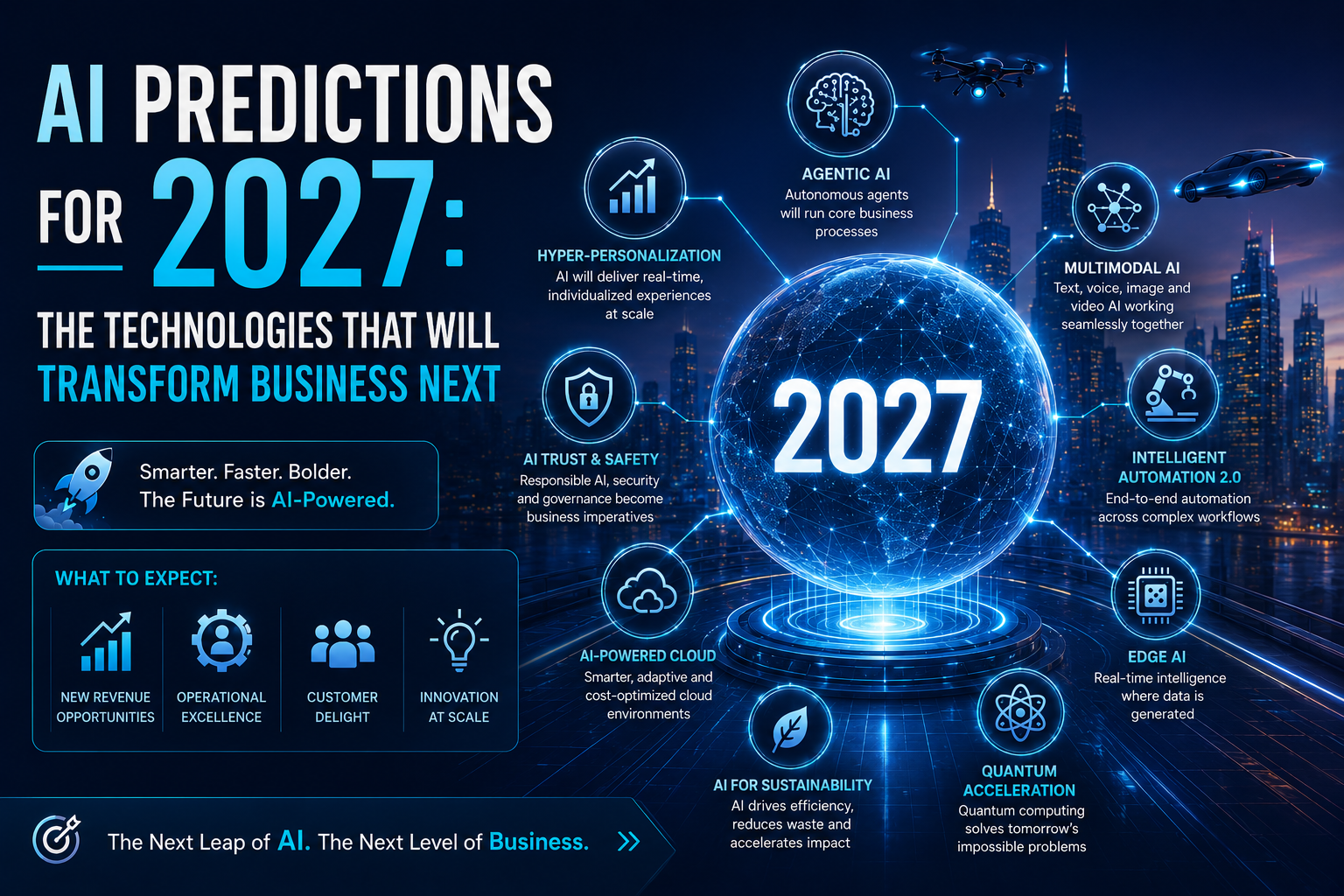
AI Predictions for 2027: The Technologies That Will Transform Business Next
The transition into 2026 proved that autonomous digital workers and standardized integration protocols (like MCP) were not just passing trends—they became core infrastructure. As we look ahead to 2027, the corporate playground is preparing for an even deeper architectural shift.
Enterprises are moving beyond simple process automation. The next wave of artificial intelligence will introduce self-healing code, proactive edge networks, and decentralized agent marketplaces that fundamentally redefine business scale.
Here are the top foundational technology predictions that will transform the business landscape heading into 2027.
1. The Emergence of Self-Healing Enterprise Systems
By 2027, the concept of software downtime will begin to vanish. Traditional IT management relies on reactive monitoring—a system breaks, an alert triggers, and an engineering team manually deploys a patch.
Next-generation systems will feature Continuous Self-Healing Code Architecture:
Proactive Diagnostics: AI agents will continuously simulate security attacks and system bottlenecks in isolated sandbox environments.
Autonomous Patching: When a vulnerability or memory leak is detected, sub-agents will rewrite, test, and deploy code optimizations in real time without human intervention.
Zero-Downtime Operations: Engineering teams will transition from manual troubleshooting to high-level policy setting, leaving system maintenance entirely to automated code protocols.
2. Tokenless Architectures and Infinite Context Windows
The cost structures of 2025 and 2026 were heavily constrained by token limitations and compute expenses. Processing massive corporate datasets required splitting data into fragmented chunks, which often degraded analytical context.
In 2027, advanced Tokenless Architecture and state-space models (such as advanced Mamba-based frameworks) will hit mainstream enterprise cloud environments.
The Impact: Businesses will be able to drop entire corporate history databases, decades of financial records, and live video feeds into a single, continuous context window. The AI will analyze multidimensional corporate operations instantly, identifying hidden efficiencies without requiring expensive database indexing or vector chunking.
    [ Legacy Data Processing ]
     Massive Data Array ──► Chunking/Vectorizing ──► Context Fragmentation ──► Higher Risk of Analytical Blindspots

   [ 2027 Tokenless Model ]
    Massive Data Array ──► Direct Ingestion ──────► Total Context Retention ──► Holistic Corporate Intelligence
3. The Decentralized B2B Agent Marketplace
We are currently witnessing the birth of localized digital employees. By 2027, this will evolve into a global, decentralized economy of specialized AI agents.
Instead of subscribing to massive, all-in-one software suites, enterprises will procure task-specific micro-agents from decentralized marketplaces. For example, if a firm needs a highly specialized customs compliance auditor for a temporary supply chain reroute, they will instantly rent a certified, pre-trained compliance agent. These agents will use secure cryptographic protocols to complete the task, verify their work via zero-knowledge proofs, settle transactions autonomously, and spin down when the job is done.
4. On-Device Edge Intelligence Takes Over the Workspace
Cloud computing bills have forced organizations to look for local alternatives. Thanks to specialized neural processing units (NPUs) built into corporate hardware, 2027 will see a massive shift toward Sovereign Edge Intelligence.
Critical decision-making agents will run directly on local employee devices—laptops, tablets, and localized micro-servers—rather than constantly pinging centralized cloud servers. This transition solves the two biggest hurdles of enterprise AI adoption:
Zero-Latency Workflows: Local agents process information instantly, eliminating cloud queue delays.
Absolute Data Privacy: Sensitive corporate data never leaves the local hardware chassis, automatically satisfying complex regional compliance mandates.
5. Synthetic Data Engines Dematerialize the Data Moat
For years, established market giants maintained an unassailable advantage because they possessed decades of proprietary consumer data. 2027 will level the playing field through the widespread adoption of hyper-realistic Synthetic Data Engines.
Startups and mid-market enterprises will no longer need billions of historical user points to train high-performing operational models. They will utilize advanced simulator engines to generate mathematically perfect, non-identifiable synthetic datasets that mirror real-world market complexities. This democratizes business intelligence, shifting the competitive advantage away from who owns the most historical data to who designs the best operational workflow.
Preparing Your Roadmap for 2027
To ensure your organization is positioned to leverage this next technological leap, leadership should begin taking strategic steps today:
De-risk Cloud Dependency: Evaluate which high-frequency workflows can be transitioned to local edge hardware over the next 18 months.
Audit Data Lineage Now: Prepare your internal infrastructure to integrate smoothly with upcoming process-aware frameworks by ensuring your current datasets are clean and structurally organized.
Implement Standardized APIs: Ensure all internal systems utilize open protocols like MCP so your infrastructure is modular enough to adopt decentralized micro-agents as they enter the market.
The future belongs to organizations that treat AI not as a tool for static automation, but as an elastic, self-evolving foundational layer.
Tags
#AI #AIPredictions2027 #FutureOfAI #ArtificialIntelligence #AITrends #EmergingTechnology #EnterpriseAI #BusinessTransformation #DigitalTransformation #AIAutomation #Innovation #FutureOfWork #TechTrends #GenerativeAI #AgenticAI #BusinessStrategy #AIInnovation #TechnologyForecast #DigitalInnovation #SmartBusiness #EnterpriseTechnology #NextGenAI #BusinessLeadership