Ray-Ban Meta AI Glasses for Blind Users: Inside Vision Ireland’s 15,000-Device Rollout
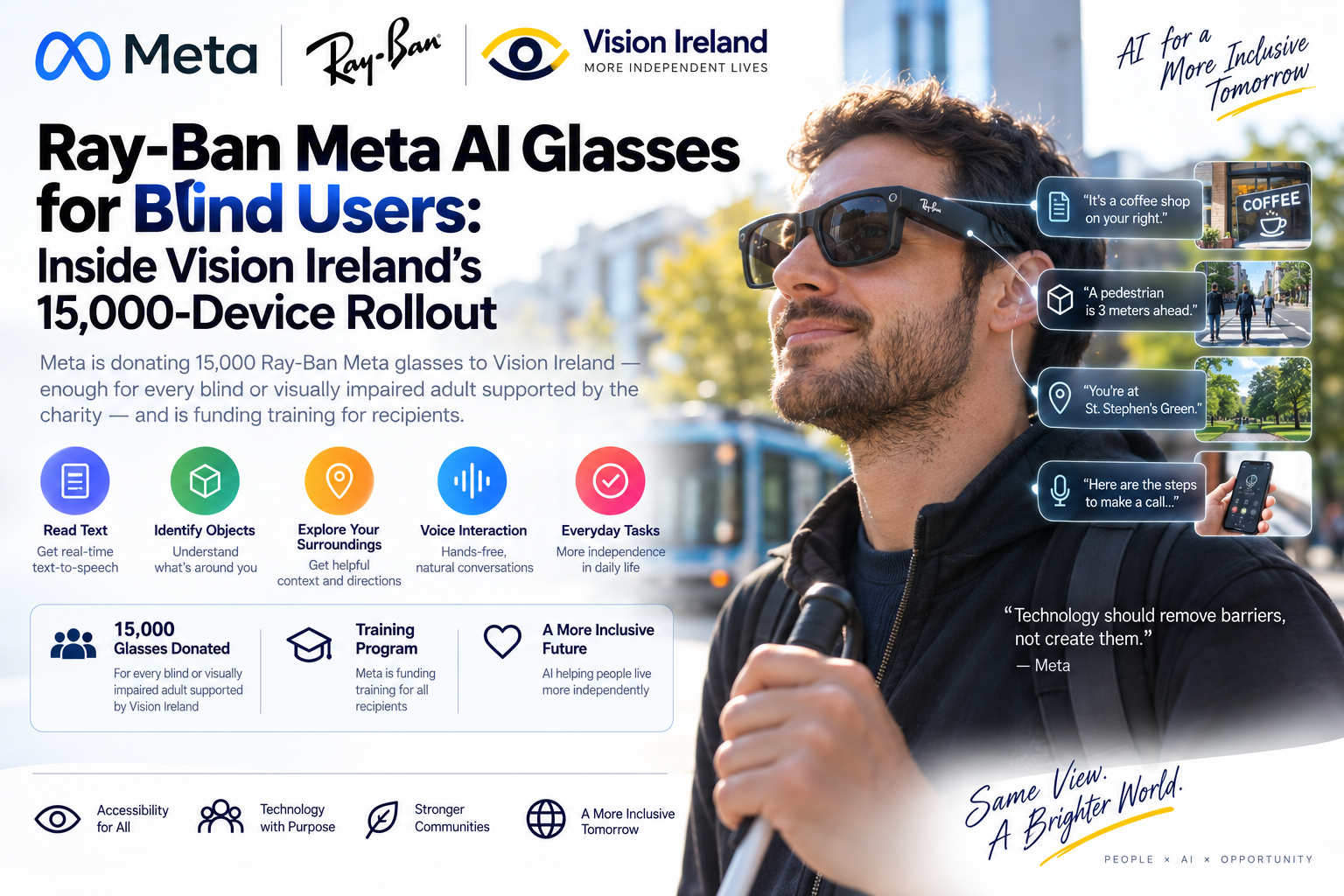
AI wearables often get judged by camera specs, battery life, model demos, and consumer hype. The Vision Ireland rollout asks a better question: can an AI device make everyday independence easier for people who are blind or have low vision?
Meta has announced a donation of 15,000 Ray-Ban Meta AI glasses to Vision Ireland, Ireland's national sight loss charity. The program is intended to provide free glasses for every blind and visually impaired adult the charity supports, with training funded by Meta and delivered through Vision Ireland's rollout process.
Quick Take
- Meta is donating 15,000 Ray-Ban Meta AI glasses to Vision Ireland, enough for every blind and visually impaired adult the charity supports.
- The rollout is free for eligible adults, with Vision Ireland managing registration, assessment, selection, training, and follow-up support.
- The glasses can support daily tasks such as reading text, identifying objects, describing surroundings, making hands-free calls, and using voice interaction.
- The biggest lesson is not the hardware alone. It is the combination of device access, practical training, trusted support, and user-centered deployment.
- Privacy and safety still matter because camera-and-audio wearables introduce bystander awareness, data handling, overreliance, and accessibility-risk questions.
This is one of 2026's clearest examples of AI moving from novelty to practical human support.
What Happened?
Meta announced the Vision Ireland program in August 2026 and positioned it as a national accessibility rollout rather than a limited product giveaway. Vision Ireland will run a phased process covering registration, eligibility, device distribution, hands-on training, and support.
That structure matters. Assistive technology succeeds when people receive it in a way that fits real life: not just a device in a box, but setup help, confidence-building practice, local support, and a feedback path when something does not work as expected.
Why This Is Bigger Than Smart Glasses
The most important part of this story is not that a pair of glasses can take photos or answer questions. It is that AI is becoming ambient, voice-first, and useful in moments where a phone screen can be a barrier.
For blind and low vision users, a wearable assistant can make a practical difference because the camera already faces the world, the speakers leave ears open, and the interaction can happen through simple spoken commands. That makes the form factor more natural for tasks that happen while moving, cooking, shopping, opening mail, or asking what is nearby.
This is why the Vision Ireland rollout is a strong AI wearable case study. It connects the technology to a specific community, gives access at scale, and includes training instead of assuming that every user will learn the system alone.
How Ray-Ban Meta Glasses Can Help
Ray-Ban Meta glasses combine a camera, microphones, speakers, touch controls, and Meta AI voice interaction. For users who are blind or have low vision, the accessibility value comes from hands-free information: asking the glasses to read, describe, identify, call, message, or connect to help.
| Everyday need | How the glasses can help | Practical value | Responsible limitation |
|---|---|---|---|
| Reading text | Use the camera and AI assistant to read signs, labels, menus, letters, and documents aloud. | Reduces waiting for another person to read routine information. | Important text should still be checked when errors could create financial, health, or safety consequences. |
| Identifying objects | Ask the assistant what is in front of the camera or where a common object appears to be. | Helps with home tasks, shopping, sorting items, and quick orientation. | AI object recognition can be wrong, especially in cluttered scenes, poor lighting, or unusual packaging. |
| Understanding surroundings | Request a spoken description of a room, street corner, display, shelf, or nearby scene. | Gives faster contextual awareness without holding a phone camera. | Scene descriptions should support judgment, not replace mobility training, a cane, guide dog, or human assistance. |
| Hands-free communication | Make calls, send messages, listen to audio, or use voice commands while on the move. | Useful when holding a phone is difficult, inconvenient, or unsafe. | Users still need clear privacy settings and trusted contact practices. |
| Real-time help | Connect to a sighted volunteer or trusted support path where supported. | Combines AI assistance with human judgment for uncertain tasks. | Human support should be used for high-stakes situations where AI confidence is not enough. |
The Rollout Model
Vision Ireland's role is central because accessibility programs depend on trust. The charity already understands the community, the support needs, and the practical barriers around assistive technology adoption.
This is the part enterprise and public-sector leaders should study. The program is not treating AI as a downloadable feature. It is treating AI as a capability that needs onboarding, support, inclusion, and governance.
Why Training Matters
Training is not a side detail. For many accessibility users, the difference between "interesting technology" and "life-improving tool" is confidence. People need to know what to ask, how to frame a scene, how to recognize weak answers, when to call a human, how to change settings, and what to do if the device fails.
That is why Meta-funded hands-on training is one of the strongest parts of the Vision Ireland program. It gives recipients a safer starting point and gives the charity a way to learn what works across different ages, levels of vision loss, devices, homes, languages, and daily routines.
Lessons For AI Builders
The Vision Ireland rollout gives a simple but important lesson: AI adoption is not only a software deployment problem. It is a human workflow problem.
| Lesson | What it means for AI teams | Why it matters |
|---|---|---|
| Design with the community | Involve users, advocates, trainers, and support teams before scaling the product. | Accessibility use cases cannot be guessed accurately from a demo room. |
| Pair devices with onboarding | Budget for setup, training, helpdesk support, and practical task walkthroughs. | Training turns a capable device into a repeatable daily habit. |
| Measure outcomes, not usage alone | Track confidence, task completion, independence, support requests, and failure patterns. | A high number of prompts does not automatically mean meaningful impact. |
| Build privacy into the experience | Make recording indicators, settings, deletion controls, and consent guidance easy to understand. | Wearable cameras affect both the user and people around them. |
| Keep a human path available | Offer escalation to trained staff, trusted contacts, or volunteer networks for uncertain tasks. | Assistive AI should expand independence while preserving support when judgment matters. |
Privacy, Consent, And Bystanders
Smart glasses create a different privacy challenge from phones because cameras and microphones are worn on the face. People nearby may not immediately know when a device is capturing media or using AI features.
Meta says its AI glasses include a white Capture LED that blinks when media is being captured, and that the camera can be disabled if the glasses detect the recording indicator has been covered or tampered with. Those safeguards are important, but social trust also depends on user education, venue rules, consent norms, and clear data controls.
For accessibility programs, privacy guidance should be practical rather than abstract. Recipients should know when capture is happening, how to delete media or voice interactions where supported, how cloud AI features work, and when to avoid recording in sensitive places such as clinics, schools, private homes, offices, or confidential meetings.
EU AI Act And GDPR Considerations
From an EU AI Act perspective, assistive AI wearables are not automatically high-risk simply because they help a person with daily tasks. The risk profile depends on how the system is used. A personal assistant that reads a menu or identifies a household object is different from an AI system making decisions about employment, public services, education, law enforcement, credit, or healthcare access.
Still, responsible deployment should follow the spirit of EU AI governance: transparency, human oversight, accuracy monitoring, accessibility, logging where appropriate, and clear user instructions. For a rollout involving people with disabilities, organizations should also avoid overstating reliability and should explain that AI output can be incomplete or mistaken.
GDPR also matters because camera, audio, account, location, and accessibility-related information can involve personal data. A careful program should minimize data collection, explain what is processed locally or in the cloud, provide deletion and access controls, and make sure support staff understand privacy duties.
Responsible AI note: Ray-Ban Meta glasses may help users read text, identify objects, and understand surroundings, but they should not be presented as a replacement for mobility aids, professional orientation and mobility training, emergency judgment, or human assistance in high-stakes situations.
Why This Could Shape The Wearable AI Market
Consumer AI glasses are becoming a contest between design, battery life, cameras, displays, apps, and assistant intelligence. But accessibility may become one of the clearest proof points for why the category matters at all.
If people use the glasses to read a letter, check a product label, understand a sign, message a friend, or complete a task without waiting for help, the value becomes easy to understand. That kind of human-centered evidence is more persuasive than a benchmark chart.
The Vision Ireland program may also influence how future wearable AI companies package adoption. The winners will not simply ship smarter devices. They will build training, trust, privacy, support, and accessible design into the product experience.
Best Fit Recommendation
For accessibility organizations: Treat Ray-Ban Meta glasses as a promising assistive AI tool, but evaluate them through structured pilots, user feedback, training outcomes, privacy readiness, and support workload.
For AI hardware companies: Learn from the Vision Ireland model. A strong assistive rollout needs community partnership, funded onboarding, clear privacy communication, and a human support path.
For enterprises and public-sector teams: The same pattern applies beyond accessibility: AI works best when adoption is designed around real users, not just procurement checklists.
FAQ
What is the Vision Ireland Ray-Ban Meta glasses rollout?
It is a program in which Meta is donating 15,000 Ray-Ban Meta AI glasses to Vision Ireland, with the goal of making the device available free to every blind and visually impaired adult the charity supports.
How can Ray-Ban Meta glasses help blind users?
The glasses can use voice interaction and AI features to read text, identify objects, describe surroundings, support hands-free communication, and connect users to real-time help where supported.
Are the glasses free for eligible users?
Yes. Vision Ireland describes the program as free for eligible blind and visually impaired adults it supports, with hands-on training included through the rollout.
Do AI glasses replace a cane, guide dog, or mobility training?
No. AI glasses should be treated as an additional assistive tool. They can provide useful information, but they should not replace mobility aids, professional training, trusted human assistance, or emergency judgment.
What are the main privacy concerns?
The main concerns are camera and microphone use, bystander awareness, where media and voice interactions are processed, how users control deletion, and whether people understand when recording or AI analysis is happening.