AI Drug Discovery Case Study: How Google Co-Scientist Identified Liver-Fibrosis Candidates
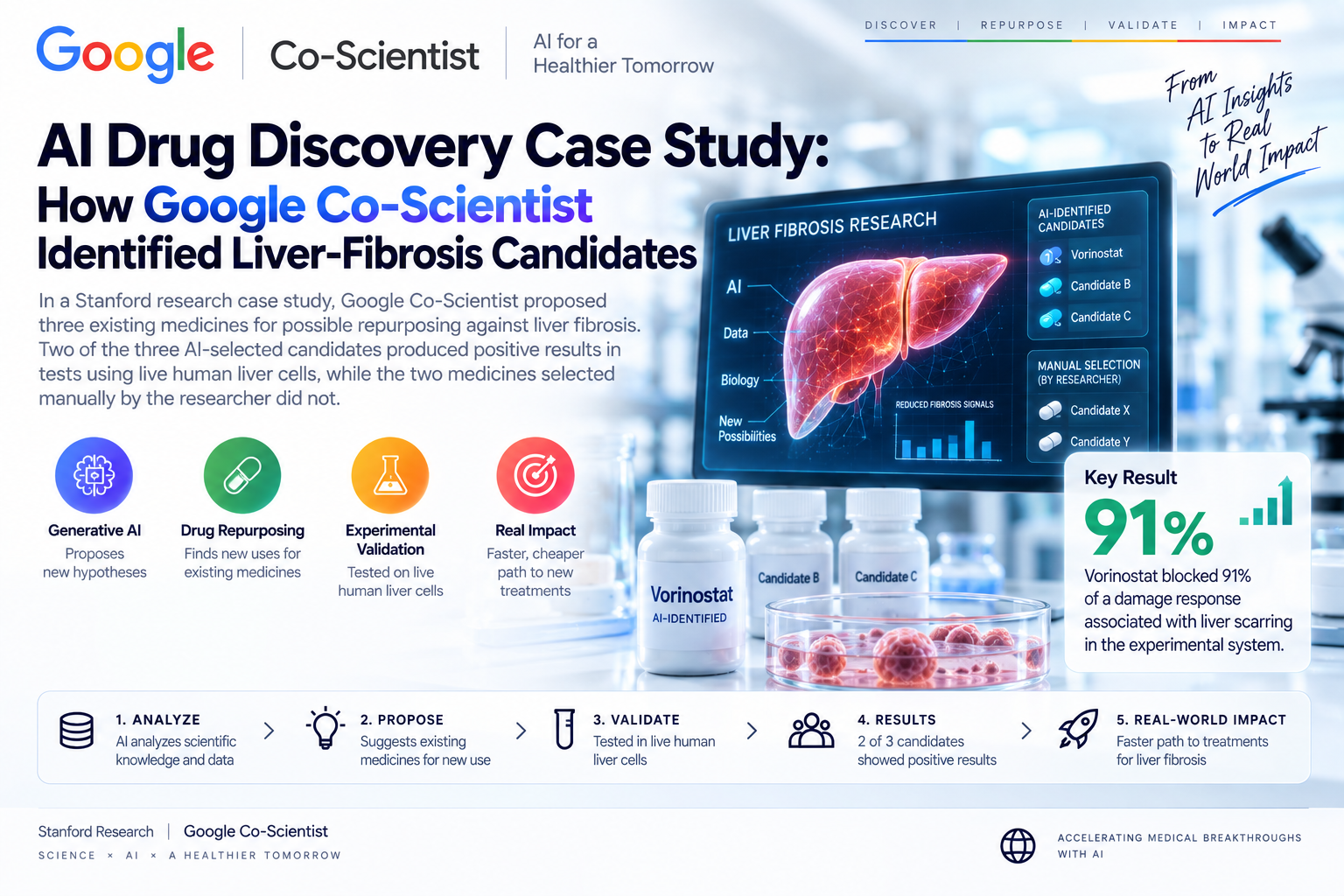
Most AI drug discovery stories sound impressive until the question becomes simple: did the AI idea survive contact with a real lab test? Google's Co-Scientist liver-fibrosis case study is interesting because it moves beyond literature search and into experimental validation using live human liver-cell models.
In a Stanford-led study highlighted by Google DeepMind, Google Co-Scientist helped identify existing drug candidates for possible repurposing against liver fibrosis. Two of the AI-selected candidates showed positive effects in a human liver organoid test system, while two candidates selected manually from the literature did not show benefit in that same setup. The standout candidate, vorinostat, reduced a scarring-linked damage response by 91% in the experimental system.
Quick Take
- Google Co-Scientist is a multi-agent AI research system built to help scientists generate, critique, rank, and refine testable hypotheses.
- The Stanford liver-fibrosis study used live human hepatic organoids, not patient trials, to test anti-fibrotic activity and toxicity signals.
- Two AI-selected candidates produced positive results in the experimental system, while two manually selected candidates did not reduce fibrosis in the same setup.
- Vorinostat was the strongest reported candidate, reducing a TGF-beta-related chromatin damage response by 91% and promoting liver-cell regeneration in microHOs.
- The big lesson is workflow design: AI can accelerate hypothesis generation, but scientific proof still comes from controlled experiments, expert review, and clinical validation.
This case matters because AI did not replace the scientist; it helped the scientist choose better experiments.
What Is Google Co-Scientist?
Google Co-Scientist is an AI system designed as a research collaborator for scientific hypothesis generation. Google describes it as a multi-agent system built with Gemini, where different agents generate ideas, critique them, rank them, evolve stronger hypotheses, and synthesize proposals for scientists to review.
That is different from a chatbot summarizing papers. In Co-Scientist, the system is structured around the scientific method: define a goal, generate possible explanations or interventions, debate the quality of those ideas, compare evidence, and produce testable research plans. The human scientist remains responsible for the goal, the interpretation, and the experiments.
Why Liver Fibrosis Is A Hard Problem
Liver fibrosis is a scarring process that can occur after chronic liver injury. When fibrosis progresses, it can contribute to cirrhosis and serious liver disease. The challenge for researchers is that promising therapies often fail because animal models and simple cell models do not fully reproduce human liver biology.
The Stanford team used multi-lineage human hepatic organoids grown in microwells, often referred to as microHOs. These are laboratory models built from human cells that can reproduce important features of liver tissue and fibrotic response. That made them useful for comparing candidate drugs in a more human-relevant experimental system than a simple two-dimensional cell assay.
What The Case Study Found
The research question was not simply "find a drug for liver fibrosis." The more precise question was whether epigenomic changes, which affect how genes are regulated, could be targeted to reduce fibrosis and support liver regeneration.
Co-Scientist proposed candidate directions connected to epigenomic modifiers. The Stanford team then tested drugs connected to those directions alongside candidates selected manually from the literature. The result was a useful comparison between AI-assisted hypothesis generation and a traditional expert literature path.
| Candidate or target path | Selection route | Experimental result | Responsible interpretation |
|---|---|---|---|
| Vorinostat / HDAC inhibition | AI-selected epigenomic-modifier direction. | Positive anti-fibrotic effect in microHOs; vorinostat reduced a TGF-beta-induced chromatin response by 91%. | Promising lab result for repurposing research, not proof of patient efficacy. |
| BRD4 inhibition | AI-selected epigenomic-modifier direction. | BRD4 inhibitors tested in the study showed anti-fibrotic activity in the organoid system. | Supports the hypothesis that gene-regulating pathways may matter in fibrosis. |
| DNMT1 inhibition | AI-selected epigenomic-modifier direction. | The DNMT1 inhibitor did not reduce fibrosis in microHOs and showed toxicity concerns. | A useful negative result; AI-generated ideas still need biological and safety validation. |
| EZH2 inhibition | Manual literature-based selection. | The selected inhibitor did not reduce fibrosis in the test system. | Shows why literature prominence alone may miss context-specific biology. |
| SMARCA2/4 inhibition | Manual literature-based selection. | The selected inhibitor did not reduce fibrosis in the test system. | Useful comparison point, not a broad dismissal of the target in every possible setting. |
Why Vorinostat Stood Out
Vorinostat is already known as an FDA-approved cancer drug, but the liver-fibrosis study examined it in a different research context. In the microHO system, vorinostat was associated with a strong reduction in a TGF-beta-induced chromatin structural change linked to liver scarring and with signs of liver parenchymal cell regeneration.
That does not mean vorinostat is ready to be used for liver fibrosis. Drug repurposing can shorten some discovery steps because safety information may already exist for another indication, but new disease contexts still require dosing analysis, toxicity assessment, mechanism validation, animal or translational work where appropriate, clinical trials, regulatory review, and careful risk-benefit evaluation.
What This Does Not Prove
The responsible reading of this AI drug discovery case study is simple: it is an impressive experimental signal, not a treatment breakthrough in patients.
| Claim | Can we say it? | Better wording for a blog |
|---|---|---|
| AI discovered a cure for liver fibrosis. | No. | AI helped identify candidates that showed promising activity in a lab model. |
| Vorinostat treats liver fibrosis. | No. | Vorinostat showed anti-fibrotic effects in a human liver organoid experimental system. |
| Co-Scientist outperformed every human scientist. | No. | In this specific comparison, AI-selected candidates performed better than two manually selected literature candidates. |
| AI can replace wet-lab validation. | No. | The value came from pairing AI hypothesis generation with controlled laboratory testing. |
Why This Matters For AI Pharmaceutical Research
Drug discovery is often slowed by literature overload, fragmented databases, expensive experiments, weak animal-to-human translation, and the difficulty of choosing which hypotheses deserve lab time. AI systems like Co-Scientist are useful when they help researchers prioritize better questions, not when they produce confident answers without evidence.
For pharmaceutical teams, biotech startups, and contract research organizations, the practical value is not "press a button and get a medicine." The practical value is a tighter loop between literature, hypotheses, assays, and expert interpretation.
| Discovery bottleneck | How AI can help | What still needs humans |
|---|---|---|
| Literature volume | Scan broad evidence and surface overlooked links across fields. | Judge biological plausibility, source quality, and clinical relevance. |
| Hypothesis selection | Generate multiple testable mechanisms instead of one narrow path. | Choose experiments that fit budget, assay quality, and patient need. |
| Experimental planning | Suggest protocols, controls, endpoints, and candidate comparisons. | Validate protocols, avoid bias, and define acceptance criteria. |
| Mechanism exploration | Connect gene regulation, cell states, pathways, and candidate drug effects. | Interpret causality and decide whether follow-up studies are justified. |
| Reproducibility | Produce structured rationale and traceable hypothesis cards. | Run independent replication, blinded analysis, and quality review. |
Production Readiness Checklist
For research organizations exploring generative AI in healthcare or pharma R&D, the lesson is to build the AI into a controlled scientific workflow. The tool should make the research process more traceable, not more mysterious.
- Define the research goal clearly: disease area, mechanism, assay type, candidate constraints, and exclusion criteria.
- Keep literature traceability: every generated hypothesis should point back to source evidence and uncertainty.
- Use hypothesis cards: candidate, mechanism, supporting evidence, risks, assay plan, controls, and decision threshold.
- Separate ideation from validation: AI can propose; experiments must test.
- Predefine lab endpoints: efficacy, toxicity, regeneration markers, statistical plan, and failure criteria.
- Track model and prompt versions: record the AI system version, inputs, outputs, human edits, and final decision trail.
- Use expert review gates: require qualified scientists to approve candidate selection and experiment plans.
- Screen for misuse: life-science AI systems should block unsafe biological, chemical, or dual-use research goals.
- Plan regulatory interaction early: if outputs may influence clinical evidence or regulatory submissions, documentation standards increase.
EU AI Act And Responsible AI Considerations
For European teams, this kind of system needs careful classification. A research-stage AI tool used internally for hypothesis generation may have a different risk profile from software used to make patient-level clinical decisions. The risk increases if the AI affects clinical trial design, patient selection, dosing, diagnosis, treatment decisions, or evidence submitted to regulators.
The EU AI Act uses a risk-based approach, and the European Commission's 2026 draft classification guidance explains that high-risk status can depend on whether the system is used as part of regulated products or in listed high-risk contexts. Healthcare and medicinal-product workflows also need to be viewed alongside medicines regulation, medical-device rules, GDPR, cybersecurity duties, and research ethics.
The European Medicines Agency's reflection paper on AI in the medicinal product lifecycle is a good practical compass. It emphasizes risk management, data quality, validation, documentation, performance monitoring, regulatory impact, and early regulatory interaction when AI may influence important development or regulatory decisions.
Responsible AI position: AI drug repurposing systems should be treated as scientific support tools. They need human oversight, reproducible experiments, strong documentation, and clear communication that lab-model results are not patient treatment recommendations.
Best Fit Recommendation
Best fit: Google Co-Scientist-style systems are strongest for hypothesis generation, drug repurposing research, mechanism exploration, literature synthesis, and experimental planning where expert scientists remain in control.
Use with caution: These systems should not be used as autonomous decision-makers for clinical trial enrollment, patient care, dosing, or regulatory conclusions. They can inform research priorities, but the proof has to come from validated experiments and clinical evidence.
Bottom line: The liver-fibrosis case study is a powerful example of AI helping researchers find better candidates faster. The exciting part is not that AI "discovered a cure." The exciting part is that AI helped point skilled scientists toward testable ideas that produced stronger early lab results than a conventional literature-first comparison.
FAQ
What is Google Co-Scientist?
Google Co-Scientist is a multi-agent AI system designed to help researchers generate, critique, rank, and refine scientific hypotheses and research plans.
What did Co-Scientist find in the liver-fibrosis study?
In the Stanford-led case study, Co-Scientist helped identify drug-repurposing candidate directions. Two AI-selected candidates showed positive anti-fibrotic effects in a human liver organoid experimental system.
Why is vorinostat important in this case study?
Vorinostat stood out because it reduced a TGF-beta-induced chromatin damage response by 91% in the study's microHO model and was linked to liver-cell regeneration signals.
Does this mean vorinostat is approved for liver fibrosis?
No. The reported result is experimental and preclinical. It does not prove safety or efficacy for treating liver fibrosis in patients.
How can pharma teams use AI drug discovery responsibly?
They should use AI for hypothesis generation and prioritization, while preserving expert review, source traceability, validated experiments, documented model versions, and regulatory-quality evidence when needed.