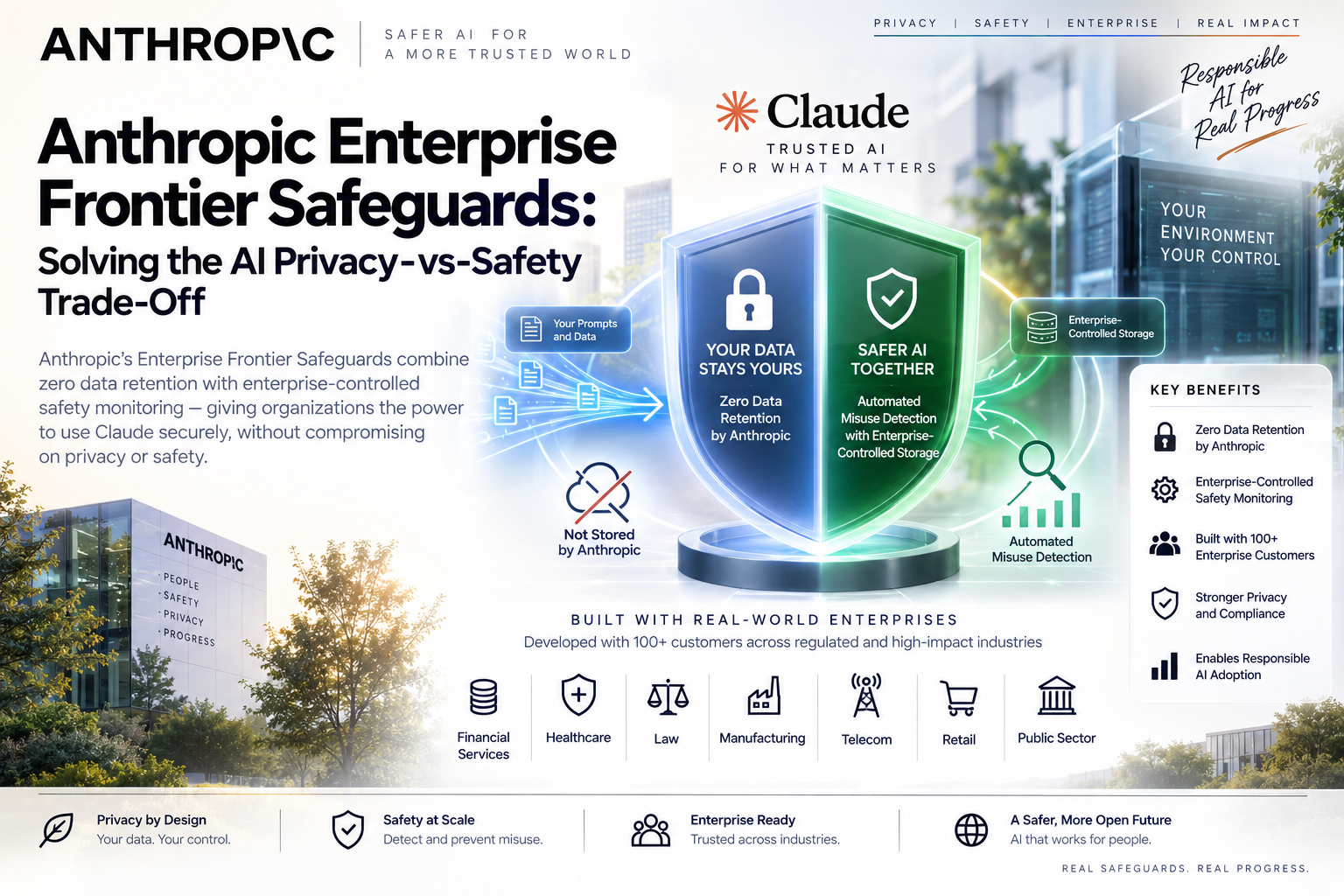
Enterprise AI adoption is running into a hard question: how can a company use frontier models safely if the AI provider cannot retain sensitive prompts and outputs? Privacy teams want zero data retention. Safety teams want misuse detection across many sessions, users, tools, and accounts. Both concerns are legitimate.
Anthropic announced Enterprise Frontier Safeguards, or EFS, on September 1, 2026. The idea is to combine zero-data-retention-style privacy from Anthropic with longer-term automated safety monitoring using storage controlled by the enterprise customer. For regulated industries, this is one of the most important Claude enterprise security updates of the year.
Quick Take
- Anthropic Enterprise Frontier Safeguards is a privacy-and-safety architecture, not just a new admin setting.
- The core design separates data custody from misuse detection: activity data can be stored in the customer's own cloud environment while automated detection looks for serious misuse patterns.
- Anthropic says it developed EFS with more than 100 customers across financial services, healthcare, manufacturing, telecom, law, retail, the public sector, and major cloud partners.
- EFS is aimed at regulated industry AI adoption, where legal privilege, non-public information, protected data, credentials, and security logs cannot casually move to another vendor.
- The real test is operational governance: enterprises still need retention rules, encryption controls, human review procedures, audit logs, and EU AI Act/GDPR-aware documentation.
EFS matters because it treats AI safety as an architecture problem, not only a policy promise.
What Is Enterprise Frontier Safeguards?
Enterprise Frontier Safeguards is Anthropic's proposed solution for customers that need both strong privacy and ongoing safety monitoring. Anthropic says EFS stores relevant activity data in cloud infrastructure controlled by the customer rather than Anthropic, while automated systems analyze a rolling window of activity for serious misuse signals.
The key phrase is customer-controlled storage. Instead of the model provider retaining prompts and outputs in its own environment, EFS lets eligible customers use their own cloud accounts, encryption keys, access policies, and audit logging. Anthropic says flags from automated monitoring go to the customer, and the customer's own approved personnel decide what to review.
That structure is designed for a common enterprise conflict. If Anthropic discards every interaction instantly, it becomes harder to detect abuse that unfolds across multiple accounts or sessions. But if Anthropic retains all enterprise activity itself, many regulated customers face privacy, contractual, compliance, and governance blockers. EFS attempts to give both sides a practical path.
The Privacy-vs-Safety Trade-Off
Zero data retention is attractive because sensitive prompts and outputs do not remain with the model provider. That is especially important for banks, hospitals, legal teams, public agencies, manufacturers, telecom providers, and companies working with sensitive intellectual property.
But safety monitoring needs context. Serious misuse is not always visible in a single prompt. It can involve repeated attempts, credential theft, cross-account coordination, fraud patterns, or cyber activity that only becomes clear over time. If every interaction disappears immediately, the provider may lose the ability to detect these patterns.
EFS is Anthropic's attempt to avoid the false choice. The customer keeps custody of the retained activity data. Automated systems can still identify suspicious patterns. Human review stays with the enterprise rather than Anthropic employees. That is the architectural compromise.
How EFS Works
Anthropic says EFS is designed to work whether customers access Claude directly or through cloud partners. The company lists support across Claude Code, Claude Enterprise, the Claude Platform, Amazon Bedrock, Claude Platform on AWS, Google's Agent Platform, and Microsoft Foundry.
The design has three important opt-in controls: customer-owned storage, customer-managed encryption keys, and fully automated review. Anthropic says these controls do not change model behavior, API pricing, or rate limits. If the customer chooses to store data in its own cloud account, normal cloud-provider storage, read, write, and egress fees may apply.
| Control area | What the customer controls | What Anthropic provides | Why it matters |
|---|---|---|---|
| Data storage | Cloud account, storage location, access policy, audit logging, and retention handling. | Architecture that lets monitoring data remain outside Anthropic-controlled storage. | Reduces the need to add Anthropic as another long-term holder of sensitive operational logs. |
| Encryption | Customer-managed encryption keys where enabled. | Integration pattern for using safeguarded frontier models with customer key control. | Important for regulated customers with strict key-management and audit requirements. |
| Automated review | Choice to enable automated monitoring and define review workflow internally. | Detection systems that analyze activity for serious misuse patterns. | Safety monitoring can operate without Anthropic employees reviewing sensitive activity. |
| Human review | Who reviews flags, what they can access, and how incidents are escalated. | Signals routed to the customer when monitoring identifies concerning patterns. | Legal, healthcare, financial, and public-sector data often requires cleared internal reviewers. |
| Cloud deployment | Preferred cloud platform and existing security stack. | Equivalent controls across Anthropic and supported cloud partner access paths. | Lets customers align AI governance with existing AWS, Google Cloud, Microsoft, or Anthropic deployments. |
Why Regulated Industries Care
Regulated organizations often want the strongest models, but they cannot treat frontier AI as an ordinary SaaS experiment. A hospital may handle protected health information. A law firm may handle privileged material. A bank may process non-public information, credentials, fraud signals, and customer records. A manufacturer may expose proprietary product and supply-chain information.
For these organizations, "we do not train on your data by default" is helpful but not always enough. They also need to know where logs live, who can read them, how long they remain, which keys protect them, what gets flagged, and how incidents are handled.
| Industry | Typical concern | Why EFS is relevant |
|---|---|---|
| Financial services | Customer data, fraud signals, credentials, trading information, and supervisory expectations. | Customer-controlled logs and internal review make frontier model adoption easier to govern. |
| Healthcare and life sciences | Health information, research records, drug safety, clinical documentation, and strict access controls. | Monitoring flags can be routed to trained customer-side reviewers rather than external vendor personnel. |
| Legal services | Legal privilege, client confidentiality, discovery material, and sensitive matter files. | Data custody and review control help preserve confidentiality obligations. |
| Manufacturing | Product designs, source code, plant data, supplier information, and operational technology risk. | Claude can be explored for engineering and support workflows while keeping logs under enterprise controls. |
| Telecom and public sector | Critical infrastructure, national regulations, citizen data, and strong audit expectations. | Customer-owned storage and audit trails fit better with high-scrutiny deployment models. |
Benefits And Remaining Risks
EFS is a meaningful architecture step because it accepts that enterprise privacy and AI safety are both real requirements. But it does not remove every risk. Customers still need governance discipline, internal capability, and a clear incident response plan.
| Benefit | What improves | Remaining question |
|---|---|---|
| Better privacy posture | Enterprise activity data can remain in cloud infrastructure the customer controls. | How will each customer configure retention, access, deletion, and regional storage? |
| Misuse detection over time | Automated systems can look for patterns across sessions and accounts. | How transparent will false positives, thresholds, and alert explanations be? |
| No Anthropic human review required | Customer teams handle flagged activity review. | Do customers have trained reviewers and escalation playbooks? |
| Cloud alignment | Customers can integrate safeguards into familiar AWS, Google Cloud, or Microsoft environments. | Will implementation quality be equivalent across access paths and regions? |
| Adoption confidence | Regulated teams may be more willing to deploy Claude in sensitive workflows. | Will procurement, privacy, security, legal, and business teams agree on acceptable use cases? |
Implementation Checklist
For a European SME or regulated enterprise, the right question is not "Should we enable EFS?" The better question is "What must be true before we use frontier AI in sensitive workflows?"
- Map the use cases: Separate low-risk productivity use from regulated, confidential, safety-related, or customer-impacting workflows.
- Define data boundaries: Decide which prompts, outputs, files, connectors, logs, and tool actions can be retained for monitoring.
- Set retention rules: Determine how long activity data remains in customer-controlled storage and who can approve deletion or extension.
- Assign reviewers: Identify internal teams responsible for reviewing misuse flags, clearing false positives, and escalating incidents.
- Connect audit trails: Log model, user, session, timestamp, tool actions, flags, reviewer decisions, and follow-up actions.
- Test false positives: Run controlled pilots to understand how often legitimate work gets flagged and how review queues behave.
- Review vendor terms: Confirm training, retention, security, subprocessor, regional, and cloud-billing implications before rollout.
EU AI Act, GDPR And Responsible AI Considerations
For European customers, EFS should be treated as part of the AI governance stack. It can support accountability, monitoring, incident handling, and documentation, but it does not automatically make a deployment compliant.
The EU AI Act focuses on risk-based AI governance, including transparency, human oversight, technical documentation, logging, cybersecurity, and high-risk use-case controls. GDPR adds privacy principles such as purpose limitation, data minimization, access control, retention limitation, and lawful processing. EFS may help with some of these requirements, but only if the customer configures and documents it properly.
| Governance area | What to document | Why it matters |
|---|---|---|
| Purpose limitation | Why activity data is retained and which safety risks it is used to detect. | Monitoring should have a clearly defined purpose, not become uncontrolled secondary data use. |
| Data minimization | Which fields are stored, masked, excluded, or deleted. | Customer-controlled storage still requires careful minimization, especially with employee or customer data. |
| Human oversight | Who reviews flags and who approves high-impact actions. | Important for regulated workflows, cyber investigations, legal files, healthcare, finance, and public-sector use. |
| Logging and auditability | Model use, tool actions, review outcomes, escalations, and retention changes. | Supports incident investigation, vendor review, and internal accountability. |
| Transparency | How employees and users are informed about AI monitoring and review procedures. | Trust improves when people know what is monitored, why, and by whom. |
| High-risk screening | Whether the Claude workflow affects employment, credit, healthcare, education, law enforcement, or essential services. | The same model can be low-risk in one workflow and high-risk in another. |
Best Fit Recommendation
Anthropic Enterprise Frontier Safeguards is most relevant for organizations that want frontier Claude models in sensitive workflows but cannot accept ordinary provider-side data retention. The strongest fit is regulated industry AI: banking, insurance, healthcare, life sciences, legal services, telecom, manufacturing, public-sector work, and cybersecurity.
For SMEs, EFS may not be the first AI control to implement. Start with basic governance: user access, data classification, prompt and output review, approved use cases, connector permissions, and model-selection policy. EFS becomes more important when AI moves into confidential workflows, multi-user agentic systems, cloud production environments, or security-sensitive automation.
The practical recommendation is to treat EFS as a serious enterprise control, not a marketing checkbox. It should sit beside existing DLP, SIEM, IAM, audit logging, cloud key management, privacy review, and incident response processes.
FAQ
What is Anthropic Enterprise Frontier Safeguards?
Anthropic Enterprise Frontier Safeguards is a privacy and safety architecture for Claude enterprise customers. It is designed to combine zero-data-retention-style privacy from Anthropic with longer-term automated misuse detection using customer-controlled cloud storage.
Does EFS mean Claude has zero data retention?
EFS is not simply "no retained data anywhere." The idea is that Anthropic does not retain the relevant activity data in its own infrastructure; the enterprise can store monitoring data in its own cloud environment under its own controls.
Who reviews safety flags under EFS?
Anthropic says automated systems can detect concerning patterns and send flags directly to the customer. The customer's own approved team then reviews and responds, without requiring Anthropic human review.
Which platforms will support EFS?
Anthropic says EFS will be supported across Claude Code, Claude Enterprise, the Claude Platform, Amazon Bedrock, Claude Platform on AWS, Google's Agent Platform, and Microsoft Foundry.
Is EFS useful for regulated industry AI?
Yes, it is designed for regulated environments where privacy, auditability, customer-controlled storage, encryption, and internal review are major adoption requirements. Compliance still depends on the customer's configuration and use case.