AI for Science Becomes Productized: Automated Research Teams Are Arriving
AI is moving beyond office productivity and into laboratories, materials science, drug discovery, quantum research, and engineering.
Introduction: AI Is Leaving the Office and Entering the Lab
For the past few years, most people have experienced AI as a productivity tool. It writes emails, summarizes documents, creates presentations, generates code, and helps teams move faster.
But the next major wave of AI will not be limited to the office.
It is moving into the laboratory.
AI is now being used to design molecules, predict protein structures, discover new materials, generate scientific hypotheses, plan experiments, and guide robotic lab systems. This shift marks an important moment: AI is becoming part of the research process itself, not just a tool for documenting it.
In other words, AI is no longer only helping scientists write faster. It is helping them discover faster.
Google DeepMind’s AlphaFold has already predicted more than 200 million protein structures, making one of biology’s hardest problems far more accessible to researchers around the world. Meanwhile, newer systems such as Google DeepMind’s Co-Scientist are being developed as multi-agent AI partners that help researchers generate and refine scientific hypotheses.
This is the beginning of a new category: automated research teams.
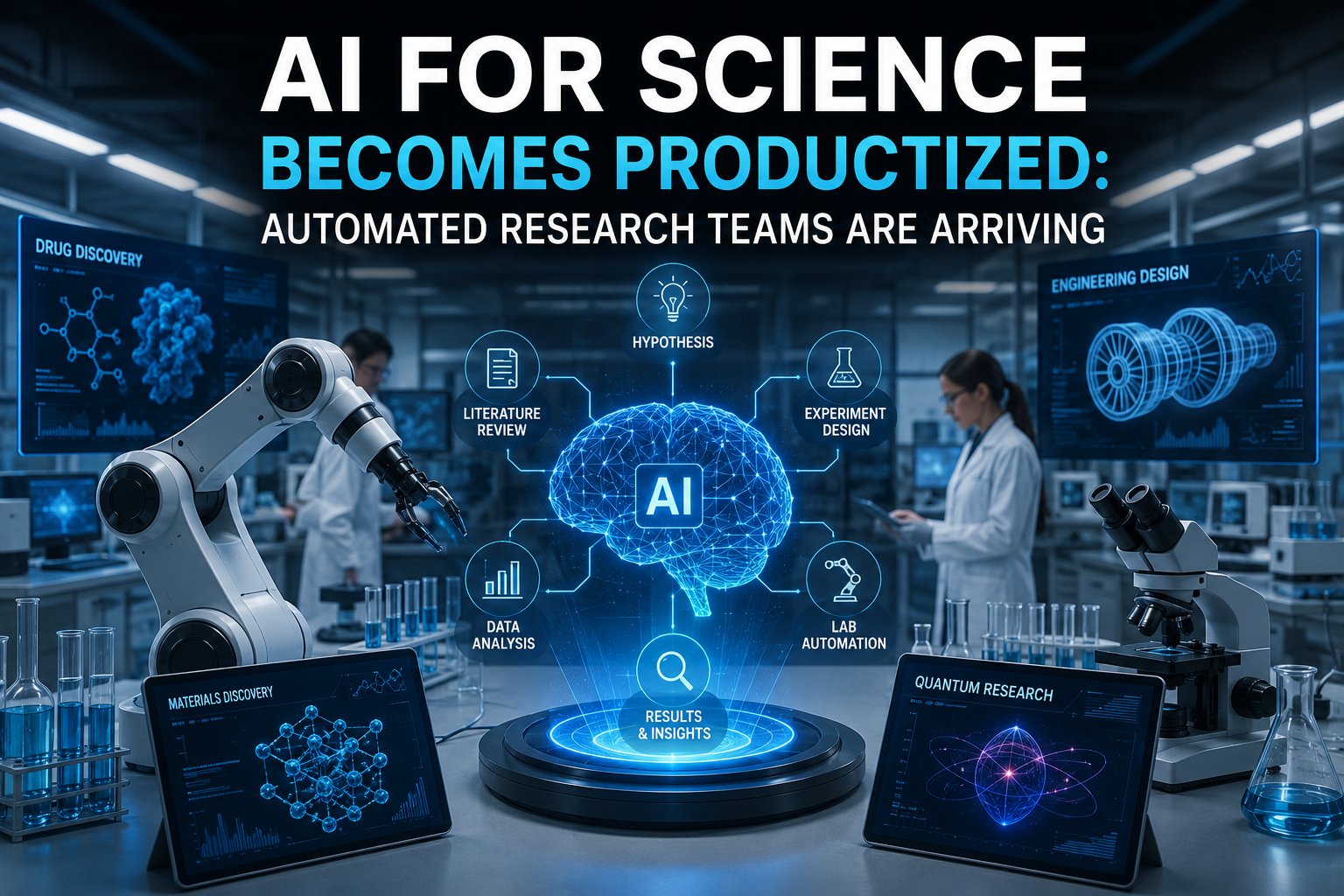
From AI Assistants to AI Research Teams
The first generation of AI tools was built around individual productivity. A person asked a model for help, and the model responded.
The next generation is more collaborative and more specialized. Instead of one chatbot answering one question, multiple AI agents can work together like a small research group. One agent may review literature. Another may generate hypotheses. Another may critique the idea. Another may design an experiment. Another may analyze the results.
This does not mean human scientists disappear. It means the structure of scientific work changes.
A researcher may soon act less like someone manually performing every step and more like a principal investigator managing an AI-augmented research team. The human sets the direction, defines the scientific goal, checks assumptions, evaluates evidence, and makes final decisions. The AI team handles speed, search, simulation, pattern recognition, and repetitive experimentation.
This is a major leap from “AI as assistant” to AI as research infrastructure.
The Productization of AI for Science
“AI for science” used to sound like a research topic. Now it is becoming a product category.
The difference is important.
A research prototype proves that something is possible. A product makes it repeatable, accessible, and useful for more people. Productized AI for science means that advanced tools can be packaged into platforms for pharmaceutical companies, biotech startups, materials labs, universities, energy companies, and engineering teams.
Instead of building custom AI systems from scratch, scientists may increasingly use ready-made platforms that combine:
scientific foundation models
literature search
simulation tools
lab automation
robotics
data pipelines
hypothesis generation
experiment planning
safety and validation workflows
The result is a new kind of scientific operating system.
Just as cloud computing made advanced computing available on demand, AI research platforms may make advanced discovery workflows available on demand.
Drug Discovery: Faster Paths From Idea to Molecule
Drug discovery is one of the clearest examples of this shift.
Traditional drug development can be slow, expensive, and uncertain. Scientists must identify disease targets, screen possible molecules, test interactions, evaluate toxicity, and move through multiple stages of validation.
AI can help compress parts of this process.
Modern AI models can analyze biological data, predict molecular interactions, suggest candidate compounds, and help researchers prioritize which experiments are worth running. AlphaFold 3 expanded this direction by modeling interactions across proteins, DNA, RNA, small molecules, ions, and chemical modifications, making AI more useful for understanding biological systems and drug mechanisms.
The bigger breakthrough is not simply that AI can suggest molecules. It is that AI can become part of an iterative loop:
design → simulate → test → learn → redesign
When connected to automated laboratories, that loop becomes even more powerful. A self-driving lab can run experiments, collect results, update the model, and choose the next experiment with minimal delay.
This is why automated research teams matter. Drug discovery is not one task. It is a chain of decisions. AI is becoming capable of supporting more of that chain.
Materials Discovery: Designing the Future Atom by Atom
Materials science may be one of the biggest winners from AI-driven research.
New materials are needed for better batteries, cleaner energy, stronger semiconductors, advanced sensors, carbon capture, aerospace systems, and next-generation manufacturing. But discovering useful materials is difficult because the possible combinations of atoms, structures, and processing conditions are enormous.
AI can search that space far faster than humans can manually.
Google DeepMind’s GNoME project reported hundreds of thousands of predicted stable materials, showing how machine learning can expand the map of possible inorganic crystals. Argonne National Laboratory has also developed Polybot, an AI-driven autonomous platform for exploring polymer film processing and improving electronic material quality.
This is where AI becomes more than a calculator. It becomes a scientific explorer.
Instead of testing one material at a time, AI systems can suggest high-potential candidates, robotic systems can synthesize or process them, sensors can measure the outcomes, and models can learn from every result.
That creates a faster discovery cycle for batteries, chips, solar cells, coatings, catalysts, and industrial materials.
Self-Driving Laboratories: When Robots Meet Reasoning Models
The phrase “self-driving lab” may sound futuristic, but the concept is already active in chemistry, materials science, and biology.
A self-driving laboratory combines AI with automation. The AI decides what experiment should happen next. The robotic system performs the experiment. Instruments collect the data. The model studies the result and updates its next decision.
A Royal Society Open Science review describes self-driving laboratories as systems that combine AI and lab automation to support research across chemistry, materials science, and biological sciences. Nature Communications has also described self-driving labs as a way to automate experimental tasks and improve research processes in chemical and materials sciences.
This changes the economics of experimentation.
In traditional research, time is often lost between steps: planning, setup, execution, measurement, analysis, and redesign. Self-driving labs reduce that delay. They turn discovery into a continuous loop.
The lab becomes less like a static room and more like a learning machine.
Quantum and Engineering: AI Expands the Design Space
AI for science is also moving into quantum research and engineering.
Quantum computing is still developing, but researchers are exploring how quantum methods could support molecular simulation, drug-target interaction prediction, and optimization problems in pharmaceutical research. A 2025 Nature npj Drug Discovery paper examined how quantum computing may integrate across the drug discovery cycle, while also highlighting the need for rigorous decision-making and practical validation.
In engineering, AI is already changing how teams design physical systems. Generative design tools can propose structures that meet strength, weight, cost, thermal, or aerodynamic goals. Simulation models can test thousands of design variations. AI agents can help engineers explore trade-offs faster than traditional workflows allow.
The direction is clear: AI is expanding the number of ideas that can be tested before anything is built.
That matters because engineering has always been limited by iteration speed. The faster teams can test, fail, learn, and redesign, the faster they can produce better machines, devices, buildings, chips, aircraft, and energy systems.
Why This Moment Feels Different
AI has supported science for decades. Researchers have long used machine learning, statistics, modeling, and simulation.
What is different now is the combination of five forces:
First, foundation models can understand language, code, data, images, formulas, and scientific literature.
Second, AI agents can break complex goals into steps and coordinate specialized tasks.
Third, scientific datasets are growing rapidly across biology, chemistry, materials, climate, and engineering.
Fourth, robotics and automation make it possible for AI to influence real-world experiments.
Fifth, cloud platforms and commercial tools are turning research workflows into scalable products.
Together, these forces create a new scientific stack.
At the top is the human researcher. Below that are AI agents. Below them are scientific models, databases, simulations, and robotic labs. The entire system is designed to accelerate the path from question to evidence.
The Human Role Becomes More Important, Not Less
It is tempting to describe this future as “AI replacing scientists.” That is too simple.
Science is not just pattern matching. It requires judgment, skepticism, ethics, domain expertise, experimental rigor, and responsibility. AI can generate ideas quickly, but speed is not the same as truth.
Automated research teams will still need humans to ask meaningful questions, define boundaries, detect false assumptions, interpret results, and decide what should be tested in the real world.
The best future is not AI-only science. It is human-led, AI-accelerated science.
In this model, scientists become more powerful because they can explore more ideas, challenge more assumptions, and run more intelligent experiments.
The Risks: Speed Without Validation Is Dangerous
Productized AI for science also creates new risks.
AI-generated hypotheses may sound convincing but still be wrong. Automated experiments may optimize for the wrong objective. Models may inherit bias from incomplete datasets. Scientific platforms may become black boxes. In drug discovery or materials engineering, a bad assumption can have serious consequences.
That means the next era of AI for science needs strong guardrails:
transparent methods
reproducible workflows
human review
careful validation
secure lab automation
clear accountability
ethical oversight
A faster research cycle is valuable only if it remains trustworthy.
The goal should not be to replace scientific rigor with automation. The goal should be to automate parts of the process while strengthening validation.
What Comes Next
The next few years will likely bring a new generation of AI-native research platforms.
Biotech companies will use AI teams to explore disease biology and molecule design. Materials labs will use autonomous systems to discover better batteries and semiconductors. Engineering groups will use AI to generate and test designs before physical prototypes are built. Quantum researchers will combine AI with emerging quantum tools to explore complex simulation problems.
The biggest change may be cultural.
Scientists and engineers will begin to expect AI collaborators in the same way office workers now expect AI writing and coding tools. Research teams may include human experts, AI agents, automated instruments, and simulation systems working together.
The laboratory will become more connected, more autonomous, and more computational.
Conclusion: The Research Team Is Becoming a Platform
AI is moving from productivity into discovery.
The first wave helped people write, summarize, and organize information. The next wave will help scientists ask better questions, design better experiments, and search larger spaces of possibility.
Automated research teams are arriving because science itself is becoming more programmable. Literature, models, simulations, instruments, robots, and data systems are being connected into continuous loops of discovery.
This does not make human scientists less important. It gives them a new kind of leverage.
The future of research will not be one scientist versus one machine. It will be human imagination working with automated teams that can read, reason, simulate, test, and learn at machine speed.
That is the real breakthrough.
AI is not just changing how we work.
It is changing how we discover.
Tags
#AI #AIForScience #AutomatedResearch #ResearchAgents #AIAgents #ScientificDiscovery #AIInnovation #AutonomousAI #EnterpriseAI #GenerativeAI #DigitalTransformation #FutureOfResearch #MachineLearning #ProductizedAI #ArtificialIntelligence #TechInnovation