Physical AI & Vision-Language-Action (VLA) Models: Software Stacks Driving Robotics
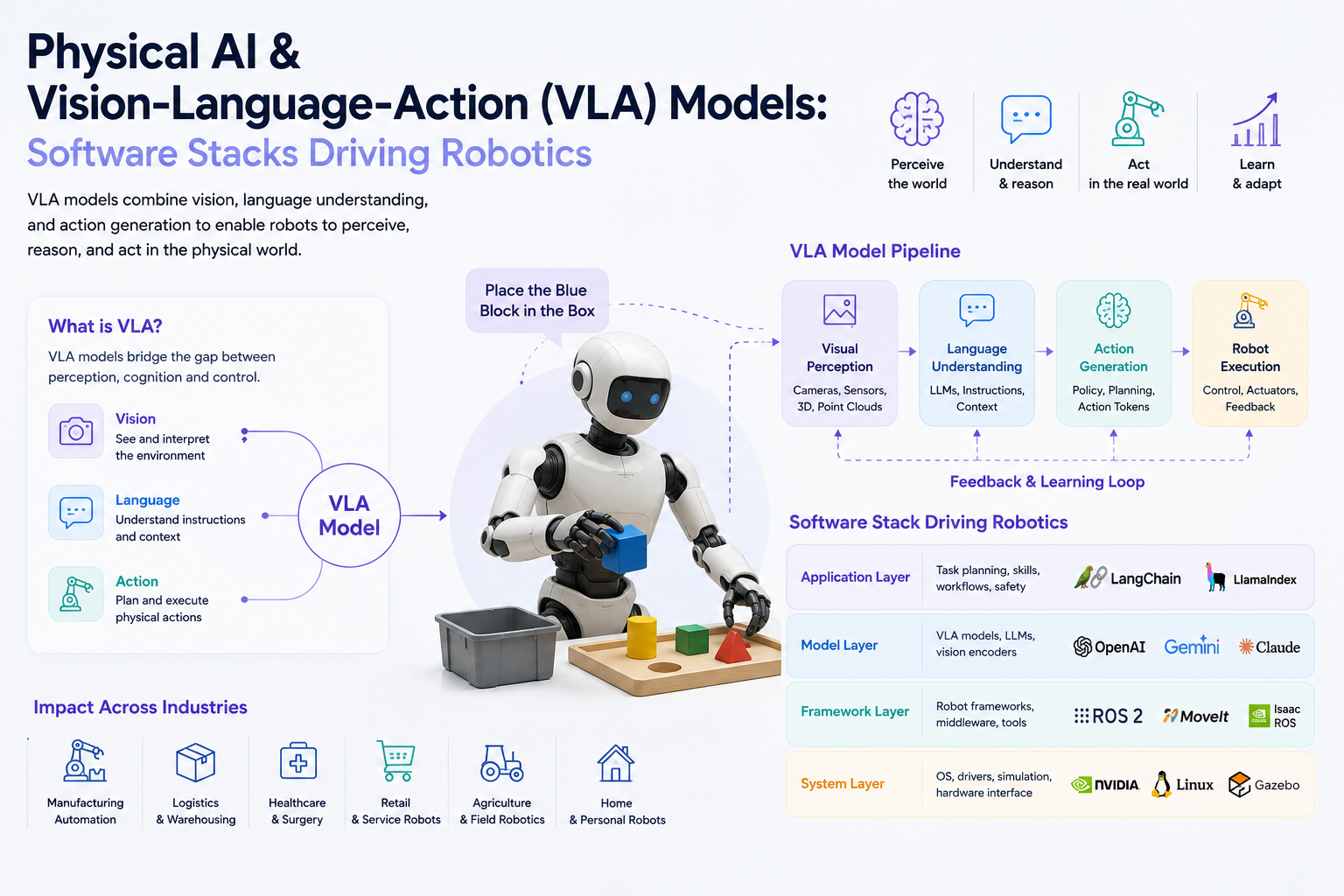
Physical AI is the next major frontier for artificial intelligence: systems that do not only generate text, images, or code, but perceive the real world and take useful physical actions through robots. Vision-Language-Action models, often called VLA models, are one of the most important building blocks behind that shift.
For business leaders, developers, and European SMEs, the key point is simple. Robotics is no longer only about mechanical engineering and fixed automation. It is becoming a software stack problem: data, simulation, perception, reasoning, action models, safety systems, edge hardware, and human supervision all need to work together.
Quick Take
- Physical AI refers to AI systems that can understand, reason about, and act in the physical world through robots, sensors, and actuators.
- VLA models connect three inputs and outputs: visual perception, language instructions, and robot actions.
- Google DeepMind's Gemini Robotics 2 positions VLA and embodied reasoning models as an intelligence layer for robots.
- NVIDIA's Isaac stack shows why simulation, synthetic data, robot learning, and edge deployment are becoming central to robotics.
- Open tools such as Hugging Face LeRobot and OpenVLA are lowering the barrier for teams to experiment with robot learning and VLA policies.
The real breakthrough is not one robot model. It is the software stack that turns perception and language into controlled, testable physical action.
What Is Physical AI?
Physical AI means AI that operates in the real world. A chatbot works with words. A coding assistant works with software. A physical AI system works with objects, rooms, tools, vehicles, machines, shelves, doors, packages, and people.
That makes the problem harder. The real world is messy. Lighting changes. Objects move. Sensors fail. Floors are uneven. A robot must understand space, timing, force, balance, uncertainty, and safety. A wrong answer in a text box is one kind of risk. A wrong physical action near a human worker is a very different kind of risk.
This is why robotics needs more than a large language model. It needs a full stack that connects AI reasoning to safe motion and measurable task outcomes.
What Are Vision-Language-Action Models?
A Vision-Language-Action model is an AI model that links what the robot sees, what the user asks, and what the robot should physically do next.
In a simple workflow, the model receives camera input and a language instruction. It then predicts an action or action sequence for the robot. For example: "pick up the red tool", "place the box on the left shelf", or "inspect this component and move it to the reject bin if damaged."
The OpenVLA research paper describes this direction clearly: large robot policies can combine internet-scale vision-language learning with diverse robot demonstrations, then be fine-tuned for new robot setups and tasks. That is the heart of the VLA idea.
The Robotics Software Stack
VLA models are powerful, but they are not the whole robotics system. A production robot needs a stack around the model.
| Stack Layer | Role in Physical AI | What Teams Must Validate |
|---|---|---|
| Robot Hardware | Arms, grippers, mobile bases, humanoid bodies, sensors, motors, and controllers. | Payload, precision, repeatability, safety rating, maintainability, and cost. |
| Perception | Cameras, depth sensors, segmentation, object detection, and scene understanding. | Lighting changes, occlusion, sensor calibration, false detections, and privacy impact. |
| Language and Reasoning | Understanding user goals, task constraints, environment state, and multi-step plans. | Instruction following, ambiguity handling, safe refusal, and escalation behavior. |
| Action Policy | Converting plans into motor commands, trajectories, gripper actions, or navigation steps. | Motion safety, task success, recovery from error, latency, and hardware compatibility. |
| Simulation | Training, testing, synthetic data generation, edge-case exploration, and digital twins. | Sim-to-real gap, physics fidelity, sensor realism, and validation against real-world tests. |
| Data Pipeline | Teleoperation recordings, synchronized video, state data, action data, labels, and evaluation sets. | Data quality, permissions, coverage, bias, traceability, and storage governance. |
| Deployment Runtime | Edge compute, robot middleware, monitoring, fallback logic, and model update process. | Latency, reliability, offline operation, rollback, cyber security, and audit logs. |
Google DeepMind: VLA Plus Embodied Reasoning
Google DeepMind's Gemini Robotics 2 page describes a stack where a Vision-Language-Action model and an embodied reasoning model work together. The VLA model converts vision and language into motor control. The embodied reasoning model handles physical understanding, planning, and coordination with humans or other robots.
This is an important design pattern. In practical robotics, the system often needs both fast low-level control and higher-level reasoning. A robot may need to decide what to do, but also how to move safely, how to coordinate with another robot, and how to respond if a human redirects it.
VLA Model
Role: Converts visual input and language instructions into robot control actions.
Why it matters: This is the layer that links human intent to physical movement.
Embodied Reasoning
Role: Reasons within physical spaces, plans multi-step tasks, and coordinates action.
Why it matters: Physical work requires spatial understanding, sequencing, and adaptation.
On-Device Robotics
Role: Runs a lightweight VLA model locally on robotic hardware.
Why it matters: Local execution can improve latency, reliability, and data control.
Multi-Robot Work
Role: Supports coordination across robots in shared spaces.
Why it matters: Warehouses, factories, and labs often need fleets, not one isolated robot.
NVIDIA: Simulation, Synthetic Data, and Deployment
NVIDIA's physical AI story is strongly connected to its Isaac ecosystem. Isaac Sim supports robotics simulation and synthetic data generation, while Isaac Lab is positioned for robot learning at scale. NVIDIA also describes Isaac GR00T N1 as an open foundation model for humanoid robot reasoning and skills, with post-training, inference, and evaluation workflows.
This matters because robotics data is expensive. Collecting real robot demonstrations takes time, hardware, expertise, and safe environments. Simulation and synthetic data can help teams explore more cases before deploying on physical machines.
But simulation is not a replacement for real-world validation. The robot still needs to prove it can handle real lighting, friction, object variation, human movement, mechanical wear, and unexpected interruptions.
In physical AI, simulation is a training accelerator, not a safety guarantee.
Open Robotics Tools: LeRobot and OpenVLA
Open tooling is one reason robotics AI is becoming easier to experiment with. Hugging Face LeRobot provides a Python-native, hardware-agnostic interface for controlling robots, collecting datasets, training policies, and deploying them. Its documented workflow is straightforward: teleoperate, record, train, and deploy.
OpenVLA adds a research foundation for open Vision-Language-Action models. The paper describes a 7B-parameter open-source VLA trained on 970,000 real-world robot demonstrations, with checkpoints, fine-tuning notebooks, and code released for training and adaptation.
For smaller teams, this open ecosystem matters. It makes it possible to learn the pattern before investing in a full industrial robotics platform.
| Tool or Model | What It Provides | Best Use |
|---|---|---|
| LeRobot | Robot control interface, dataset tools, policy training, simulation paths, and deployment workflow. | Learning robot imitation workflows and building small-scale experiments. |
| OpenVLA | Open-source VLA model, fine-tuning code, and research pipeline for robot action prediction. | Research, adaptation, and understanding how VLAs can be trained and evaluated. |
| NVIDIA Isaac Sim | Robotics simulation, synthetic data generation, sensor simulation, robot learning, and digital twin workflows. | Testing and training robots before real-world deployment. |
| Gemini Robotics | VLA and embodied reasoning model direction for general robotics intelligence. | Understanding where foundation models for robots are heading. |
Where Physical AI Will Create Business Value
Physical AI will not arrive everywhere at once. The first useful deployments are likely to happen where tasks are repetitive, structured, measurable, and valuable enough to justify hardware and safety investment.
- Warehouses: picking, sorting, pallet handling, inventory checks, and material movement.
- Manufacturing: inspection, assembly assistance, tool handling, and rework support.
- Healthcare and labs: logistics, sample movement, repetitive preparation, and controlled environment tasks.
- Retail and facilities: shelf scanning, cleaning, restocking, and back-room operations.
- Agriculture: crop inspection, selective harvesting, sorting, and field monitoring.
- Commercial vehicles and off-road: yard automation, inspection support, remote assistance, and autonomous maintenance workflows.
The common pattern is not "replace every worker." It is to automate physically repetitive tasks while keeping humans in charge of supervision, exception handling, planning, and safety-critical decisions.
Production Readiness Checklist
Before deploying Physical AI or VLA-based robots, teams should evaluate the full stack, not only the model demo.
- Define the task boundary: specify what the robot is allowed to do and what it must never do.
- Map the environment: document lighting, object variation, humans nearby, floor layout, and safety zones.
- Collect representative data: include normal operations, edge cases, failures, and rare but important scenarios.
- Validate in simulation: test policies in varied scenes before using physical hardware.
- Measure real-world success: track task completion, near misses, retries, intervention rate, and downtime.
- Add human override: ensure operators can pause, redirect, or stop the robot immediately.
- Control model updates: retest the robot before deploying a new model, policy, prompt, or control configuration.
- Log actions: record sensor context, model version, action decisions, errors, and human interventions.
- Secure the stack: protect robot APIs, network access, cameras, edge devices, and remote update channels.
- Start small: begin with one controlled workflow before expanding to more complex physical tasks.
Risks and Limitations
Physical AI is promising, but the risks are more concrete than in ordinary software. A VLA model may misread a scene, misunderstand an instruction, overgeneralize from training data, or fail when lighting or object placement changes.
Teams should also watch for:
- Sim-to-real gap: policies that work in simulation may fail on real hardware.
- Data mismatch: training examples may not cover the real operating environment.
- Latency: a delay in perception or action can become a safety issue.
- Mechanical constraints: model reasoning cannot overcome weak grippers, poor calibration, or unstable hardware.
- Cybersecurity: connected robots need strong protection against unauthorized access.
- Human factors: workers must understand what the robot can do, when to intervene, and how to report problems.
Good robotics engineering keeps the AI ambitious but the deployment controlled.
EU AI Act and Responsible AI Considerations
For European companies, Physical AI should be evaluated with special care because it can affect people, workplaces, safety, and operational decisions. The EU AI Act risk category depends on the use case, not just the technology.
This article is not legal advice, but practical responsible AI controls should include:
- Use-case screening: check whether the robot affects employment, worker management, healthcare, education, public services, safety, or other sensitive domains.
- Human oversight: require supervision and emergency stop mechanisms for physical operations.
- Transparency: inform workers and users when AI-enabled robots are operating in shared spaces.
- Data protection: manage camera, audio, location, and worker-related data carefully.
- Auditability: log model versions, sensor inputs, decisions, actions, operator interventions, and incidents.
- Safety validation: test under realistic conditions before moving from lab demos to production floors.
Physical AI should be treated as both an AI system and an operational safety system. That means AI governance, cybersecurity, machine safety, and workplace processes need to meet each other early.
Best Fit Recommendation
For most SMEs, Physical AI is not yet a plug-and-play replacement for human work. It is a strategic area to monitor, pilot carefully, and connect to specific operational pain points.
If your business has controlled environments, repetitive physical workflows, structured inspection tasks, or high labor pressure in warehouses and production lines, Physical AI may become relevant sooner. If your environment is highly variable, safety-critical, or hard to instrument, start with simulation, data collection, and supervised pilots.
Developers should focus less on one model name and more on the architecture. The strongest robotics systems will combine VLA models with simulation, datasets, edge deployment, human override, monitoring, and safety validation.
The future of robotics will be built by teams that understand both AI models and the software stack that makes physical action reliable.
FAQ
What is Physical AI?
Physical AI is artificial intelligence that perceives and acts in the real world through robots, sensors, actuators, vehicles, machines, or other physical systems.
What is a Vision-Language-Action model?
A Vision-Language-Action model connects visual input, language instructions, and robot actions. It helps a robot understand what it sees, interpret a command, and decide what movement or control action to take.
Why are VLA models important for robotics?
VLA models can help robots generalize beyond fixed programmed tasks by using visual understanding, language grounding, and learned action policies together.
Can SMEs use Physical AI today?
SMEs can start with pilots, simulation, data collection, and narrow robotics tasks. Full production deployment should be limited to well-defined workflows with strong safety controls and human oversight.
Is simulation enough to prove a robotics AI system is safe?
No. Simulation is useful for training and testing, but physical robots still need real-world validation under realistic operating conditions.