AI, Cybersecurity & Quantum Convergence: Defending Enterprise Systems Against AI-Driven Exploits
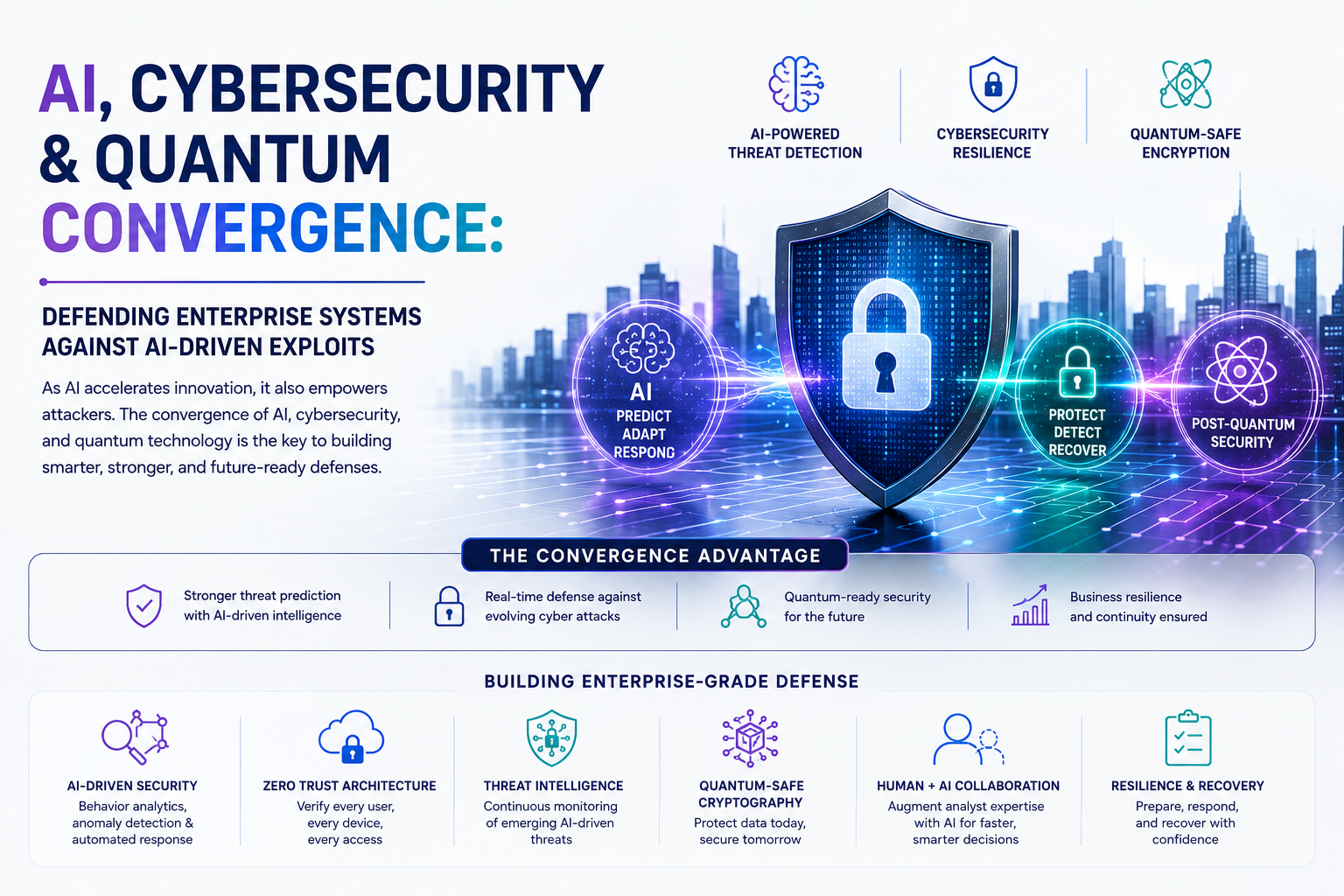
Enterprise cybersecurity is entering a new phase. AI is changing how quickly attackers can research targets, craft social engineering, review exposed code, and test weak configurations. At the same time, defenders can use AI to triage alerts, summarize incidents, prioritize patches, and strengthen secure development workflows. Quantum computing adds another layer: even before large-scale cryptographically relevant quantum computers arrive, organizations need a plan for cryptographic inventory and post-quantum migration.
For engineering leaders, this convergence is not a distant research topic. It is a board-level resilience issue. Identity systems, software supply chains, AI agents, sensitive data flows, incident response, and encryption choices now sit in the same risk conversation.
Quick Take
- AI can lower the cost of reconnaissance, phishing, vulnerability triage, code review, and social engineering for attackers.
- Defenders should respond with stronger identity controls, faster patch prioritization, AI-assisted security operations, and secure-by-design engineering.
- Quantum risk is mainly a cryptography planning challenge today: inventory public-key dependencies, improve crypto agility, and prepare for post-quantum migration.
- AI systems themselves introduce new attack surfaces, including prompt injection, sensitive information disclosure, data poisoning, supply chain risk, and excessive agency.
- For EU organizations, cybersecurity controls must connect to governance evidence: system inventories, risk classification, testing, logs, vendor documentation, and human accountability.
The winning strategy is not AI versus attackers. It is AI-aware defense, post-quantum preparation, and governance that can prove the system was built responsibly.
Why This Topic Matters Now
Traditional cybersecurity assumed that defenders had some time between vulnerability discovery, public disclosure, patch release, and large-scale exploitation. That timeline is compressing. ENISA has warned that frontier AI can accelerate the vulnerability management lifecycle and that European organizations, especially SMEs inside dense supply chains, may need more support as AI increases pressure on patching, triage, and secure design.
The risk is not only that attackers become more capable. The bigger issue is operational speed. If a security team needs weeks to verify findings, approve changes, patch systems, review AI-generated code, and update detection rules, it may be too slow for an environment where discovery and exploitation can move closer together.
Quantum computing creates a different kind of pressure. It is not a daily incident response problem for most organizations, but it is a long-horizon cryptographic risk. Sensitive data with a long shelf life, such as health, defense, financial, identity, and intellectual property records, may need protection against future decryption attempts. That is why post-quantum planning belongs in the same strategic conversation as AI cybersecurity.
The Convergence Map
AI, cybersecurity, and quantum security overlap in five practical areas. This table gives engineering leaders a simple way to frame the work.
| Convergence Layer | What Changes | Defensive Priority |
|---|---|---|
| AI in Attacks | Attackers can scale research, phishing, target profiling, code analysis, and vulnerability chaining. | Phishing-resistant MFA, attack surface management, exposure reduction, secure code review, and faster patch decisions. |
| AI in Defense | Security teams can use AI to summarize alerts, correlate signals, enrich investigations, and prioritize remediation. | Human-gated workflows, verified outputs, audit logs, detection tuning, and clear escalation paths. |
| AI Systems as Targets | LLM apps, agents, RAG systems, model pipelines, plugins, and tool permissions create new attack surfaces. | Prompt injection testing, output validation, least-privilege tools, data controls, model monitoring, and supplier checks. |
| Quantum Risk | Future quantum computers may threaten widely used public-key cryptography. | Cryptographic inventory, crypto agility, post-quantum migration planning, and protection for long-lived sensitive data. |
| EU Governance | AI security must be documented, tested, monitored, and explainable enough for internal and external accountability. | AI system inventory, risk classification, lifecycle controls, human oversight, incident reporting, and compliance evidence. |
AI-Driven Exploits: What Defenders Should Expect
The phrase "AI-driven exploit" can sound dramatic, but the practical meaning is straightforward. AI can reduce friction around tasks that used to require more manual time: reading public documentation, comparing software behavior, summarizing leaked credentials, generating convincing messages, testing assumptions, and helping attackers connect weak points across systems.
That does not mean every attacker becomes elite overnight. It means the baseline may rise. Low-skill actors may become more productive, and advanced teams may automate parts of the attack chain that used to slow them down.
| Enterprise Surface | How AI Changes Risk | Best Defensive Response |
|---|---|---|
| Email and Collaboration | More convincing impersonation, multilingual phishing, and tailored social engineering. | Phishing-resistant MFA, verified payment workflows, user reporting, and executive impersonation controls. |
| Software Development | Faster review of exposed repositories, dependency issues, configuration mistakes, and AI-generated insecure code. | Secure coding standards, SAST and DAST, dependency scanning, signed commits, code owner review, and secrets prevention. |
| Cloud and SaaS | Misconfigurations and over-permissioned accounts become easier to identify and chain together. | Least privilege, continuous posture management, conditional access, workload identity controls, and logging. |
| Vulnerability Management | More findings arrive faster, including weak signals that still require human verification. | Risk-based triage using exploitability, asset criticality, exposure, business context, and compensating controls. |
| AI Applications | Prompt injection, sensitive data leakage, excessive agency, untrusted plugins, and weak output handling can create business risk. | AI threat modeling, scoped tool permissions, retrieval controls, output validation, red-team testing, and monitoring. |
AI does not remove the value of security fundamentals. It makes weak fundamentals fail faster.
The Defensive Architecture
A practical enterprise response should be layered. The goal is to reduce what attackers can reach, detect suspicious behavior faster, and make sure AI systems are governed like business-critical software rather than experimental side tools.
Securing AI Systems Themselves
Many enterprises now use AI in customer support, internal search, code assistance, HR workflows, marketing operations, finance analysis, and security operations. Those systems need cybersecurity controls because they often touch sensitive data, business decisions, internal documents, or third-party tools.
OWASP's LLM application work highlights recurring risk categories such as prompt injection, sensitive information disclosure, supply chain weakness, data and model poisoning, improper output handling, excessive agency, system prompt leakage, vector and embedding weaknesses, misinformation, and unbounded consumption. These risks should be translated into ordinary engineering controls.
Control Tool Access
Rule: Give AI agents only the permissions they need for the specific workflow.
Why it matters: Excessive agency can turn a bad instruction, bad retrieval result, or bad output into real business impact.
Validate Inputs and Outputs
Rule: Treat prompts, retrieved documents, model outputs, and tool responses as untrusted data.
Why it matters: AI output should not flow into code execution, payments, access changes, or customer actions without checks.
Protect Retrieval Systems
Rule: Segment vector stores, enforce document permissions, and monitor unusual retrieval behavior.
Why it matters: RAG systems can expose sensitive documents if identity and access rules are weak.
Log Decisions
Rule: Record model version, prompt class, retrieved source, tool action, human approval, and outcome.
Why it matters: Logs support debugging, incident response, vendor review, and EU-style accountability.
Quantum Convergence: Start With Crypto Inventory
NIST approved three Federal Information Processing Standards for post-quantum cryptography in 2024: FIPS 203 for key encapsulation, FIPS 204 for digital signatures, and FIPS 205 for stateless hash-based digital signatures. The enterprise takeaway is not that every system changes overnight. The takeaway is that cryptography needs an upgrade plan.
The highest priority is cryptographic visibility. Many organizations do not have a complete map of where public-key cryptography is used across applications, APIs, VPNs, certificates, code signing, hardware devices, backups, databases, identity systems, and supplier platforms. Without that inventory, migration becomes guesswork.
| Quantum-Ready Step | What To Do | Business Value |
|---|---|---|
| Classify Sensitive Data | Identify data that must remain confidential for many years. | Focuses investment on records most exposed to harvest-now, decrypt-later risk. |
| Build a Crypto Inventory | Map protocols, certificates, libraries, keys, HSMs, signing processes, and third-party dependencies. | Reveals where migration work will be easy, difficult, or vendor-dependent. |
| Improve Crypto Agility | Design systems so algorithms can be changed without full application rewrites. | Reduces future migration cost and emergency replacement risk. |
| Ask Vendors for Roadmaps | Request post-quantum plans for SaaS, cloud, identity, device, and security tooling providers. | Prevents hidden supplier gaps from becoming enterprise gaps. |
| Pilot Post-Quantum Options | Test standards-based approaches in low-risk environments before broad rollout. | Builds internal skill before deadlines or customer demands arrive. |
EU AI Act and Responsible AI Considerations
For European organizations, AI cybersecurity is also a governance issue. The EU AI Act requires high-risk AI systems to be designed and developed with appropriate levels of accuracy, robustness, and cybersecurity throughout their lifecycle. It also refers to resilience against unauthorized attempts to alter a high-risk system's use, outputs, or performance by exploiting vulnerabilities.
For a blog audience, the practical lesson is clear: AI adoption should come with evidence. Teams should be able to show what the system is used for, what data it touches, who can approve actions, how incidents are handled, which vendor claims have been reviewed, and how cybersecurity risks are tested over time.
| EU AI Act Theme | What It Means In Practice | Evidence To Keep |
|---|---|---|
| Risk Classification | Check whether the AI system falls into prohibited, high-risk, transparency, GPAI, or lower-risk categories. | Use-case register, intended purpose, user group, impact assessment, and legal review notes. |
| Cybersecurity and Robustness | Test for AI-specific weaknesses such as prompt injection, data poisoning, adversarial manipulation, leakage, and unsafe tool use. | Test plan, red-team results, mitigation log, monitoring dashboard, incident records, and retest dates. |
| Human Oversight | Keep humans responsible for high-impact decisions and make override, pause, and escalation paths clear. | Approval workflow, role matrix, training records, escalation rules, and intervention logs. |
| Transparency | Tell users when they interact with AI where required and explain meaningful limits of the system. | User notices, model cards, system instructions, known limitation notes, and version history. |
| Data and IP Governance | Control personal data, confidential documents, copyrighted materials, and third-party content inside AI workflows. | Data source list, license checks, retention rules, access permissions, and supplier contracts. |
Compliance is easier when security evidence is created during normal engineering work, not reconstructed after an incident.
Implementation Checklist for Enterprise Leaders
This checklist is designed for organizations that want a realistic starting point without waiting for a complete transformation program.
- Create an AI system inventory: include public tools, internal copilots, RAG apps, agents, vendor AI features, and experimental deployments.
- Map sensitive data flows: identify where customer, employee, financial, health, source code, security, and confidential business data enters AI workflows.
- Enforce least privilege: limit what AI tools and agents can read, write, send, delete, approve, or execute.
- Adopt phishing-resistant identity controls: prioritize MFA, passkeys, conditional access, device posture, and privileged access management.
- Speed up patch prioritization: combine exploitability, internet exposure, business criticality, asset ownership, and compensating controls.
- Use AI defensively with verification: let AI summarize, triage, correlate, and draft, but require human approval for containment, legal, customer, and access-impacting actions.
- Secure the software supply chain: scan dependencies, protect build systems, sign releases, review generated code, and monitor open-source risk.
- Test AI applications: evaluate prompt injection, sensitive information disclosure, unsafe output handling, excessive agency, and retrieval leakage.
- Start a post-quantum roadmap: classify long-lived sensitive data, inventory cryptography, ask vendors for migration plans, and pilot standards-based options.
- Keep governance evidence: document risk classification, model purpose, data sources, security tests, incidents, human oversight, and supplier commitments.
Best Fit by Organization Type
| Organization Type | Most Important First Step | Why |
|---|---|---|
| European SME | Inventory AI tools, strengthen identity, and control sensitive data in AI workflows. | Small teams often have limited security capacity, so reducing exposure and improving visibility gives the fastest protection. |
| Software Company | Secure AI-assisted development, dependencies, build pipelines, and customer-facing AI features. | Code, APIs, model features, and integrations are part of the product attack surface. |
| Regulated Enterprise | Connect AI security to compliance evidence, logging, incident response, and vendor assurance. | Security failures can become regulatory, contractual, operational, and reputational events. |
| Critical Infrastructure Operator | Separate operational technology from AI experimentation and require strict approval for any automation touching production systems. | Availability and safety matter as much as confidentiality in physical and infrastructure environments. |
| Public Sector Team | Adopt a risk-based AI governance model with procurement controls and documented human oversight. | Public trust depends on lawful, explainable, secure, and accountable use of AI systems. |
Recommended Board-Level Questions
Executives do not need to understand every technical detail, but they should ask sharper questions.
- Where are we using AI in business-critical workflows today?
- Which AI systems can access confidential data, customer records, code, email, payment workflows, or operational systems?
- Can any AI tool take action without human approval?
- How quickly can we prioritize and patch vulnerabilities on exposed systems?
- Do we test our AI applications for prompt injection, leakage, unsafe output handling, and excessive agency?
- Do we have a cryptographic inventory and a post-quantum migration owner?
- What evidence would we show after an AI-related security incident?
FAQ
What is AI cybersecurity?
AI cybersecurity is the practice of securing AI systems and using AI responsibly inside security operations. It includes protecting models, prompts, data, agents, plugins, retrieval systems, infrastructure, and human decision workflows.
What are AI-driven exploits?
AI-driven exploits are cyber risks where AI helps accelerate parts of the attack process, such as research, social engineering, vulnerability analysis, target profiling, or chaining weak points. This article discusses the topic only from a defensive perspective.
Why does quantum computing matter for cybersecurity?
Quantum computing matters because sufficiently capable future quantum computers may weaken current public-key cryptography. Organizations should prepare by mapping cryptographic dependencies and planning migration to post-quantum standards.
How does the EU AI Act affect AI cybersecurity?
The EU AI Act connects AI governance with safety, robustness, documentation, human oversight, and cybersecurity, especially for high-risk systems. Organizations should treat AI security evidence as part of the AI lifecycle, not as a one-time compliance document.
Can AI help defenders?
Yes. AI can help summarize alerts, correlate events, draft incident timelines, prioritize vulnerabilities, review code, and support detection engineering. The safest pattern is human-gated use where AI accelerates work but people approve high-impact actions.