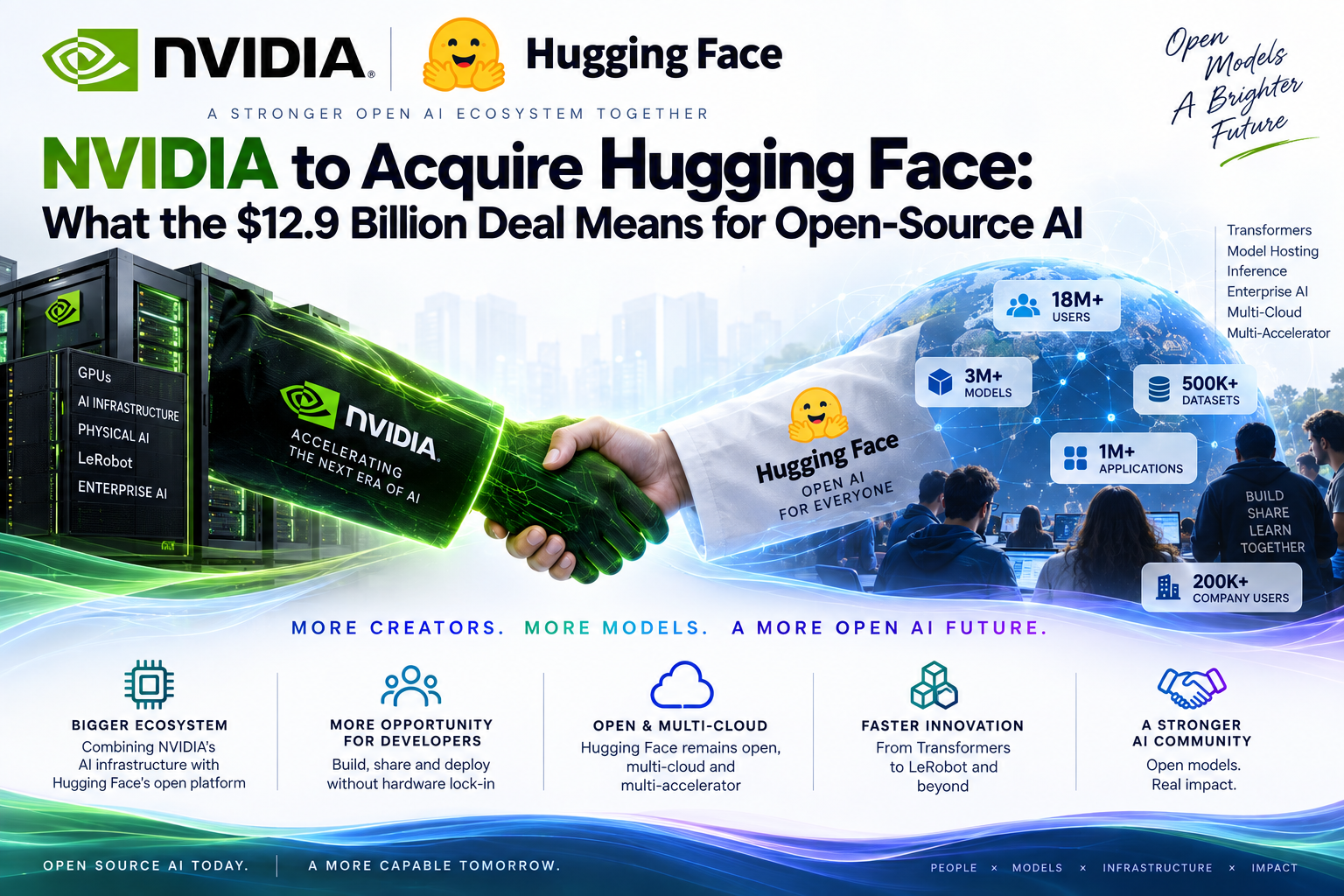
NVIDIA has agreed to acquire Hugging Face for about $12.9 billion, making one of the most important open AI platforms part of the world's most powerful AI infrastructure company. For developers, enterprises, cloud providers, and open-source AI builders, this is not just another acquisition. It is a shift in who controls the distribution layer of open AI.
The deal matters because Hugging Face is where many teams discover, evaluate, share, fine-tune, and deploy models. NVIDIA already dominates much of the AI compute layer. With Hugging Face, it gains a direct position in the model ecosystem, the developer workflow, and the open AI community.
Quick Take
- The deal is about distribution. NVIDIA already has chips, systems, networking, software, and cloud partnerships. Hugging Face gives it deeper access to the open model workflow.
- NVIDIA says Hugging Face will remain open, multi-cloud, and multi-accelerator. That promise is essential, because developers rely on Hugging Face precisely because it is broad and hardware-flexible.
- The biggest question is neutrality. Hugging Face can stay valuable only if AMD, Intel, AWS, Google Cloud, smaller inference providers, researchers, and independent developers still feel welcome.
- Transformers, Inference Providers, Spaces, datasets, and LeRobot become strategically more important. They are not only tools; they are distribution routes for future AI workloads.
- For enterprises, the opportunity is better scale and reliability, but the risk is vendor concentration. Procurement teams should keep model portability, cloud choice, and governance controls in the architecture.
The core question after the NVIDIA Hugging Face acquisition is simple: can the world's leading AI compute company own the open AI hub without making the hub feel less open?
What Happened?
On 3 September 2026, NVIDIA announced that it had agreed to acquire Hugging Face for $12,930,300,000. NVIDIA said Hugging Face serves more than 18 million developers, researchers, and creators, with more than 3 million models, 500,000 datasets, 1 million applications, and over 200,000 company users.
NVIDIA also stated that Hugging Face will remain open to the whole AI ecosystem. The company specifically said developers should continue to choose their models, frameworks, clouds, inference providers, and computing platforms, and that NVIDIA hardware will not be required to build or deploy through Hugging Face.
That detail matters as much as the purchase price. Hugging Face became important because it acted as neutral infrastructure for the AI community. If the platform becomes perceived as a NVIDIA-only funnel, it could lose part of the trust that made it valuable.
Why NVIDIA Wants Hugging Face
NVIDIA's chip business is already central to AI. But the future of AI will not be decided only by who sells GPUs. It will also be decided by where developers find models, where enterprises test them, where researchers publish them, where inference is routed, and where deployment workflows begin.
Hugging Face is that distribution layer for open AI. It is a model library, dataset hub, software ecosystem, demo platform, inference marketplace, enterprise workflow, and community layer all at once. Owning that layer gives NVIDIA insight into what builders are using and where the next workloads are forming.
| NVIDIA Already Has | Hugging Face Adds | Strategic Meaning |
|---|---|---|
| GPUs, accelerated systems, networking, CUDA, NIM, DGX, Jetson, and data center influence. | Model discovery, datasets, Spaces, Transformers, Inference Providers, community workflows, and open model distribution. | NVIDIA moves closer to the developer decision point, not only the infrastructure purchase order. |
| Strong position in training and inference compute. | Visibility into which models, architectures, tasks, and deployment paths are gaining adoption. | Better ability to optimize hardware and software around real model demand. |
| Physical AI platforms, robotics compute, simulation tools, and edge AI hardware. | LeRobot, open robotics datasets, policies, model sharing, and developer robotics workflows. | A stronger route into open physical AI, robotics experimentation, and edge deployment. |
Can Hugging Face Remain Hardware-Neutral?
This is the most important question for developers. NVIDIA says Hugging Face will remain open, multi-cloud, and multi-accelerator. That is the right message. But neutrality is not proven by a launch-day statement. It is proven by product decisions over time.
Developers will watch whether AMD, Intel, AWS, Google Cloud, independent inference providers, CPU inference stacks, open runtimes, and non-NVIDIA accelerators remain first-class citizens. They will also watch ranking defaults, sponsored placements, benchmark surfaces, model cards, inference routing, pricing, and documentation examples.
| Neutrality Signal | What Developers Should Watch | Why It Matters |
|---|---|---|
| Inference Choice | Do Hugging Face Inference Providers continue to support multiple clouds and independent providers on fair terms? | Inference routing is where open models become production workloads. |
| Accelerator Support | Are AMD, Intel, TPU, CPU, Apple Silicon, and other backends visible in examples, docs, and optimization paths? | Open AI needs hardware competition to keep costs and deployment choices healthy. |
| Model Ranking | Do model recommendations remain transparent and based on task fit, quality, license, and deployment needs? | Default ranking can quietly shape which models enterprises adopt. |
| Enterprise Deployment | Can customers still deploy models across their preferred cloud, region, VPC, on-prem, or edge infrastructure? | Enterprise AI depends on procurement, security, compliance, and data residency requirements. |
| Open Governance | Does the platform maintain transparent policies for model takedowns, safety rules, licenses, and dataset documentation? | Trust in open AI platforms depends on predictable governance, not only technical performance. |
Implications for Competitors and Partners
The deal affects nearly every major AI infrastructure player. Some companies will see it as a partner scaling the open ecosystem. Others will see it as NVIDIA moving closer to their customers and developer communities.
| Player | Likely Concern | Likely Response |
|---|---|---|
| AMD | Hugging Face becoming more optimized by default for NVIDIA GPUs. | Push harder on ROCm, open model performance, inference partnerships, and visible benchmark parity. |
| Intel | Less visibility for CPU, Gaudi, OpenVINO, and edge inference paths. | Emphasize open runtimes, enterprise CPU inference, AI PCs, and cost-efficient deployment. |
| AWS | NVIDIA gaining influence over a major model discovery and deployment gateway. | Strengthen Bedrock, SageMaker, Trainium, Inferentia, marketplace integrations, and private deployment controls. |
| Google Cloud | Potential competition with Vertex AI, TPUs, Gemini Enterprise, and model hosting workflows. | Highlight TPU economics, managed AI platforms, Gemini integration, and enterprise governance. |
| Independent Inference Providers | Fear that discovery, ranking, and routing could favor NVIDIA-backed options. | Compete on speed, price, regional hosting, privacy, model choice, and transparent SLAs. |
| Enterprises | More convenience, but more concentration risk in the AI supply chain. | Adopt portability rules: exportable models, documented licenses, multi-cloud options, and vendor exit plans. |
What It Means for Transformers and Model Hosting
Transformers is one of the most important libraries in modern AI because it standardizes how many model architectures are loaded, trained, fine-tuned, and used for inference across tasks such as text, vision, audio, video, and multimodal AI.
If NVIDIA invests heavily in Hugging Face infrastructure, developers could benefit from better model serving, faster downloads, stronger security scanning, improved evaluation, better enterprise deployment workflows, and more reliable inference options.
But the open ecosystem will watch for subtle shifts. If examples, default optimizations, and deployment buttons gradually steer users toward one hardware stack, the platform could still be technically open while becoming behaviorally less neutral.
Potential Upside
Faster infrastructure, stronger enterprise support, improved model evaluation, better inference scaling, and more serious investment in open-weight AI workflows.
Potential Risk
Default choices could slowly favor NVIDIA compute, even if the platform formally remains open to all models and accelerators.
Developer Priority
Keep models portable, track licenses, test multiple inference routes, and avoid building systems that depend on one hidden platform assumption.
Enterprise Priority
Ask for documentation, audit logs, data residency options, security controls, exit paths, and evidence that non-NVIDIA deployment remains practical.
What It Means for LeRobot and Physical AI
LeRobot may become one of the most interesting parts of the deal. Hugging Face's LeRobot project provides a hardware-agnostic, Python-native interface for real-world robotics, including dataset recording, policy training, simulation, and deployment. That fits directly into NVIDIA's physical AI ambitions.
NVIDIA has already been investing in world models, robotics models, Jetson edge computing, simulation, and physical AI tooling. If Hugging Face remains neutral, LeRobot could benefit from stronger infrastructure while still supporting a wide robotics community. If it tilts too heavily toward one hardware path, it could become less useful to researchers and developers working with diverse robots and accelerators.
For LeRobot users, the best outcome is stronger infrastructure without losing hardware-agnostic robotics experimentation.
Risks of Vendor Concentration
This deal could strengthen open AI, but it also increases concentration risk. NVIDIA already has huge influence over the AI compute supply chain. Hugging Face adds influence over model discovery, distribution, hosting, developer workflows, datasets, demos, and community trust.
Concentration risk does not mean the deal is automatically bad. It means buyers and policymakers should ask sharper questions. Can competitors access the platform fairly? Are rankings transparent? Are open licenses respected? Can enterprises deploy outside NVIDIA infrastructure? Are dataset and model governance policies clear? Can researchers reproduce results across multiple hardware environments?
| Risk | Why It Matters | Mitigation |
|---|---|---|
| Hardware Bias | Open models may become practically easier to run on one vendor stack. | Benchmark across NVIDIA, AMD, Intel, CPU, cloud, and edge targets where relevant. |
| Inference Lock-In | Hosted inference can create hidden dependencies around pricing, latency, regions, and model availability. | Keep exportable deployment plans and test at least one alternative inference provider. |
| Data Governance Risk | Enterprises may upload datasets, prompts, evaluations, and model artifacts without enough control. | Use private repositories, access controls, data classification, retention rules, and vendor review. |
| Open-Source Trust | Community trust can weaken if decisions feel driven by one commercial hardware strategy. | Maintain transparent platform policies, independent community participation, and visible multi-vendor support. |
| Regulatory Scrutiny | Large AI infrastructure deals may attract competition, national security, and data governance questions. | Track regulatory review, commitments, platform access terms, and regional deployment guarantees. |
What Developers Should Do Now
Developers do not need to panic. Hugging Face remains the default home for much of open AI, and NVIDIA's investment could improve reliability and scale. But teams should avoid treating any platform as permanent neutral ground without evidence.
- Keep a list of the models, datasets, Spaces, and endpoints your project depends on.
- Review model licenses and dataset licenses before enterprise use.
- Test deployment outside the default hosted path, especially for critical workloads.
- Benchmark cost, latency, and accuracy across more than one inference provider.
- For LeRobot projects, document robot hardware, accelerators, policy versions, datasets, and deployment assumptions.
- For enterprise systems, keep an exit plan: model export, containerized deployment, alternate provider, and data backup.
EU AI Act and Responsible AI Considerations
For European organizations, the acquisition does not change the basic responsibility: AI systems must still be assessed by use case, data type, risk level, and deployment context. Open models are not automatically lower-risk. Closed models are not automatically higher-risk. Risk depends on how the AI system is used.
If an enterprise uses Hugging Face models or datasets in employment, education, credit, healthcare, public services, law enforcement, biometric processing, safety-related systems, or worker management, it should screen for high-risk classification and document controls before deployment.
| Control Area | What To Check | Why It Matters |
|---|---|---|
| Model Provenance | Who published the model, what license applies, what training information is available, and what limitations are documented? | Enterprises need evidence before using open models in regulated or customer-facing systems. |
| Dataset Governance | Check dataset source, consent, personal data, copyright risk, bias, and intended use. | Open datasets can create legal, ethical, and quality risks if reused blindly. |
| Transparency | Tell users when AI is used where required, especially for generated content, chatbots, automated decisions, or synthetic media. | Transparency is central to user trust and EU AI Act compliance themes. |
| Human Oversight | Define where humans review outputs, approve actions, override recommendations, and handle exceptions. | Open models still need human accountability in consequential workflows. |
| Cybersecurity | Test prompt injection, model supply-chain risk, malicious files, unsafe code generation, and exposed credentials. | Open AI repositories can become part of the software supply chain and must be treated accordingly. |
| Portability | Keep model weights, containers, dependency lists, evaluation sets, and deployment scripts portable where licenses allow. | Portability reduces vendor lock-in and supports resilience if platform terms change. |
Open AI is powerful, but enterprise adoption still needs documentation, risk screening, security controls, and human accountability.
Best Fit and Recommendation
For developers, the NVIDIA Hugging Face acquisition is worth watching closely, but it is not a reason to leave the platform. The better response is to become more disciplined: know your dependencies, track licenses, test inference alternatives, and avoid hidden lock-in.
For startups and SMEs, this deal could make open models easier to deploy at scale. NVIDIA may improve infrastructure, evaluation, and enterprise readiness. But procurement teams should ask direct questions about cloud choice, accelerator support, data residency, access controls, and portability.
For the open AI ecosystem, the acquisition will be judged less by the announcement and more by defaults. If Hugging Face remains genuinely multi-cloud, multi-accelerator, model-neutral, and community-oriented, the deal could strengthen open AI. If defaults drift toward one stack, developers will notice quickly.
FAQ
Did NVIDIA buy Hugging Face?
NVIDIA announced on 3 September 2026 that it had agreed to acquire Hugging Face for $12,930,300,000. Until closing and regulatory processes are complete, it is best to describe it as an announced acquisition agreement.
Why does NVIDIA want Hugging Face?
NVIDIA wants more than compute demand. Hugging Face gives it a central position in model discovery, datasets, model hosting, Transformers, inference workflows, enterprise deployment, and the open AI developer community.
Will Hugging Face remain open-source?
NVIDIA says Hugging Face will remain open, multi-cloud, multi-accelerator, and will not require NVIDIA compute. Developers should watch whether that promise holds in product defaults, rankings, docs, and inference options.
What does the deal mean for AMD, Intel, AWS, and Google Cloud?
They will likely push harder on alternative inference, open runtimes, cloud marketplaces, private model deployment, and visible hardware support so developers do not feel locked into one stack.
What does this mean for LeRobot?
LeRobot could benefit from stronger infrastructure and NVIDIA's physical AI investments. The key is whether it remains hardware-agnostic and useful for diverse robots, datasets, accelerators, and research workflows.