Google Project Suncatcher Explained: Could the Next AI Data Center Be in Space?
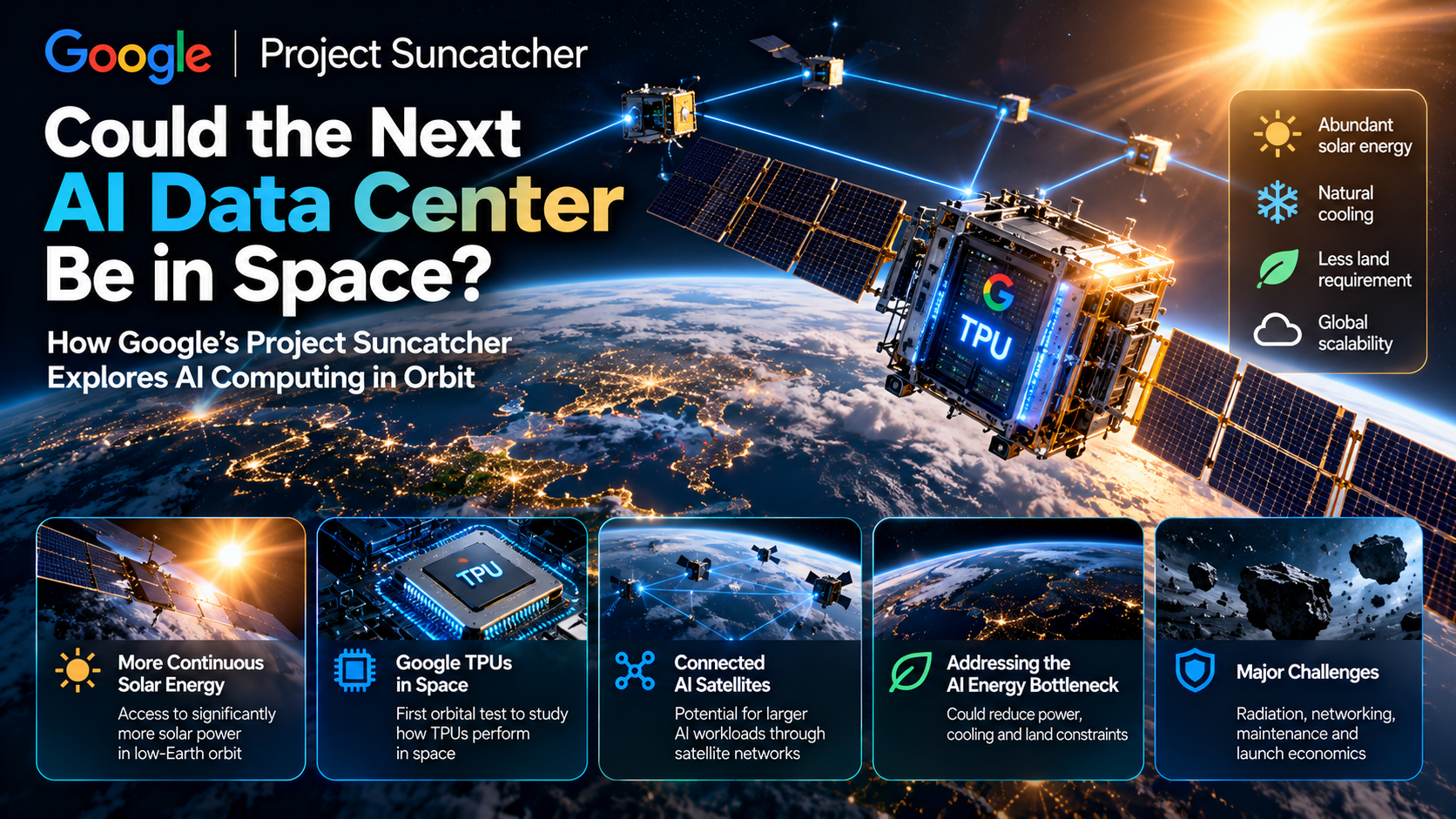
Google is preparing an orbital test of AI-computing hardware—not opening a working space data center. Project Suncatcher asks whether satellites with solar power and fast optical links could someday host substantial AI workloads.
Quick Take
- Technology demonstrator: the first planned orbital test studies how Google TPUs behave in space.
- Potential upside: some low-Earth-orbit configurations may receive much more continuous sunlight than terrestrial solar sites.
- Unsolved physics: vacuum does not make heat disappear; chips must radiate waste heat away.
- Economics remain hypothetical: launch, radiation protection, optical interconnects, maintenance and disposal could erase the energy advantage.
What Is Project Suncatcher?
Google’s September 24 Project Suncatcher update describes a planned satellite test to learn whether TPUs and related systems can operate reliably in low Earth orbit. The longer-range concept is a network of satellites linked with optical communications and powered by solar energy. A first orbital trial is a research milestone, not evidence that commercial AI training or inference is running in space.
Google’s earlier system-design research examines formation flying, interconnects and launch-cost scenarios. The proposal is technically interesting because modern AI data centers demand enormous power and cooling capacity, but every benefit has to survive real engineering and economic scrutiny.
Why Consider Putting AI Compute in Orbit?
Terrestrial data centers compete for electricity, water, grid connections and suitable land. Sun-synchronous orbits can, under favorable assumptions, expose solar arrays to much more continuous sunlight. Google says some configurations could yield solar-energy availability up to eight times that of comparable panels on Earth. This is a scenario-dependent comparison, not a guaranteed eightfold improvement in delivered compute or cost.
Satellites could in theory reduce dependence on certain grid-constrained sites. They could also introduce new demand for launches, spacecraft components, tracking and ground stations. Neither “space fixes AI power” nor “space cannot work” is a useful conclusion before orbital hardware and system economics are measured.
The Engineering Stack: Power, Heat and Networking
| Constraint | Why it matters | What must be demonstrated |
|---|---|---|
| Radiation | High-energy particles can damage electronics and cause transient faults. | TPU reliability, shielding and recovery under real exposure. |
| Thermal management | Vacuum removes convection; heat must leave through radiators. | Cooling mass, radiator area and sustained chip power. |
| Satellite networking | Distributed workloads need low-latency, high-throughput links. | Laser link alignment, uptime and bandwidth under orbital motion. |
| Maintenance | Failed equipment cannot be serviced like a server rack. | Redundancy, replacement cycles and responsible deorbiting. |
| Launch economics | Each kilogram carries substantial deployment cost. | Fully loaded cost per useful compute-hour, not just launch price. |
Google discusses future laser-based inter-satellite links; these are not the same thing as having a production-scale satellite cluster today. Large AI jobs need data movement as much as arithmetic. If moving model weights or training data becomes the bottleneck, abundant sunlight alone will not make the design competitive.
Would a Space Data Center Solve Cooling?
No. Air cooling on Earth moves heat into the atmosphere; water cooling moves it into a liquid loop. In the vacuum of space, spacecraft reject heat mainly as thermal radiation. Radiators have mass and surface-area requirements that grow with the heat to remove. A space system might exploit different ambient conditions, but it does not obtain free cooling.
Compute also needs stable electrical supply, data storage and fault tolerance. Battery or other energy storage may be needed during eclipse periods depending on orbit. Real system comparisons should account for full hardware mass and energy conversion, rather than comparing a solar panel in orbit with an Earth data center in isolation.
The Business Case and Environmental Ledger
Google’s design study explores what might be possible if launch prices decline dramatically in the 2030s. A hypothetical price such as below $200 per kilogram is an assumption for future analysis, not today’s standard rate. Operators would also need to price spacecraft manufacture, replacement launches, ground networking, insurance and shorter hardware refresh cycles.
The environmental comparison must include launch emissions, materials, orbital debris, end-of-life disposal and any terrestrial backup infrastructure. Earth-based alternatives—cleaner grids, more efficient models, heat reuse and better siting—are moving targets. Comparing a speculative orbital design with a static terrestrial baseline would mislead readers.
What to Watch After the First Orbital Test
Does a TPU sustain useful operation after real radiation exposure?
Can the craft hold stable thermal limits under meaningful compute load?
Can future satellite groups exchange data with acceptable bandwidth and delay?
Do independent cost models include launch, failure, recovery and ground links?
A successful first experiment would validate a piece of the puzzle. It would not by itself show that orbital compute is cheaper, cleaner or more reliable than building on Earth. The honest milestone sequence is technology demonstration, network prototype, useful workload, then credible economics.
EU AI Act, Privacy and Responsible Deployment
A satellite-based compute service serving Europeans would still need to assess GDPR, contractual data location, international transfers and security controls. The EU AI Act applies to AI systems according to use and deployment, not whether the processor is on Earth. Space activities also raise national licensing and orbital-sustainability questions. Organizations should not assume “in space” means outside privacy or safety obligations.
For transparency requirements, see European Commission guidance on AI transparency. This overview is general information, not legal, medical or regulatory advice; assess the specific use case with qualified professionals.
MaGeN-AI View
The Takeaway
Project Suncatcher is a serious research question about the AI energy bottleneck, not an operational escape hatch. Google’s orbital TPU test should tell us something useful about radiation and reliability. The much harder case—economical, maintainable and environmentally defensible AI compute at scale—has not yet been made.
Frequently Asked Questions
Does Google have an AI data center in space?
No. Project Suncatcher describes a planned orbital technology test and a longer-term research concept.
Why might orbit help with power?
Certain orbital designs could access sunlight more continuously, but delivered energy and cost depend on the complete system.
Is cooling easier in space?
Not automatically. Spacecraft must radiate heat away; vacuum does not provide air convection.
What is the first Suncatcher test meant to prove?
Google says it will investigate how TPU hardware performs in the orbital environment.
Will space AI computing be cheaper than Earth data centers?
No reliable conclusion exists yet; launch cost, maintenance, networking and thermal design must be assessed together.