Meta Connect 2026: Muse Comes to AI Glasses — Is the Smartphone Losing Its Role as the AI Interface?
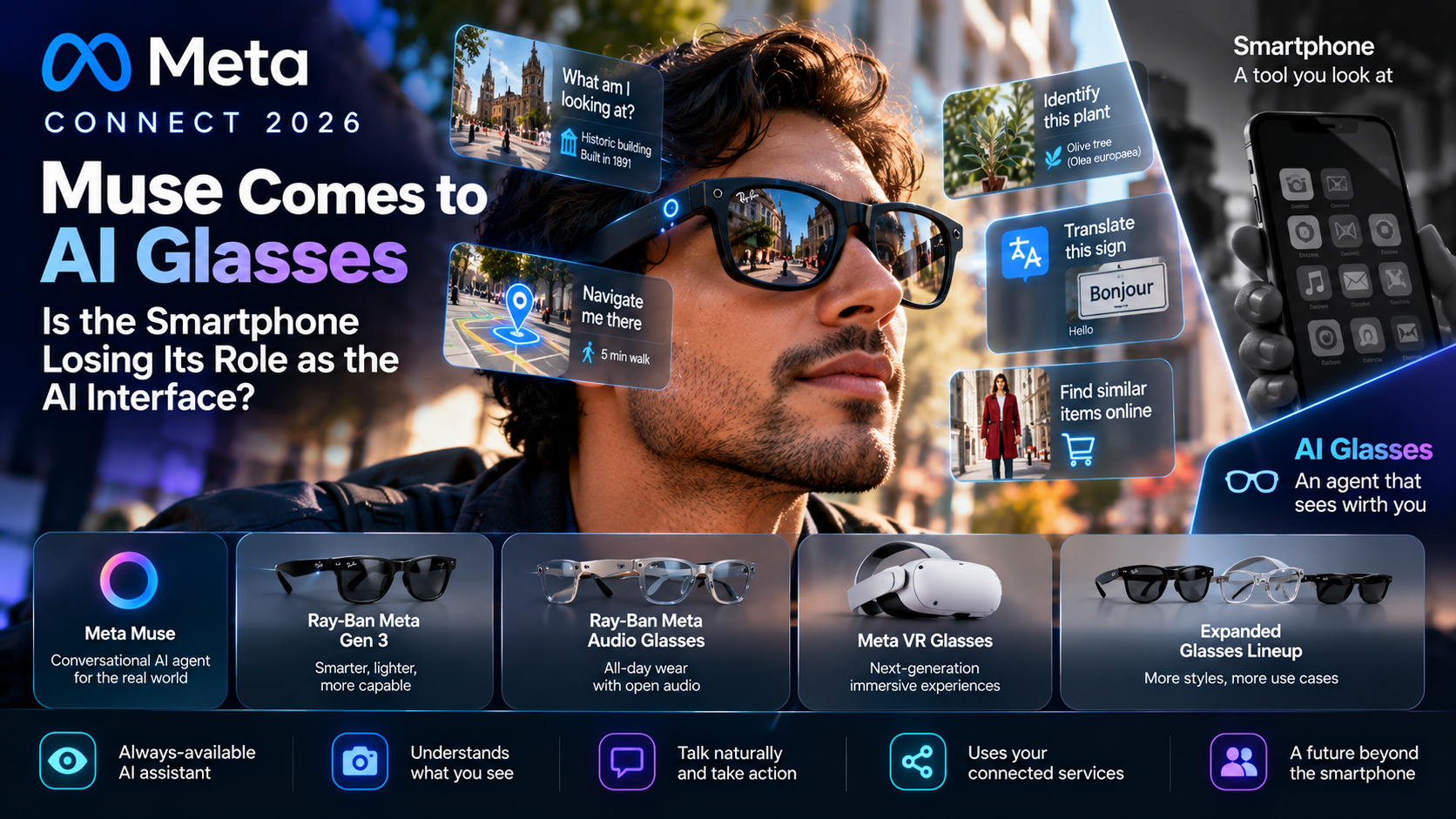
At Meta Connect 2026, the bigger story was not another pair of frames: Muse is being positioned as a persistent assistant across eyewear and services. Here is what is real, what is coming, and what still belongs on your phone.
Quick Take
- Multi-device direction: Meta wants Muse to be accessible through glasses as well as existing screens.
- Timing matters: Meta describes fuller Muse-on-glasses capabilities as coming in the months ahead, not universally available today.
- Hardware is diverse: camera-equipped Ray-Ban Meta Gen 3, audio-focused glasses without a camera and separate VR Glasses address different situations.
- A smartphone remains important: setup, complex review, payments and privacy controls still benefit from a screen.
What Meta Announced at Connect 2026
Meta’s Connect 2026 recap introduced a broader glasses lineup and said Muse would expand across wearable experiences. Its glasses announcement distinguishes the camera-equipped Ray-Ban Meta Gen 3 from audio-focused frames. The products are not interchangeable: their sensors, battery profiles, use cases and bystander implications differ.
Meta says Muse will eventually be able to use what a wearer is looking at and work with connected services while a conversation continues. The word eventually is important. This is a product direction rather than proof that every feature is present on every device or in every region as of September 25, 2026.
From Phone App to Always-Available Agent
Most digital work still follows a familiar pattern: unlock the smartphone, open an application, search, switch contexts and complete an action. Glasses could compress the first two steps. A voice request may be paired with the wearer’s immediate environment—an object, sign or navigation cue—without first reaching for a screen.
The next step is an agent that can use permissioned services: finding an appointment, retrieving a list or drafting a reply while the person continues talking. That is more ambitious than hands-free voice search. It requires secure identity, action previews, precise tool permissions and useful fallbacks when the glasses mishear or misidentify what they see.
Which Glasses Do What?
| Device category | Interface advantage | Practical limitation |
|---|---|---|
| Ray-Ban Meta Gen 3 | Camera plus voice enables visual questions about the immediate environment. | Continuous cameras raise bystander and consent concerns; availability varies. |
| Ray-Ban Meta Audio | Hands-free listening and voice without a camera. | Cannot ground answers in a live camera view. |
| Meta VR Glasses | A more immersive interface for specific mixed or virtual experiences. | Different weight, context and social acceptability from everyday eyewear. |
| Smartphone | Detailed review, typing, authentication and app compatibility. | Requires attention and screen switching. |
This is not a contest in which all eyewear replaces all phone functions. The likely near-term arrangement is complementary: glasses for quick contextual input and responses, a phone or computer for intricate tasks and explicit confirmation.
Use Cases Worth Testing First
Ask about an immediate scene or receive a short, timely instruction; verify safety-critical directions independently.
Retrieve a permitted checklist or dictate a draft while hands remain available for another task.
Request brief contextual help with a sign or itinerary, with fallback when speech or vision fails.
Compare a visible product with a saved preference, without allowing automatic purchases.
Success is not simply a lower number of taps. It is whether the agent reduces effort while preserving clarity about what information it used and what it actually did. Evaluate interruption rate, battery life, ambient noise, accessibility and how quickly a person can correct an error.
The Privacy Problem That Does Not Fit in a Demo
An always-ready interface operates around other people. The wearer may have given permission, but a stranger in a shop, a patient in a clinic or a colleague in a meeting has not necessarily agreed to be analyzed or recorded. Device indicators, meaningful user controls, on-device processing and rules for sensitive spaces matter more than marketing descriptions of convenience.
Connected services create a second boundary: an agent may have access to calendars, messages or commerce. Separate read and write permissions; require explicit confirmation before sending, paying or sharing; and make it possible to view and revoke connections. Companies rolling out glasses to employees also need policies covering recordings, workplace surveillance and data retention.
Will the Smartphone Disappear?
Probably not soon. A screen remains better for complex comparison, proofreading, detailed forms, private authentication and auditing an agent’s proposed actions. Glasses are more plausibly an additional input and notification layer. The market question is whether people prefer quick access enough to accept hardware cost, social norms, battery constraints and privacy friction.
This is our inference from Meta’s product direction, not a claim by Meta that phones are obsolete. The long-term interface may be a system that moves between wearables, phones and desktops while maintaining the user’s consent and task context.
EU AI Act, Privacy and Responsible Deployment
In Europe, camera and microphone features require particular care under GDPR and applicable national privacy rules. Employers should assess workplace processing and provide a viable non-wearable option where appropriate. AI Act transparency duties may apply when a person interacts with an AI system or sees synthetic media; context and intended use determine further obligations. Make the assistant clearly identifiable, minimize capture of bystanders and obtain meaningful permission before sharing personal information with connected services.
For transparency requirements, see European Commission guidance on AI transparency. This overview is general information, not legal, medical or regulatory advice; assess the specific use case with qualified professionals.
MaGeN-AI View
The Takeaway
Muse on glasses could turn “open the right app” into “ask for help in the moment.” That is a useful shift, but the real test is not whether Meta can add a voice interface to a camera. It is whether wearers and everyone around them understand what is captured, what the agent can do and how to stop it. Expect coexistence with the smartphone for the foreseeable future.
Frequently Asked Questions
Can Meta Muse already use everything my AI glasses see?
Meta describes expanded visual and connected-service actions as forthcoming; specific features depend on device, rollout and region.
Do Ray-Ban Meta Audio glasses have a camera?
Meta describes the Audio line as camera-free, unlike the camera-equipped Gen 3 range.
Are AI glasses replacing smartphones?
They may reduce the need to open a phone for quick tasks, but screens remain useful for reviewing, authorizing and editing complex work.
What is the biggest enterprise risk?
Unclear capture of bystanders and excessive access to connected accounts are major concerns; assess both before deployment.
What should users check before buying?
Verify local availability, hardware features, battery, app support and current privacy settings for the specific model.