NVIDIA Isaac ROS 5.0 Explained: AI Agents Can Now Help Build and Program Robots
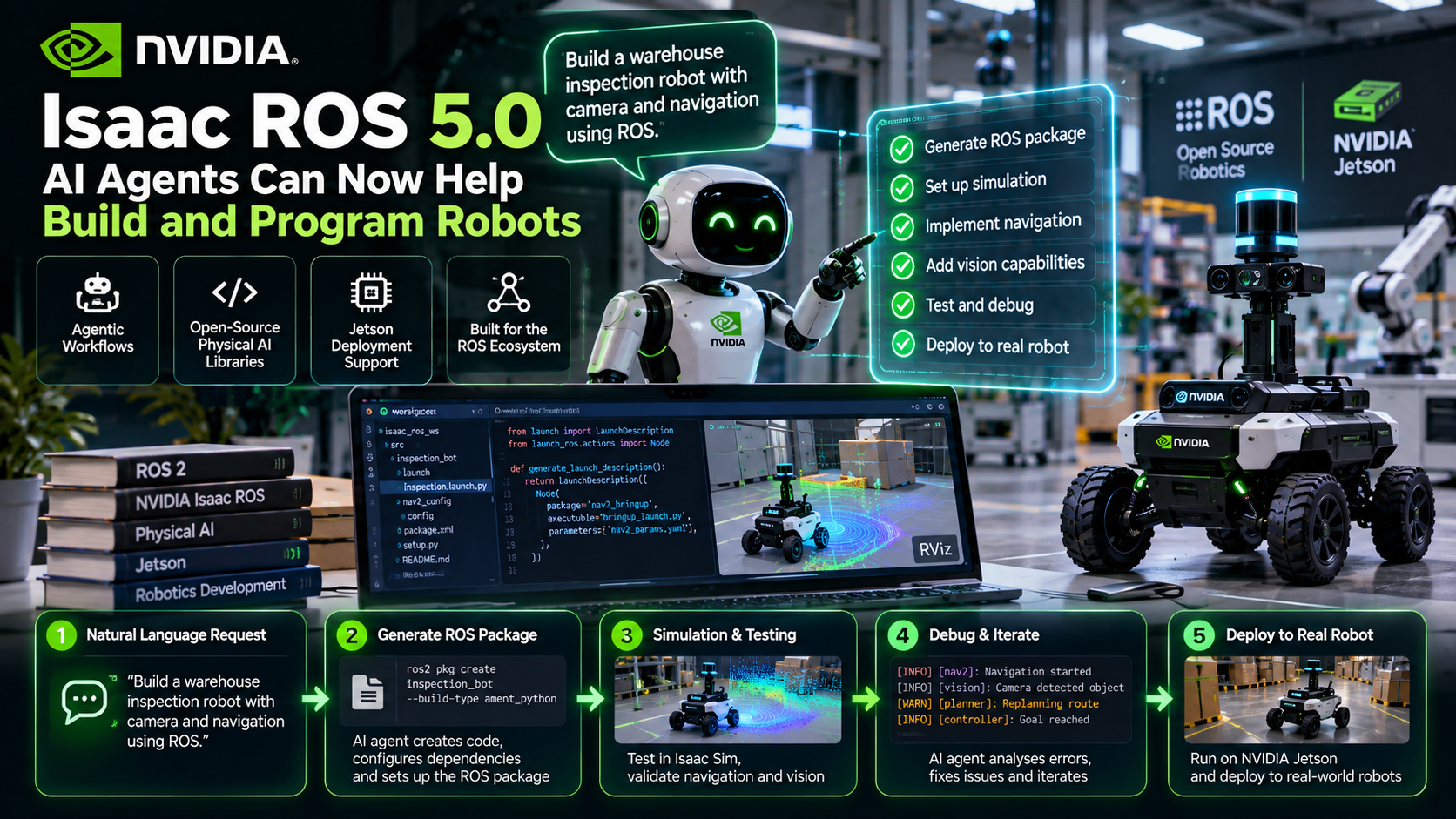
Isaac ROS 5.0 brings agent-assisted development into NVIDIA’s robotics toolkit. The practical path runs from a bounded requirement through ROS code, simulation, tests and controlled Jetson deployment—not from a prompt straight to an unsupervised robot.
Quick Take
- Release: NVIDIA announced Isaac ROS 5.0 at ROSCon on September 22, 2026.
- Developer focus: agent skills and accelerated ROS building blocks can help engineers create and refine packages.
- Different from robot autonomy: an AI assistant writing robotics software is not the same as a robot safely acting on its own.
- Physical validation is mandatory: simulation, human review, hardware checks and emergency stops remain part of deployment.
What Is NVIDIA Isaac ROS 5.0?
NVIDIA’s September 22 announcement describes GPU-accelerated ROS software, expanded open-source physical-AI tools, Jetson deployment support and agent-oriented workflows. ROS is the software ecosystem many robot teams use to compose sensing, planning and control components. Isaac ROS supplies accelerated packages and development tools within that ecosystem.
Agent assistance here is mainly about helping a developer plan, implement, profile and debug robotics software. NVIDIA also reports improvements in specific perception components such as FoundationPose; a performance gain under stated conditions does not establish that an entire robot will move 5.5 times faster or operate more safely.
From Natural-Language Requirement to Running Robot
| Stage | Example engineering work | Human checkpoint |
|---|---|---|
| 1. Specify | Describe the sensor, desired behavior, timing and environmental constraints. | Approve acceptance tests and prohibited actions. |
| 2. Build | Agent proposes a ROS package and connects appropriate Isaac ROS components. | Review dependencies, interfaces, licenses and code. |
| 3. Simulate | Run representative scenarios, regressions and failure injection. | Check edge cases and unexpected movement. |
| 4. Profile | Measure latency, memory and throughput on the target hardware. | Verify improvements are real and reproducible. |
| 5. Deploy | Package a constrained build for a supported Jetson or robot. | Apply staged rollout, monitoring and emergency stop. |
Consider a warehouse robot that must identify a box and report its position. A natural-language request might help an agent sketch a ROS node and choose a perception component. Engineers still need to define camera calibration, coordinate frames, timing limits and what the robot must do when perception confidence is low. The assistant cannot infer those safety requirements from a marketing demo.
What Agent Skills and Acceleration Add
An agent skill can capture domain-specific instructions for an AI coding agent—how to configure a package, use a supported API or validate output. NVIDIA’s technical example walks through agent-assisted acceleration of a ROS 2 node. Such examples illustrate a developer workflow, not an approved template for every robot or processor.
GPU acceleration can help when perception workloads become compute bottlenecks. But bottlenecks can sit elsewhere: camera bandwidth, CPU scheduling, network delay or mechanical actuation. Profile before and after each change on the target device. An optimization that saves compute but breaks message timing or increases memory pressure may harm the overall system.
Jetson, Simulation and Real-World Boundaries
NVIDIA describes support across Jetson devices from compact Orin configurations to higher-capability platforms. Deployment choice should follow power budget, sensor configuration, expected inference rate and thermal limits, not only benchmark numbers. Hardware-in-the-loop testing can reveal differences that a desktop simulation misses.
Simulators are useful for collision scenarios, sensor failures and regression suites, but the real world adds lighting shifts, worn components, moving people and unpredictable obstacles. Start in a supervised test environment. Specify a safe state for dropped frames, bad localization and communications loss, and test the emergency stop as a system property rather than trusting any AI-generated code comment.
What Developers Should Verify Before Production
Reproducible builds, pinned dependencies, test coverage and documented interfaces.
Collision avoidance, speed limits, geofencing and human override independent of the agent.
Power draw, temperature, sensor delay and real end-to-end latency on Jetson.
Signed images, limited network access, credential separation and a rollback path.
Open-source libraries make integration inspectable, but they do not remove maintenance or license responsibilities. Audit upstream dependencies and monitor version changes. Agent-generated patches should go through the same code review and physical safety verification as human-authored changes.
Where This Could Matter Most
Strong early applications include faster prototype assembly, porting compatible perception nodes to accelerators and investigating why a pipeline misses its latency target. Less appropriate initial use includes allowing a general-purpose assistant to rewrite safety-critical control logic and immediately deploy it to a fleet.
Measure time to a verified working prototype, regression counts and operator intervention. A successful agent-assisted robotics workflow saves engineering effort while making test evidence clearer; it does not simply generate more code.
EU AI Act, Privacy and Responsible Deployment
Robotics can engage the EU AI Act, machinery safety rules, product standards, GDPR for cameras and sector-specific requirements depending on intended use. A factory sorting assistant and a robot operating around patients pose different risks. Define the machine’s safe behavior independently of model output; retain human oversight, technical documentation, incident handling and a safety assessment before field deployment. A code-generating agent does not transfer product responsibility away from the manufacturer or operator.
For transparency requirements, see European Commission guidance on AI transparency. This overview is general information, not legal, medical or regulatory advice; assess the specific use case with qualified professionals.
MaGeN-AI View
The Takeaway
Isaac ROS 5.0 matters because physical-AI development has been slow and integration-heavy. Agents may shorten the path from idea to a tested ROS package, especially when paired with accelerated, inspectable components. The winning workflow still ends with a human proving that the robot behaves safely outside the simulator.
Frequently Asked Questions
What is Isaac ROS 5.0?
It is NVIDIA’s ROS-focused robotics software release with accelerated components and added agent-assisted development workflows.
Can an AI agent fully program and deploy a robot safely?
An agent can assist with code and testing, but humans must specify constraints, verify hardware behavior and control deployment.
Does Isaac ROS 5.0 run on Jetson?
NVIDIA describes support across multiple Jetson devices; verify the specific package and hardware configuration.
Does a faster FoundationPose make the whole robot faster?
Not necessarily. NVIDIA’s reported component gain is not an end-to-end system performance guarantee.
What should a developer test first?
Reproducibility, latency, sensor failures, safe fallback, emergency stop and behavior on the actual device.