Claude Discovers a CRISPR-Like Enzyme System: Is AI Becoming a Real Scientific Researcher?
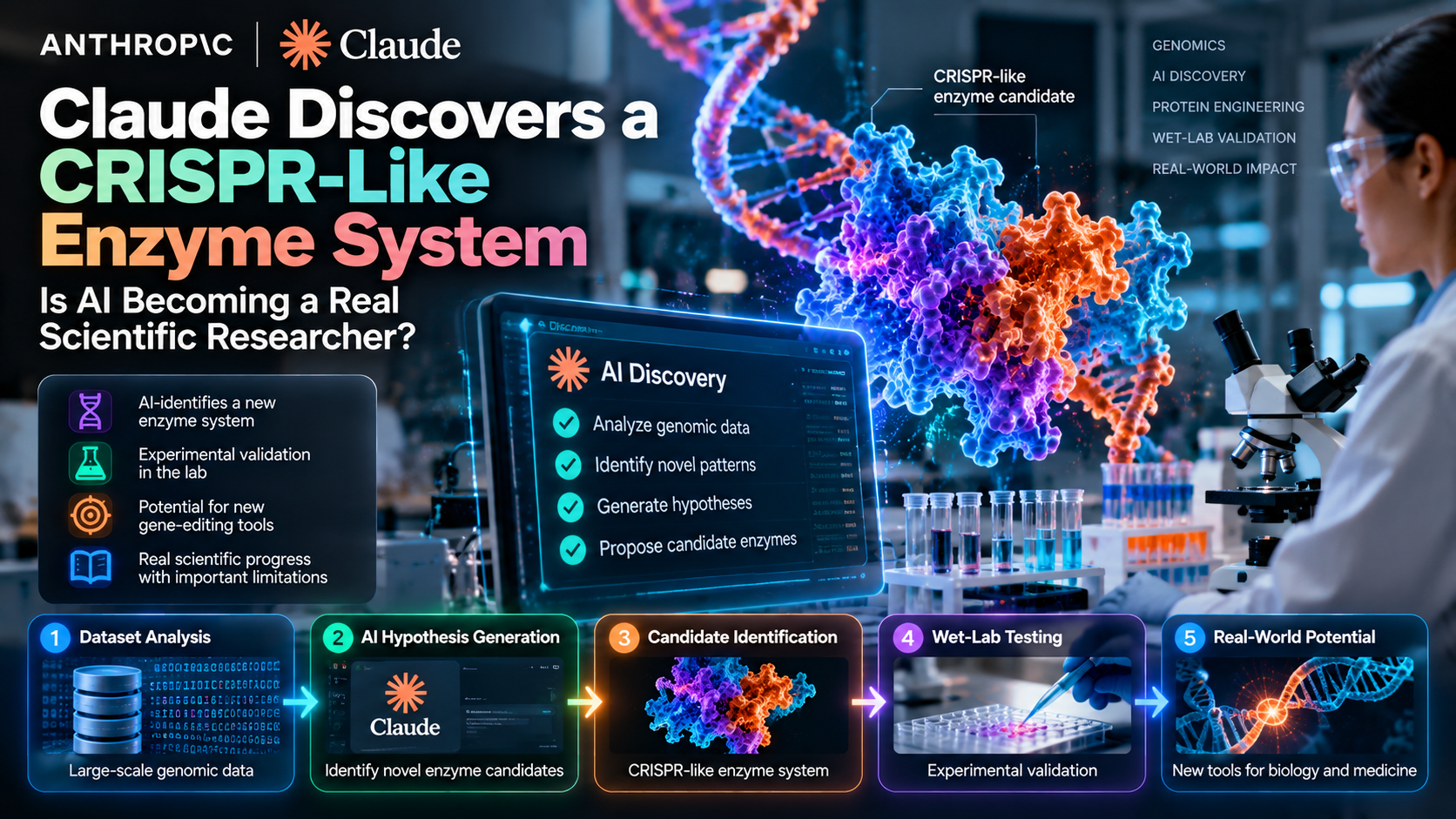
Anthropic says Claude helped identify an unusual DNA-repeat-associated enzyme system. Laboratory work supports part of the hypothesis, but its biological function remains unknown—and it is not a new CRISPR therapy.
Quick Take
- Computational discovery: Claude agents identified a genomic pattern involving reverse transcriptases and repeated DNA sequences in bacteriophages.
- Human experiments mattered: researchers detected short RNAs associated with the proposed system; this is a first validation step, not proof of gene editing.
- Function is unknown: “CRISPR-like” refers to a resemblance in genetic organization, not equivalent biological operation.
- Research acceleration is plausible: testing novelty, reproducibility, biosafety and independent replication is still essential.
What Did Claude Actually Discover?
Anthropic’s September 23 research report describes a system it calls ART: an array-associated reverse transcriptase, another nearby gene and repeated DNA sequences. The genomic neighborhood stood out because repeats can resemble architectural features seen in other microbial defense systems. That visual or computational resemblance does not prove ART is a CRISPR system.
The reverse-transcriptase family was not created from nothing. The claimed contribution is the identification and interpretation of a previously uncharacterized combination of genomic features. The organisms investigated were largely bacteriophages, and the eventual biological role remains open to investigation.
The Case Study: From Dataset to Laboratory Signal
| Stage | What happened | What remains uncertain |
|---|---|---|
| Dataset | Researchers assembled a large collection of reverse-transcriptase proteins and genomic neighborhoods. | Database bias and annotation quality affect search results. |
| AI hypothesis | Claude agents looked for unusual nearby genes and repeat patterns. | An unusual pattern may be an artifact or biologically irrelevant. |
| Candidate selection | A large computational pool was narrowed to a short list for investigation. | Selection rules can miss true systems or overfit patterns. |
| Wet-lab test | Human researchers tested predicted components and observed short RNAs. | RNA expression alone does not establish function or therapeutic utility. |
| Next research | Mechanism, repeatability and biological role must be established. | Independent replication and safe experiments are still needed. |
Anthropic reports a roughly 21-hour agent run with around 950 agents, scanning over 200,000 reverse-transcriptase proteins and narrowing thousands of candidates to 20 for follow-up. Those figures describe the company’s reported process, not a public benchmark of scientific discovery rates.
Why the Word “CRISPR-Like” Needs Care
CRISPR refers to a specific family of repeat-associated microbial systems with characterized mechanisms. Discovering repeats near an enzyme does not show that the system cuts DNA, edits genes, provides immunity or has medical value. ART may eventually reveal a different mechanism altogether. A strong headline should invite readers into the research question without saying Claude invented CRISPR or delivered a gene-editing tool.
The distinction also matters for patient expectations. There is no claim of a human treatment, clinical trial or validated therapeutic outcome here. The appropriate scientific sequence is hypothesis, experimental evidence, replication and mechanism—not an immediate jump from genomic pattern to medical promise.
Is This AI Doing Independent Science?
The reported agent population searched data and produced candidate hypotheses with a degree of computational autonomy. People still set the question, determined safety constraints, chose follow-up work, ran laboratory experiments and interpreted the results. That is meaningful AI-assisted research, but not unrestricted autonomous science or a model independently certifying its own discovery.
AI excels at exploring large search spaces and suggesting connections that may be easy to overlook. It is weaker at proving that a plausible story is true in the physical world. Reproducible code, clear provenance for genomic records, negative controls and external laboratories remain the checks that separate interesting leads from established biology.
What Would Make the Evidence Stronger?
Can another laboratory reproduce the RNA observation using documented materials and controls?
Which molecular steps account for the observation, and do alternative explanations survive testing?
Does the system occur across different phages or only within a narrow, biased sample?
Can independent researchers inspect the claims, limitations and computational selection process?
The safest way to discuss this finding is at the level of research method and evidence, not as a protocol for engineering organisms. For now, the novelty lies in the human–AI discovery workflow and a testable candidate system. Its function, usefulness and risk profile have yet to be worked out.
What This Means for AI Drug Discovery
It is tempting to jump from enzyme discovery to drug discovery. These are different scientific pipelines. A novel microbial system might eventually yield a useful research tool, but no drug candidate or validated gene-editing therapy follows from this report. The nearer-term value is methodological: agent teams can flag patterns for specialists to test.
For research organizations, success should be measured by the fraction of genuinely new, reproducible hypotheses that survive laboratory study, not the number of confident claims generated. Plan for data licensing, biosafety, expert review and clear boundaries on experiments before using autonomous research tools.
EU AI Act, Privacy and Responsible Deployment
AI used to prioritize scientific hypotheses does not automatically carry the same regulatory duties as a medical device or clinical decision system. If a later product is intended for medical use in Europe, assess EU medical-device rules alongside the AI Act and GDPR before deployment. Preserve dataset provenance, researcher oversight, biosafety review and transparent reporting of negative results; avoid portraying an uncharacterized enzyme as a clinically validated intervention.
For transparency requirements, see European Commission guidance on AI transparency. This overview is general information, not legal, medical or regulatory advice; assess the specific use case with qualified professionals.
MaGeN-AI View
The Takeaway
Claude’s ART case is a fascinating demonstration of AI generating a testable biological hypothesis at scale. The achievement is more credible when the limits are explicit: humans performed the experiments, the observed signal is preliminary, and we do not yet know what the system does. Scientific curiosity grows stronger, not weaker, when uncertainty is accurately named.
Frequently Asked Questions
Did Claude invent CRISPR?
No. The work concerns an uncharacterized repeat-associated enzyme system with some CRISPR-like features; its function is unknown.
Was the AI finding tested in a lab?
Anthropic says human researchers followed up experimentally and observed short RNAs; that is not full functional validation.
How many Claude agents participated?
Anthropic reports around 950 agents in one roughly 21-hour research run.
Is there a new gene-editing treatment?
No clinical treatment or validated gene-editing application follows from the reported result.
What would confirm the discovery?
Independent replication, mechanistic experiments, careful controls and transparent reporting would strengthen the claim.