Software development is entering a new era. For decades, developers manually translated business requirements into code, carefully writing every function, class, and API. Today, Artificial Intelligence is introducing a different approach—Intent-Driven Software Development (IDSD).
Instead of telling computers how to perform every step, developers increasingly describe what they want to achieve. AI-powered development platforms then generate code, tests, documentation, and even deployment pipelines automatically.
This shift doesn't replace software engineers—it changes how they work.
In this article, we'll compare intent-driven software development with traditional programming, explore their strengths and limitations, and understand why many technology companies are investing heavily in AI-assisted software engineering.
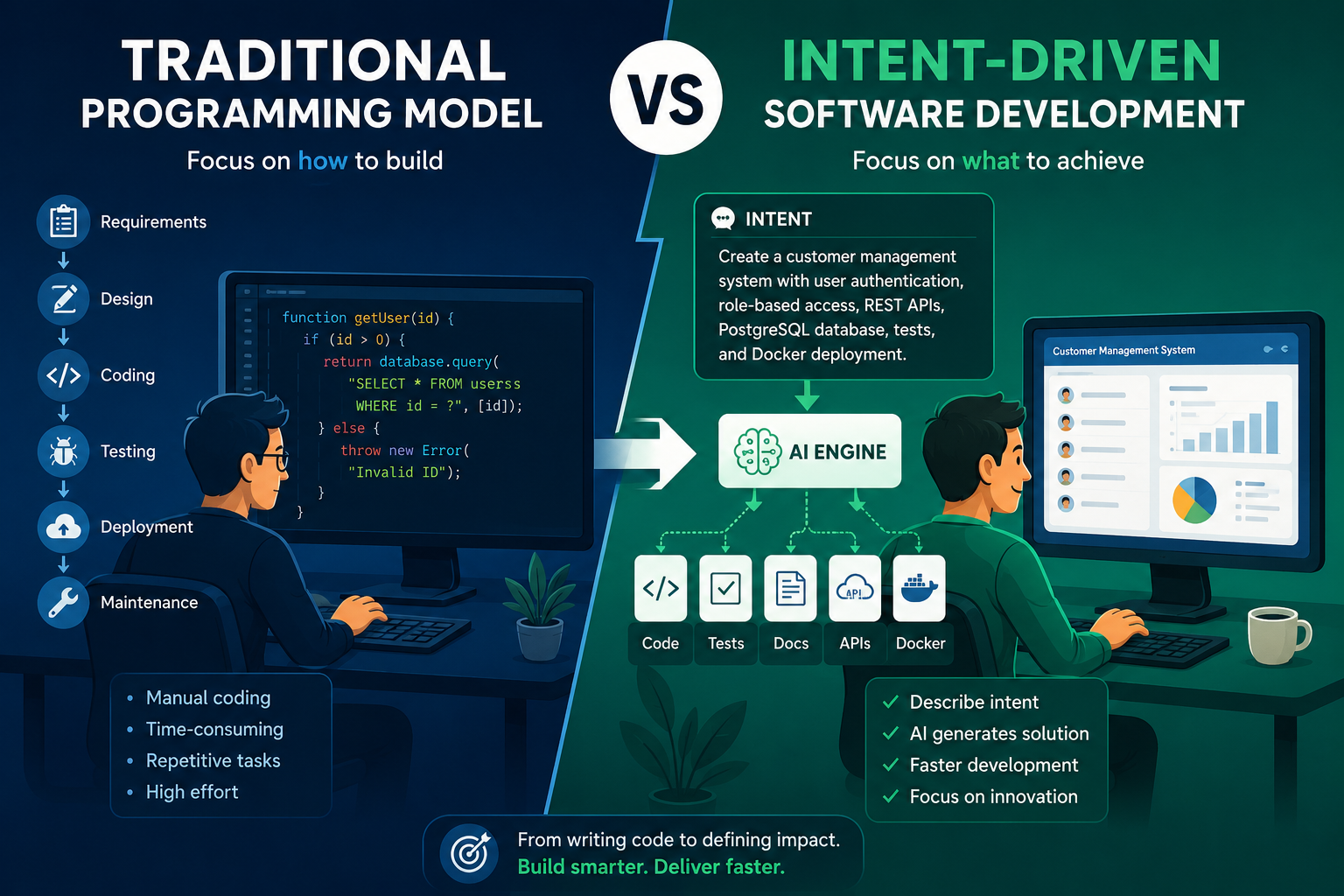
What Is Traditional Programming?
Traditional programming is the software development model that has powered the technology industry for decades.
Developers manually:
Analyze requirements
Design software architecture
Write source code
Debug applications
Perform testing
Deploy releases
Maintain software
Programming languages such as:
Python
Java
C++
C#
JavaScript
Go
Rust
require developers to explicitly define every instruction the computer should execute.
Traditional Workflow
Business Requirement
↓
Software Design
↓
Manual Coding
↓
Testing
↓
Deployment
↓
Maintenance
While this approach provides excellent control and performance, it often requires significant development time.
What Is Intent-Driven Software Development?
Intent-driven development focuses on describing the desired outcome rather than manually implementing every technical detail.
Instead of writing hundreds of lines of code, a developer might provide instructions such as:
"Create a customer management system with user authentication, role-based access, REST APIs, PostgreSQL support, automated tests, and Docker deployment."
Modern AI development tools can generate much of the implementation from that description.
Developers then review, refine, validate, and improve the generated output rather than creating everything from scratch.
Traditional Programming vs Intent-Driven Development
Feature Traditional Programming Intent-Driven Development
Primary Focus Writing code manually Describing business intent
Development Speed Moderate Faster for many tasks
AI Usage Limited Core development component
Code Generation Manual AI-assisted
Documentation Written separately Often generated automatically
Testing Manual or scripted AI-generated test cases
Learning Curve Programming language expertise Problem definition and AI guidance
Developer Role Code creator System designer and reviewer
Why Intent-Driven Development Is Growing
Several factors are driving the adoption of intent-driven development.
1. Faster Development
AI can generate boilerplate code, APIs, configuration files, documentation, and unit tests within minutes.
Developers spend more time solving business problems rather than repetitive coding tasks.
2. Better Productivity
Routine development activities become partially automated.
Examples include:
CRUD operations
API generation
Database models
Validation logic
Configuration files
Documentation
This allows engineers to focus on architecture and innovation.
3. Rapid Prototyping
Startups and product teams can validate ideas much faster.
Instead of weeks of initial coding, working prototypes may be created within hours or days.
4. Improved Collaboration
Business stakeholders can describe desired functionality in natural language.
Developers refine these requirements while AI translates them into technical implementations, reducing communication gaps.
Benefits of Intent-Driven Development
Faster Time to Market
Products can move from concept to prototype significantly faster.
Lower Development Costs
Automation reduces repetitive engineering effort.
Easier Knowledge Sharing
Natural-language descriptions are easier for cross-functional teams to understand than complex code.
Improved Documentation
Many AI development tools automatically generate technical documentation alongside the code.
Continuous Improvement
AI can recommend:
Performance improvements
Security enhancements
Code refactoring
Test coverage expansion
Challenges to Consider
Intent-driven development also introduces new responsibilities.
AI-Generated Code Requires Review
Generated code may contain:
Logic errors
Security vulnerabilities
Inefficient implementations
Outdated libraries
Human validation remains essential.
Prompt Quality Matters
Poorly defined requirements often produce poor results.
Clear, structured intent generally leads to better software.
Complex Systems Still Need Experts
Large enterprise systems require experienced engineers to:
Design scalable architectures
Ensure compliance
Optimize performance
Integrate legacy systems
Review AI-generated solutions
Real-World Use Cases
Intent-driven development is already influencing many industries.
Enterprise Software
Generate internal business applications with less manual coding.
Healthcare
Accelerate secure patient management systems while keeping engineers responsible for compliance and validation.
Financial Services
Rapidly build reporting tools and dashboards with AI assistance.
Manufacturing
Develop factory monitoring applications and Industrial IoT solutions more efficiently.
E-commerce
Create storefronts, inventory management systems, and recommendation engines with AI-generated foundations.
Popular AI Development Tools
Several modern platforms support intent-driven development.
GitHub Copilot
OpenAI Codex-powered tools
ChatGPT for coding assistance
Google Gemini Code Assist
Amazon Q Developer
Cursor AI
Windsurf
Claude Code
Replit AI
These tools assist developers by generating code, explaining logic, identifying bugs, and suggesting improvements.
Is Traditional Programming Becoming Obsolete?
Not at all.
Traditional programming remains essential for:
Operating systems
Embedded software
Real-time applications
Aerospace
Automotive ECUs
Safety-critical systems
High-performance computing
Game engines
However, AI is changing how much manual coding is required.
Rather than replacing developers, intent-driven development shifts their focus toward system design, validation, and problem-solving.
The Future of Software Development
The future is likely to combine both approaches.
Developers will increasingly:
Define business intent
Review AI-generated code
Improve architecture
Ensure security and compliance
Optimize performance
Manage AI-assisted development workflows
Organizations that successfully combine human expertise with AI capabilities are likely to deliver software more quickly while maintaining quality and reliability.
Final Thoughts
Intent-driven software development represents a significant evolution in software engineering. By allowing developers to express goals instead of manually coding every detail, AI-powered tools can accelerate development, improve productivity, and simplify collaboration.
Traditional programming, however, remains indispensable for complex, performance-sensitive, and safety-critical applications. The most effective development teams will combine the precision of traditional engineering with the speed and flexibility of AI-assisted workflows.
As AI continues to mature, software development will become less about writing every line of code and more about designing solutions, validating outcomes, and delivering value efficiently.
Frequently Asked Questions (FAQ)
What is intent-driven software development?
Intent-driven software development is an AI-assisted approach where developers describe the desired functionality or business outcome, and AI helps generate code, documentation, tests, and configurations.
Is intent-driven development replacing programmers?
No. It changes the developer's role from writing every line of code to designing systems, reviewing AI-generated output, and ensuring quality, security, and maintainability.
What are the main advantages of intent-driven development?
The biggest benefits include faster development, improved productivity, quicker prototyping, better documentation, and enhanced collaboration between technical and non-technical teams.
Which industries benefit most from intent-driven development?
Industries such as software, finance, healthcare, manufacturing, retail, and cloud services are already using AI-assisted development to speed up application delivery.
Can AI generate production-ready code?
AI can generate high-quality code for many use cases, but human review, testing, security validation, and architectural oversight remain essential before deploying software to production.
Tags
#IntentDrivenDevelopment #SoftwareDevelopment #ArtificialIntelligence #AICoding #Programming #SoftwareEngineering #DeveloperTools #GitHubCopilot #ChatGPT #GenerativeAI #CodeAutomation #EnterpriseSoftware #CloudComputing #FutureOfProgramming #TechTrends2026