Artificial Intelligence is changing software engineering faster than ever before. While AI coding assistants already help developers write code, the next breakthrough is Multi-Agent Systems (MAS)—networks of intelligent AI agents that collaborate to build, test, repair, and optimize software with minimal human intervention.
Imagine a software project where one AI agent writes code, another reviews it, another runs automated tests, and a fourth fixes bugs before they reach production. This collaborative approach is making software development faster, smarter, and more resilient.
In this article, we'll explore how Multi-Agent Systems self-assemble software applications and self-heal code, why they matter, and how they could redefine software development over the next decade.
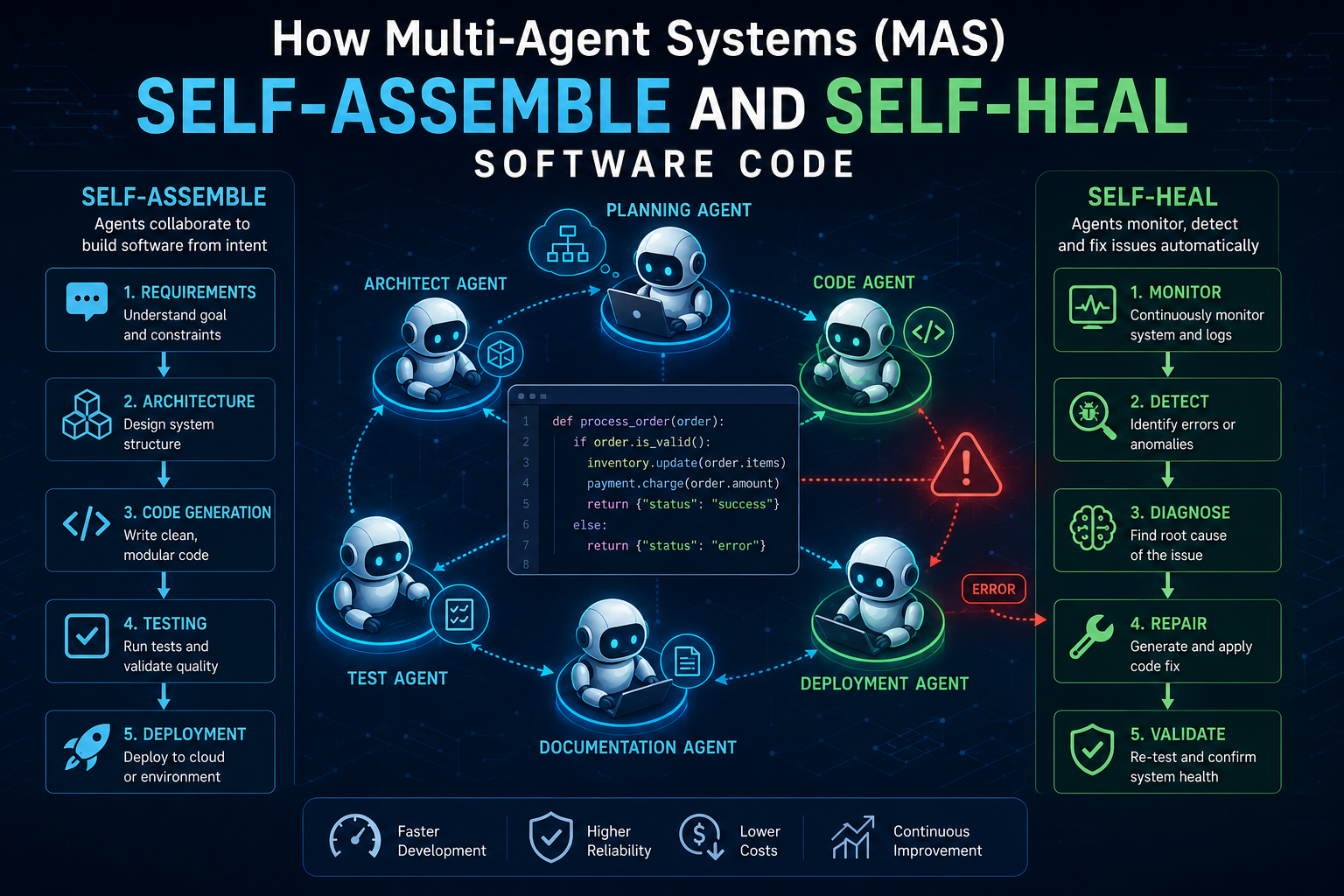
What Is a Multi-Agent System (MAS)?
A Multi-Agent System is a collection of intelligent software agents that work together to accomplish shared objectives.
Unlike a single AI assistant, each agent has a specialized responsibility and communicates with others to solve complex problems.
Typical AI agents include:
Planning Agent
Software Architect Agent
Code Generation Agent
Testing Agent
Security Agent
Documentation Agent
Deployment Agent
Monitoring Agent
Together, they function like an autonomous software engineering team.
What Does "Self-Assemble" Mean?
Self-assembly refers to the ability of AI agents to automatically organize themselves into an effective workflow based on the project's goals.
Rather than assigning every task manually, the system determines:
Which agents are required
What each agent should do
Task dependencies
Execution order
Collaboration strategy
For example, if the objective is to build an e-commerce platform, the system might automatically assign:
Requirements Agent
↓
Architecture Agent
↓
Backend Development Agent
↓
Frontend Development Agent
↓
Database Agent
↓
Testing Agent
↓
Security Review Agent
↓
Deployment Agent
The workflow adapts dynamically as the project evolves.
What Does Self-Healing Software Mean?
Self-healing software can detect issues, diagnose root causes, and apply corrective actions automatically.
Instead of waiting for developers to identify and fix problems, AI agents continuously monitor the application and respond to failures in real time.
Typical self-healing actions include:
Fixing syntax errors
Correcting broken APIs
Updating incompatible libraries
Repairing configuration files
Resolving dependency conflicts
Improving performance bottlenecks
Restarting failed services
Regenerating failing test cases
This enables software to recover faster while reducing operational downtime.
How Multi-Agent Systems Work
A typical AI-driven software workflow follows several coordinated stages.
Step 1: Understand the Goal
A planning agent interprets business requirements and creates a structured development plan.
Example:
"Build a secure inventory management application with authentication, analytics dashboards, REST APIs, and cloud deployment."
Step 2: Design the Architecture
An architecture agent selects:
Programming language
Framework
Database
APIs
Cloud platform
Security model
It produces the overall technical blueprint.
Step 3: Generate Code
Development agents create:
Backend services
Frontend components
Database schemas
API endpoints
Infrastructure configuration
Each agent focuses on its area of expertise.
Step 4: Validate the Software
Testing agents automatically generate:
Unit tests
Integration tests
Performance tests
Regression tests
Failures are immediately reported to the responsible coding agent.
Step 5: Self-Heal
If an issue is detected:
Monitoring Agent identifies the failure.
Diagnostic Agent analyzes the root cause.
Repair Agent generates a fix.
Testing Agent verifies the correction.
Deployment Agent publishes the validated update.
This closed-loop process minimizes manual intervention.
Benefits of Multi-Agent Software Development
Faster Development
Multiple AI agents work simultaneously, reducing development time and accelerating delivery.
Improved Software Quality
Continuous testing, peer review, and automated validation help identify issues early in the development cycle.
Reduced Operational Costs
Routine tasks such as debugging, documentation, and code reviews can be automated, allowing developers to focus on higher-value work.
Continuous Optimization
Monitoring agents can recommend or apply performance improvements as applications evolve.
Greater Reliability
Automated recovery mechanisms improve resilience and reduce downtime caused by software failures.
Real-World Applications
Multi-Agent Systems are increasingly relevant across many industries.
Enterprise Software
Automate business application development while maintaining quality and consistency.
Financial Services
Build secure transaction systems with continuous compliance monitoring.
Healthcare
Support clinical software with automated validation and reliability improvements.
Manufacturing
Coordinate Industrial IoT systems, predictive maintenance, and factory automation.
Autonomous Vehicles
Manage complex software modules responsible for perception, planning, diagnostics, and system health monitoring.
Cloud Platforms
Optimize infrastructure, resource allocation, and deployment pipelines in real time.
Challenges of Multi-Agent Systems
Although promising, MAS introduces new considerations.
Agent Coordination
Agents must communicate effectively to avoid conflicting decisions.
Security
Autonomous code generation requires strong governance and secure execution environments.
Human Oversight
Critical systems still require engineers to validate architecture, compliance, and safety.
Resource Consumption
Running multiple AI agents simultaneously can require significant computing resources.
Technologies Powering Multi-Agent Systems
Modern MAS platforms often combine several technologies.
Large Language Models (LLMs)
AI Planning Engines
Knowledge Graphs
Retrieval-Augmented Generation (RAG)
Vector Databases
Workflow Orchestration Platforms
Containerized Microservices
Cloud-Native Infrastructure
Together, these technologies enable intelligent coordination and decision-making across autonomous agents.
The Future of Self-Assembling Software
Software development is shifting from manual implementation toward intent-driven engineering.
In the coming years, AI agents are expected to:
Design application architectures
Generate production-ready code
Perform continuous security analysis
Monitor live systems
Detect failures
Repair defects automatically
Improve performance over time
Collaborate with human developers as intelligent teammates
Developers will increasingly focus on defining business objectives, validating AI-generated solutions, and making strategic design decisions rather than writing every line of code.
Final Thoughts
Multi-Agent Systems represent a significant step toward autonomous software engineering. By combining specialized AI agents that can self-organize, collaborate, and continuously improve software, organizations can accelerate development while improving quality and resilience.
Although human expertise remains essential for architecture, governance, and critical decision-making, MAS is transforming the software lifecycle from a largely manual process into an intelligent, adaptive workflow.
As AI continues to evolve, self-assembling and self-healing software will become a defining capability of next-generation software platforms.
Frequently Asked Questions (FAQ)
What is a Multi-Agent System (MAS)?
A Multi-Agent System is a collection of AI agents that collaborate to complete complex tasks such as software design, coding, testing, deployment, and monitoring.
What does self-assembling software mean?
Self-assembling software uses AI agents to automatically organize development workflows, assign responsibilities, and build applications based on business intent.
What is self-healing software?
Self-healing software detects failures, diagnoses root causes, applies corrective actions, and validates fixes automatically, improving reliability and reducing downtime.
Will Multi-Agent Systems replace software developers?
No. They are designed to enhance developer productivity by automating repetitive tasks, while engineers continue to lead architecture, governance, security, and innovation.
Which industries benefit from MAS?
Industries including finance, healthcare, manufacturing, cloud computing, e-commerce, logistics, and autonomous vehicles can benefit from AI-powered Multi-Agent Systems.
Key Takeaways
Multi-Agent Systems coordinate specialized AI agents to build software collaboratively.
Self-assembling workflows reduce manual planning and accelerate development.
Self-healing capabilities enable software to detect and repair issues automatically.
Human developers remain essential for oversight, security, and strategic design.
MAS is becoming a core technology for the future of AI-assisted software engineering.
Tags
#MultiAgentSystems #MAS #ArtificialIntelligence #AgenticAI #SoftwareEngineering #AutonomousCoding #SelfHealingSoftware #SelfAssemblingSoftware #GenerativeAI #AIAgents #FutureOfProgramming #EnterpriseAI #CloudComputing #SoftwareDevelopment #TechTrends2026