Inside NVIDIA’s 2026 AI Hardware Roadmap After Blackwell
The AI gold rush is entering its next phase, and NVIDIA just set the roadmap.
For the past two years, the Blackwell architecture was the unmatched king of compute, powering the first true foundation models and agentic workflows. But as March 2026 unfolds, the industry is already looking past the horizon. This month's data center revelations have confirmed that NVIDIA is moving beyond simply building powerful GPUs; they are now engineering complete, integrated computational ecosystems.
The core challenge has shifted. In 2024, the priority was "compute at all costs." In 2026, the bottlenecks are interconnect speed, extreme power density, and efficient thermal management. Blackwell proved that air cooling was dead for high-end training clusters; its successors are designed to thrive in a liquid environment.
The "Rubin" Architecture: 3D Stacking and the Memory Wall
The successor to Blackwell, codenamed "Rubin" (named after astronomer Vera Rubin), made its quiet debut this spring. Its defining characteristic is the move from 2.5D packaging to true 3D silicon stacking.
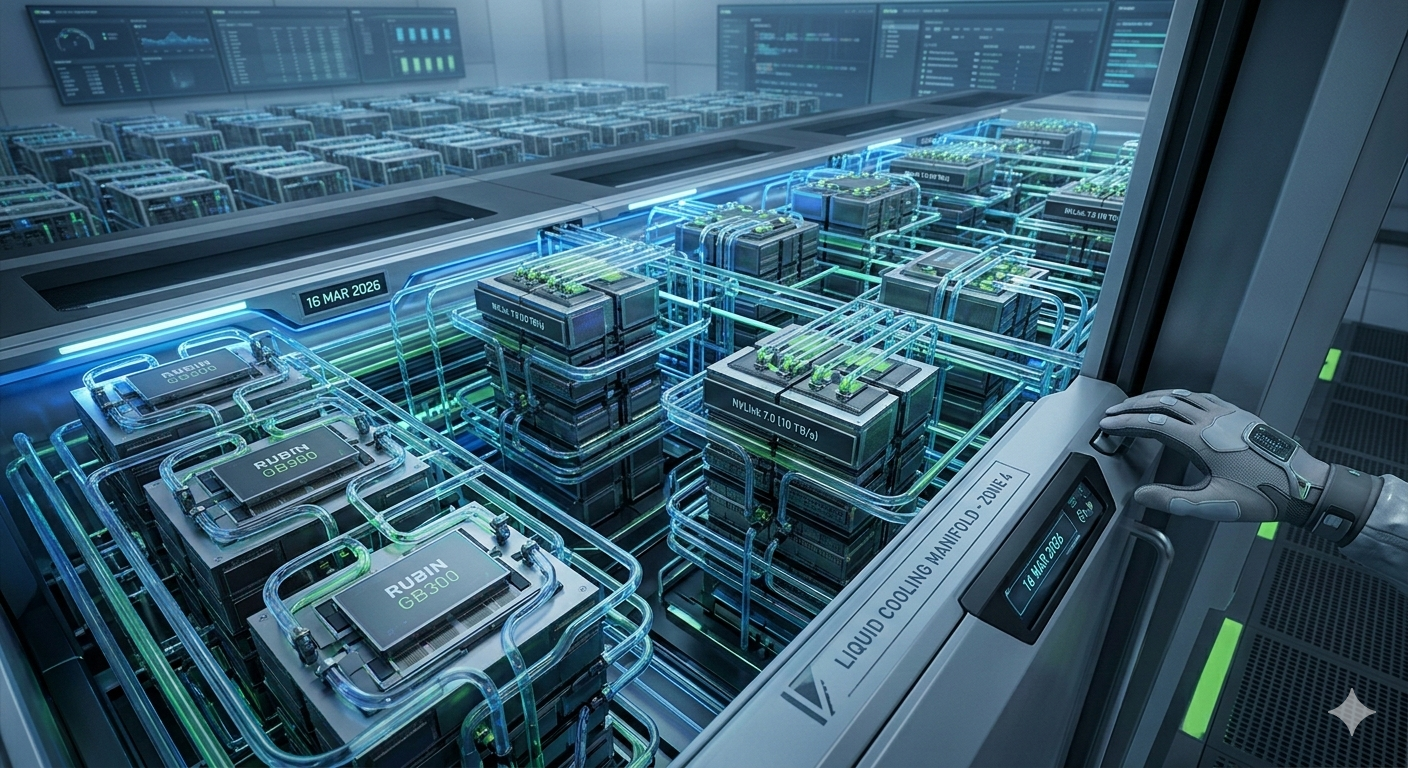
By stacking memory directly on top of the logic die, Rubin achieves staggering bandwidth: NVLink 7.0 is now pushing past 10 terabytes per second. This isn't just a marginal gain; it breaks the "memory wall" that previously choked large-scale inference. The entire architecture is optimized for 1,000-watt, liquid-cooled operation, integrating sophisticated coolant manifolds directly into the compute racks.
This shift toward vertical integration solves the density puzzle. As shown in the image below, these new "superchips" thrive in tightly packed, transparent coolant channels, allowing for massive computational power in a remarkably small footprint.
The Rise of NVLink Switch and Data Center Scale
We are also seeing the rollout of the second-generation NVLink Switch. The roadmap is clear: the data center is now the unit of compute. NVIDIA isn’t just selling chips; they are deploying entire data center fabrics. This month, clusters incorporating these new switches have demonstrated the ability to scale to over 100,000 unified GPUs, all interacting with near-local memory latency.
This scaling is critical for training the multi-trillion-parameter models scheduled for release later this year.
Beyond Training: Inference and Edge AI
While training gets the headlines, the 2026 roadmap also reinforces NVIDIA’s dominance in inference hardware. The specific optimizations found in the lower-wattage Grace CPU companions of the Rubin platform are tailored for running massive agents autonomously.
NVIDIA is also doubling down on Jetson Thor (its robotics SoC), leveraging the same architectural advances to power physical AI at the edge. The focus is on enabling complex, real-time multimodal processing—critical for the humanoid robot pilots currently being deployed in automotive manufacturing.
As we look deeper into 2026, the message from NVIDIA is unmistakable: the speed of silicon innovation is not slowing down. Blackwell was the beginning; Rubin is the foundation for the age of agentic intelligence.