China Dominates the Open-Source AI Scene: How It Happened and Why It Matters
Over the past year, the global artificial-intelligence ecosystem has undergone a noticeable power shift. While Western firms once led the open-source AI movement almost unchallenged, a surge of model releases, research output, and developer adoption from Chinese organizations has dramatically altered the balance. The result is a new reality: China is now one of the most influential forces shaping the open-source AI landscape.
A Rapid Acceleration in Open-Source Releases
A key reason for this rise is volume combined with quality. Major technology companies such as Alibaba, ByteDance, and Baidu have released increasingly capable open or partially open models across language, vision, and multimodal domains.
These models are not just experimental—they’re production-grade systems designed for enterprise, research, and developer ecosystems. Many now rival or surpass earlier Western open-source benchmarks in:
reasoning accuracy
multilingual performance
inference efficiency
deployment cost
This rapid iteration cycle has made Chinese model releases a constant presence on developer platforms such as Hugging Face, where new checkpoints and fine-tuned variants appear weekly.
Strategic National Alignment
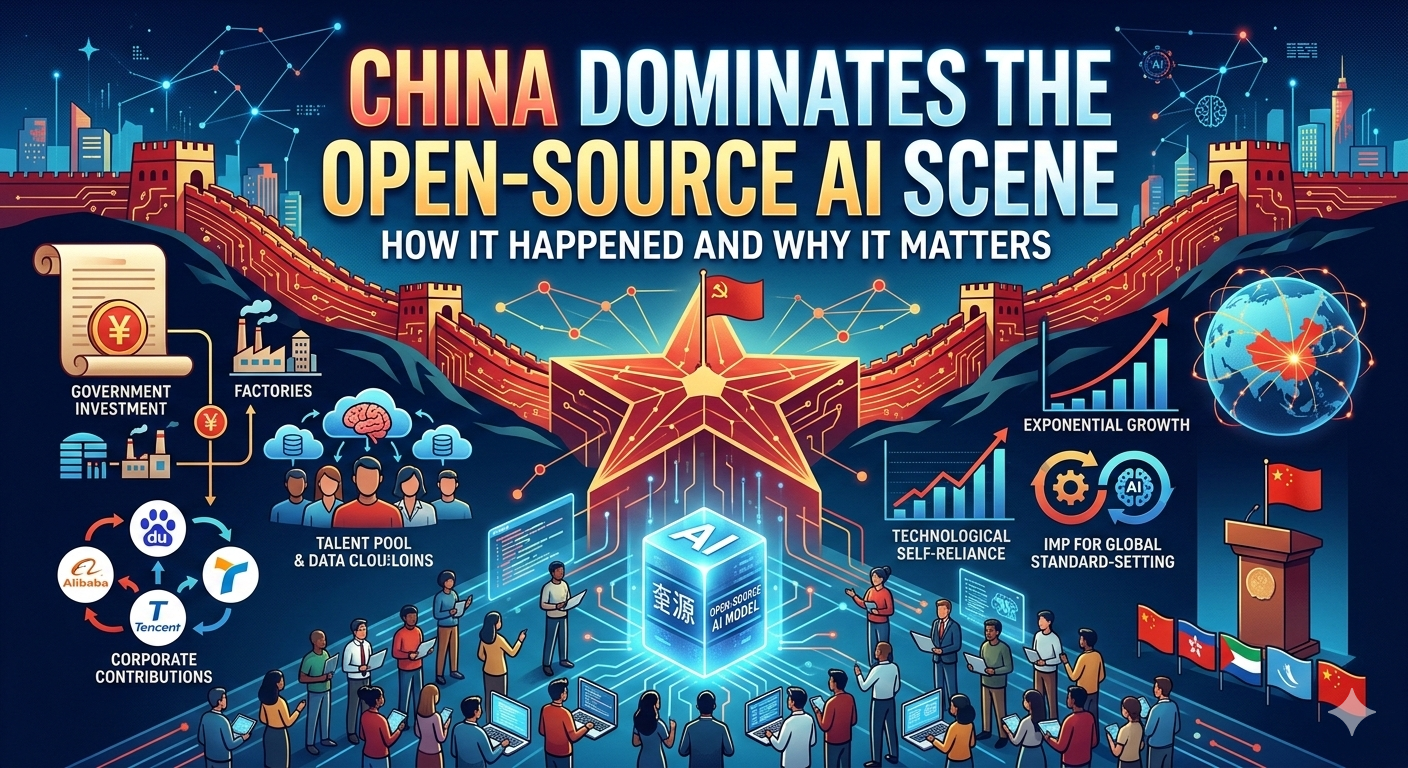
Another factor is coordinated ecosystem strategy. Unlike fragmented private-sector approaches elsewhere, China’s AI push aligns:
government policy
academic research
private industry
cloud infrastructure providers
This alignment allows rapid scaling. National initiatives emphasize sovereign AI capability—the ability to train, deploy, and maintain advanced models domestically without dependency on foreign infrastructure.
That focus has accelerated investment in chips, data centers, and training datasets, creating a vertically integrated AI stack.
Why Open Source Is Central to the Strategy
Open-source AI is not just a technical philosophy—it’s a geopolitical and economic lever.
By releasing models publicly, organizations can:
Drive global adoption of their architectures
Attract developers who build on their frameworks
Establish de-facto technical standards
Expand influence without export restrictions
This approach contrasts with more closed commercial strategies historically favored in the United States, where proprietary models dominate enterprise deployments.
Developer Community Momentum
Open-source dominance ultimately depends on developers, and this is where momentum is especially visible. Chinese model repositories increasingly show:
higher fork counts
faster community fine-tuning
more multilingual datasets
strong performance in resource-limited environments
Many developers choose these models because they run efficiently on smaller hardware footprints, making them practical for startups, researchers, and emerging markets.
Global Implications
China’s growing leadership in open AI ecosystems has several implications:
Innovation decentralization: Cutting-edge AI is no longer concentrated in a single region.
Competitive pressure: Western firms face increased urgency to open models or risk losing developer mindshare.
Standards influence: The architectures most widely adopted today may define tomorrow’s industry norms.
Access expansion: Lower-cost open models broaden participation in AI development worldwide.
Challenges and Skepticism
Despite the momentum, concerns remain:
transparency of training data
governance standards
long-term licensing terms
geopolitical trust
Some organizations hesitate to adopt foreign-developed foundational models for sensitive applications. As a result, technical excellence alone does not guarantee universal adoption.
The Bigger Picture
The rise of China in open-source AI signals a structural transformation in the global technology landscape. Instead of a single dominant innovation hub, the future is shaping into a multipolar ecosystem where leadership shifts dynamically based on research velocity, infrastructure scale, and developer engagement.
In practical terms, this means the next breakthrough in AI may come from anywhere—and increasingly, it’s just as likely to come from Beijing or Shenzhen as from Silicon Valley.
Bottom line: China’s dominance in open-source AI isn’t a temporary surge—it’s the outcome of coordinated strategy, heavy investment, and rapid technical iteration. For developers, businesses, and policymakers, understanding this shift is essential to navigating the next phase of the AI era.