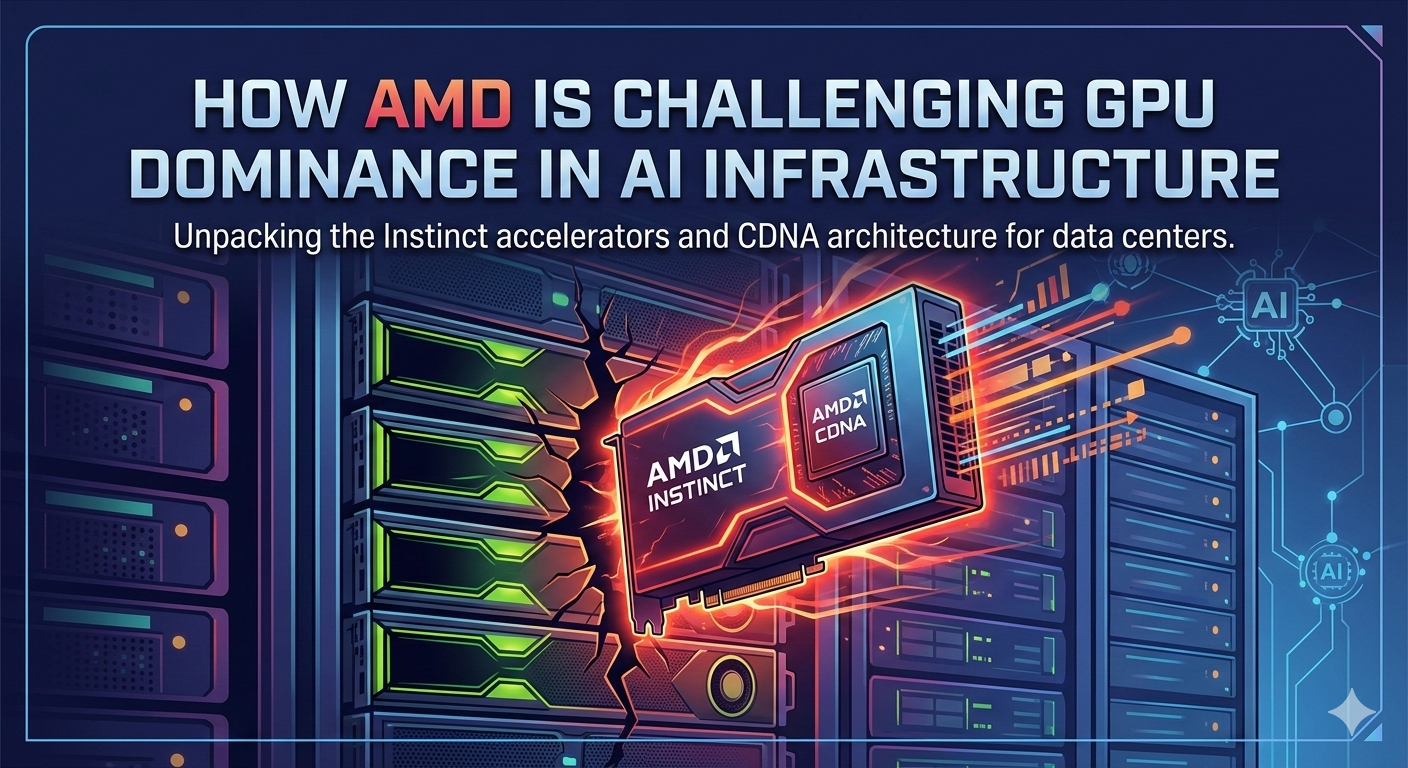
How AMD Is Challenging GPU Dominance in AI Infrastructure
Unpacking the Instinct Accelerators and CDNA Architecture for Data Centers
In the recent years, NVIDIA has held an iron grip on the AI infrastructure market. Their powerful GPUs and robust CUDA software ecosystem have been the backbone of deep learning, from large language model (LLM) training to complex scientific simulations. However, the rapidly expanding AI landscape, with its insatiable thirst for computing power and memory, is demanding diverse solutions. This is where AMD is making a significant move, shaking up the status quo with its Instinct line of accelerators and underlying CDNA architecture. Let's delve into how AMD is positioning itself as a legitimate challenger in the battle for AI supremacy.
The Rise of the AMD Instinct Accelerators
While NVIDIA established dominance early on, AMD has been quietly and aggressively building its enterprise-grade AI hardware lineup. The AMD Instinct accelerators, starting with the MI100 and progressing significantly with the MI200 and MI300 series, are designed specifically to meet the grueling demands of high-performance computing (HPC) and AI in the data center.
AMD's recent flagship, the Instinct MI300X accelerator, makes a bold statement. Here’s how it takes the fight to the competition:
Massive Memory Capacities: LLMs continue to swell in size, requiring vast amounts of high-speed memory. The MI300X stands out with industry-leading High Bandwidth Memory 3 (HBM3) capacities, offering significantly more per-accelerator memory than many existing solutions. This allows data centers to load even larger models and handle massive batch sizes, which can be crucial for training and inference.
Leading-Edge Process Technology: AMD is leveraging advanced chip packaging and manufacturing processes (TSMC's 5nm and 6nm) to integrate billions of transistors efficiently. This translates to more processing power packed into a standard server rack footprint.
A Focus on Total Cost of Ownership (TCO): Data centers are not just about raw power; efficiency and cost are paramount. AMD designs the Instinct accelerators with a focus on delivering strong performance-per-watt and performance-per-dollar, aiming to provide a compelling TCO advantage for large-scale AI deployments.
Under the Hood: The AMD CDNA Architecture
The raw power of the Instinct hardware is driven by the innovative AMD CDNA (Compute DNA) architecture. In an era where "GPU" is often shorthand for any accelerator, AMD’s architectural choice is deliberate: CDNA is built from the ground up for compute, not graphics.
While AMD’s graphics division focuses on the RDNA architecture for gaming, the CDNA team is single-mindedly focused on maximizing matrix and vector math performance.
What makes CDNA different?
Optimized Compute Units: The basic building blocks (Compute Units or CUs) in CDNA are stripped of unnecessary graphics functions and refined to excel at mathematical operations common in AI workloads, particularly matrix multiply-accumulate operations (the bread-and-butter of deep learning).
Scalability Through Advanced Fabric: The "challenge" in large AI systems isn't just a single card; it’s connecting hundreds or thousands of them. CDNA is built with AMD Infinity Fabric, an efficient interconnect that allows for massive scalability. It enables high-speed communication between multiple GPUs (and with AMD EPYC CPUs), reducing bottlenecks in clustered environments.
Focus on Numerical Precision: CDNA is engineered to support a wide array of data types (from standard double and single precision to mixed and reduced precision like FP16, BF16, and INT8), which are crucial for achieving the right balance between speed and model accuracy in AI training and inference.
Beyond Hardware: The Software Frontier (ROCm)
NVIDIA’s primary strength hasn't just been its silicon; it’s the massive CUDA software ecosystem. If AMD wants to be a true alternative, it must overcome this software barrier.
Enter ROCm (Radeon Open Compute).
ROCm is AMD’s open-source software platform designed specifically for GPU compute. In recent years, AMD has invested heavily to mature this platform, focusing on several key areas:
Framework Support: A critical component is ensuring compatibility with standard AI frameworks like PyTorch and TensorFlow. Major progress has been made, with key libraries being ported and optimized for ROCm, allowing developers to migrate their models relatively easily.
Developer Tools and Libraries: AMD is continuously expanding its suite of developer tools, including compilers, debuggers, profilers, and mathematical libraries, creating an environment that feels familiar and robust for data scientists and engineers.
Community and Collaboration: By making ROCm open-source, AMD is fostering community contributions and allowing researchers to tailor the stack for their specific needs, accelerating its development and integration.
While ROCm is still in its evolution compared to the maturity of CUDA, the gap is rapidly closing. The commitment from AMD, coupled with growing industry demand for open and vendor-neutral software solutions, is fueling ROCm’s momentum.
The Competition Heated Up: What This Means for the Industry
AMD’s emergence as a strong competitor in AI infrastructure is a positive development for the entire industry. Here’s why:
Choice and Vendor Diversification: Data center operators are eager to diversify their suppliers to mitigate risk and gain negotiating leverage. The availability of a powerful and viable alternative like AMD Instinct provides crucial choice.
Driving Innovation: Healthy competition is a powerful catalyst. When two (or more) players fiercely vie for market share, it accelerates the pace of innovation, leading to faster hardware advancements, better software support, and improved overall performance.
Potential for Lower Costs: Increased competition often leads to more aggressive pricing. While top-tier AI hardware will likely remain expensive, AMD’s focus on performance-per-dollar may put downward pressure on prices, making large-scale AI adoption more affordable.
Looking Ahead: The Battle Ground for AI Compute
AMD’s Instinct accelerators and CDNA architecture represent a formidable challenge to existing GPU dominance. While the battle will be fiercely contested, particularly in the critical domain of software compatibility and adoption, AMD has established itself as a serious contender with compelling hardware and a rapidly maturing ecosystem.
For organizations building and managing the infrastructure for the next generation of AI applications, watching the continued evolution of AMD’s solutions is not just an option—it’s a necessity. The landscape of AI computing is shifting, and AMD is a major force driving that change.