Apple Autumn 2026 Launch Expectations: Next-Gen Neural Engines, Private Cloud Compute, and Agentic Siri AI
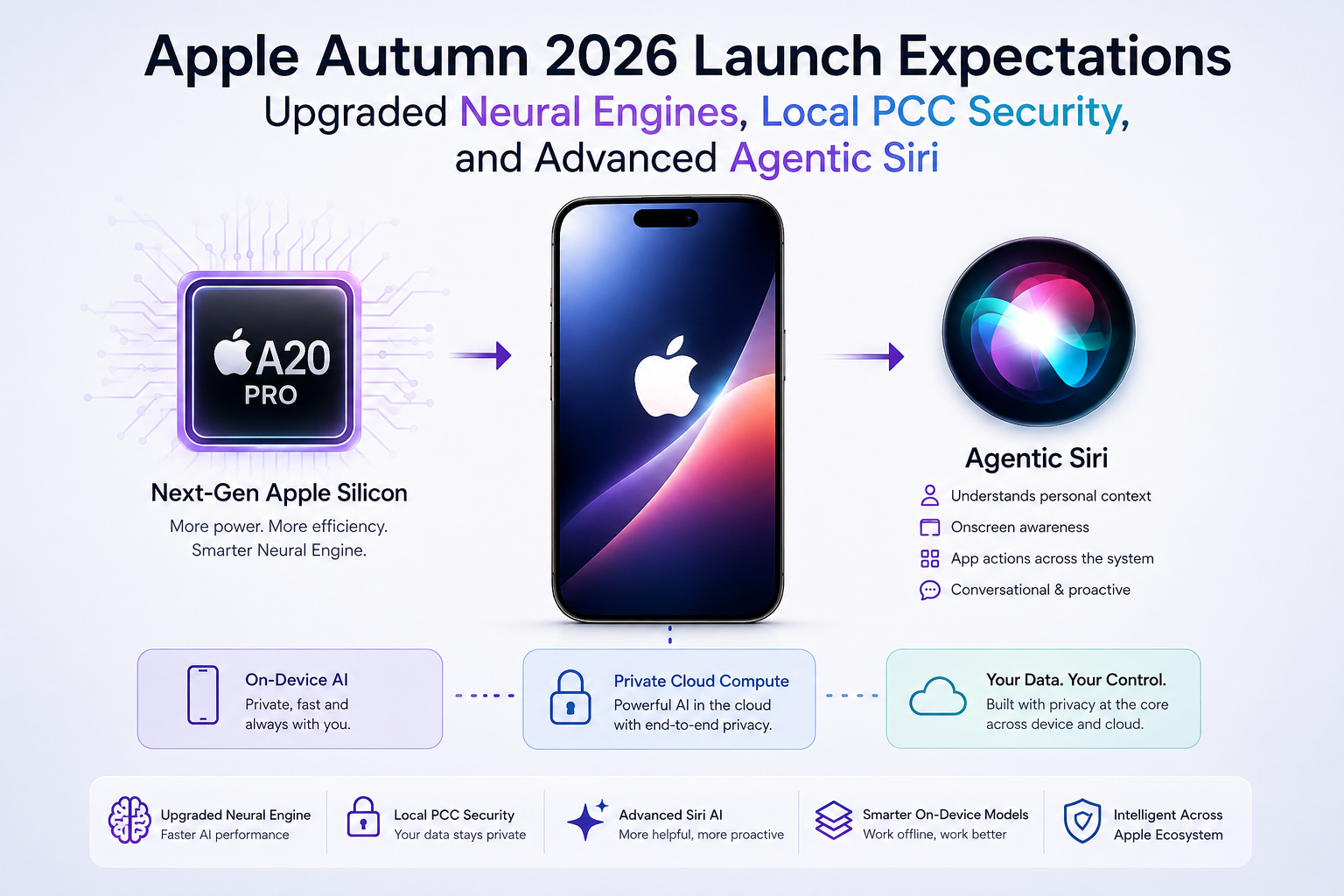
Apple’s Autumn 2026 launch cycle could become one of the company’s most important AI moments yet.
For years, Apple has approached artificial intelligence differently from many of its competitors.
While OpenAI, Google, Anthropic, and others have concentrated heavily on massive cloud-based AI models, Apple has increasingly emphasized a hybrid architecture built around:
On-device AI + Apple silicon + Private Cloud Compute + deeply integrated personal context.
That strategy is becoming much clearer in 2026.
Apple has already introduced its next generation of Apple Intelligence and an entirely rebuilt Siri AI, alongside third-generation Apple Foundation Models and expanded Private Cloud Compute capabilities.
The next question is hardware.
With Apple's autumn product cycle approaching, attention is shifting toward the expected next generation of iPhones and Apple silicon—and how new hardware could strengthen Apple's increasingly agentic AI architecture.
So what should we expect?
Let's separate what Apple has already confirmed from what remains expected for Autumn 2026.
Apple’s AI Strategy Is Moving Beyond the Chatbot
The biggest change in Apple's AI strategy isn't simply a smarter Siri.
It is the architecture behind Siri.
Traditional digital assistants generally followed a simple model:
User command → Intent recognition → Fixed action
For example:
“Set an alarm for 7 AM.”
or:
“Call John.”
Generative AI assistants introduced a more flexible model:
User request → Language model → Generated response
But agentic AI introduces another level.
An agent needs to understand the user's objective, gather information, choose tools, execute actions and potentially maintain context across multiple steps.
Apple's new Siri AI moves significantly closer to this model.
The result could transform Siri from primarily a voice interface into something closer to a personal AI agent embedded across Apple's operating systems.
1. Siri AI: Apple's Move Toward Agentic Computing
Apple has already confirmed a major redesign of Siri.
The new Siri AI is built around Apple Intelligence and Apple's latest Foundation Models.
Its capabilities include:
- Personal context understanding
- Onscreen awareness
- Conversational interaction
- Searching information across apps
- Accessing information from messages, emails and photos
- Web knowledge
- Systemwide app actions
- Integration with Apple services
- Persistent conversation history
This represents a major architectural change.
Imagine telling Siri:
“Find the hotel reservation Sarah sent me, check when my flight arrives, and remind me when I should leave for the airport.”
Completing that request requires more than language generation.
Siri needs to understand several pieces of context:
Who is Sarah?
Which reservation is relevant?
What flight is the user taking?
When does it arrive?
What action should be created?
This is essentially an agent workflow.
2. Personal Context Could Become Apple's Biggest AI Advantage
One of Apple's strongest potential advantages in AI isn't necessarily having the world's largest model.
It is having access—when users permit it—to highly relevant personal context.
An iPhone may contain information across:
- Messages
- Photos
- Calendar
- Contacts
- Files
- Notes
- Reminders
- Safari
- Maps
- Apps
- Notifications
For a personal AI assistant, this information can be more useful than broad internet knowledge.
Consider the difference between asking a generic chatbot:
“When should I leave for my flight?”
and asking a context-aware personal agent.
The personal agent could potentially understand:
Your flight + your calendar + your current location + traffic + your preferences.
That is where AI moves from answering questions toward taking intelligent actions based on personal context.
Apple's operating-system integration gives the company an interesting position in this transition.
3. Apple Foundation Models Become the Intelligence Layer
Behind Apple Intelligence sits Apple's Foundation Models architecture.
Apple's third-generation Foundation Model family includes both on-device and server-side models.
This allows Apple to route AI workloads according to their complexity.
A simplified architecture could look like:
While a more complicated request could follow:
This hybrid architecture could become central to Apple's AI strategy.
Instead of treating cloud AI as the default, Apple can attempt to process tasks locally first and escalate more demanding workloads when necessary.
4. The Neural Engine Could Become Even More Important
One of the most interesting hardware questions for Apple's upcoming devices concerns the Neural Engine.
Apple has integrated dedicated machine-learning acceleration into its chips for years.
But generative AI changes the workload dramatically.
Modern AI systems increasingly require efficient execution of:
- Transformer models
- Multimodal models
- Image understanding
- Speech processing
- Embeddings
- Semantic search
- Language generation
- Personal-context retrieval
- Small AI agents
This means the Neural Engine is no longer simply accelerating isolated machine-learning features.
It is becoming part of the computational foundation for Apple's AI operating environment.
The expected next generation of Apple silicon could therefore place even greater emphasis on AI performance.
5. A20 and A20 Pro: AI Hardware to Watch
Current reports suggest Apple's next premium iPhones could use a new A20 Pro generation of silicon.
The exact Neural Engine architecture and AI performance remain unconfirmed until Apple formally announces the hardware.
However, the direction is important.
Apple's future chips will increasingly need to balance:
CPU performance
for application logic,
GPU performance
for graphics and parallel workloads,
and
Neural Engine performance
for AI inference.
For everyday users, the result may not appear as a benchmark number.
Instead, faster AI hardware could translate into:
- Faster Siri responses
- More local AI processing
- Better image understanding
- Improved speech recognition
- More sophisticated personal-context processing
- Lower latency
- Reduced dependence on cloud processing
The most important AI hardware race may therefore become less about raw TOPS and more about how much useful intelligence can run locally within the device's power and thermal limits.
6. Why On-Device AI Matters
On-device AI offers several advantages.
Privacy
Sensitive information can remain on the device instead of being transmitted to external servers.
Latency
Local inference can eliminate network round trips.
Offline Operation
Some AI capabilities can continue functioning without an internet connection.
Cost
Running inference locally reduces dependence on expensive cloud GPU infrastructure.
Personalization
Local models can potentially work more closely with information stored on the user's device.
This makes Apple's enormous installed base of devices strategically important.
Instead of thinking about every iPhone only as a smartphone, we can increasingly think about it as a personal edge-AI computer.
7. Private Cloud Compute Handles the Harder Problems
Not every AI task can efficiently run on a smartphone.
Complex reasoning, large context windows and demanding generative workloads may require significantly more compute.
Apple's solution is Private Cloud Compute (PCC).
Private Cloud Compute allows supported AI workloads to move from the device to Apple's server infrastructure while maintaining strict privacy protections.
Apple says personal data processed through PCC isn't stored or made accessible to Apple.
This creates a hybrid AI architecture:
On-device model
when specialized capabilities are required.
Rather than choosing between edge AI and cloud AI, Apple is attempting to combine both.
8. Private Cloud Compute Is Not “Local” AI
There is an important distinction.
Private Cloud Compute should not be confused with on-device processing.
PCC still uses remote server infrastructure.
The difference is in how that infrastructure is designed.
Apple built PCC around privacy guarantees intended to prevent user data from becoming available to Apple or other parties.
Therefore Apple's AI architecture can be understood as two major privacy-oriented layers:
Layer 1 — On Device
Data remains on the user's hardware whenever possible.
Layer 2 — Private Cloud Compute
More demanding requests are processed using privacy-focused server infrastructure.
This hybrid model could become an important alternative to conventional cloud-first AI architectures.
9. Larger Context Windows Enable More Capable Agents
Apple has also expanded what its server-side Foundation Models can handle.
Private Cloud Compute models can provide stronger reasoning and substantially larger context capacity than Apple's local models.
Why does this matter?
Agentic AI often requires significant context.
Imagine Siri being asked:
“Review the emails about my Rome trip, compare the hotel options people sent me, check my calendar and suggest the best itinerary.”
The system potentially needs to process:
- Multiple emails
- Calendar events
- Travel information
- Personal preferences
- Maps data
- Previous conversation history
That requires considerably more context than a traditional voice command.
Larger-context models therefore become increasingly important as Siri evolves into an agent.
10. Siri Could Become a System-Level AI Orchestrator
The most interesting possibility is that Siri may increasingly become an orchestration layer rather than a single AI model.
A future request might move through something like:
This is very different from the old Siri architecture.
Siri becomes less like an application and more like an AI interface connecting the entire Apple ecosystem.
11. Agentic Apps Could Be Even Bigger Than Siri
Apple's AI ambitions extend beyond its own assistant.
The Foundation Models framework gives developers access to Apple Intelligence capabilities.
Developers can build experiences involving:
- Structured generation
- Tool calling
- Semantic search
- Image understanding
- Dynamic model selection
- On-device models
- Private Cloud Compute models
This opens the door to agentic applications running across Apple's ecosystem.
Imagine a travel application that can:
- 1. Understand your destination.
- 2. Search available options.
- 3. Read itinerary information.
- 4. Use local context.
- 5. Recommend activities.
- 6. Update your travel plan.
Or a productivity application that can:
- 1. Analyze documents.
- 2. Extract action items.
- 3. Search related information.
- 4. Create tasks.
- 5. Generate summaries.
- 6. Maintain workflow context.
The important change is that apps no longer need AI only for generating text.
They can build AI systems capable of reasoning and using tools.
12. Apple's Model-Routing Strategy Is Particularly Interesting
Another emerging trend is dynamic model routing.
Not every task needs the largest AI model.
For example:
Simple summarization
→ On-device model
Image understanding
→ Multimodal local model
Complex reasoning
→ Private Cloud Compute
Specialized frontier task
→ External model
This approach can optimize:
- Performance
- Privacy
- Cost
- Energy consumption
- Latency
- Capability
Model routing may become one of the defining architectural patterns of next-generation AI applications.
Apple's combination of hardware, operating systems, Foundation Models and Private Cloud Compute provides the company with an unusually integrated environment for implementing it.
13. The iPhone Is Becoming an Edge AI Platform
The broader transformation is easy to miss.
Smartphones were originally communication devices.
They evolved into application platforms.
Now they are becoming AI computing platforms.
The next-generation iPhone architecture could increasingly resemble:
This gives Apple something cloud-first AI companies cannot easily replicate:
deep integration between hardware, operating system, personal context and AI inference.
14. What We Should Watch at Apple's Autumn 2026 Launch
When Apple unveils its next hardware generation, AI enthusiasts should look beyond traditional specifications such as camera resolution or CPU performance.
The most interesting questions may be:
Neural Engine
Has Apple significantly increased AI inference capability?
Memory
Has system memory increased to support larger local models?
Local Models
Can more sophisticated Apple Foundation Models run entirely on the device?
Energy Efficiency
How efficiently can AI workloads run continuously?
Siri AI
Which capabilities are available immediately?
Private Cloud Compute
How frequently do complex requests require cloud processing?
Agentic Actions
How deeply can Siri interact with third-party applications?
Developer Access
How easily can developers build their own agentic experiences?
These factors may tell us much more about Apple's future than traditional smartphone benchmarks.
15. Apple vs. Google vs. OpenAI: Different AI Strategies
The AI platform competition is increasingly producing different architectural philosophies.
OpenAI
has traditionally emphasized powerful frontier models and cloud-based AI agents.
combines Gemini models, cloud infrastructure, Android and increasingly capable on-device AI.
Apple
is emphasizing deep device integration, personal context, privacy-oriented computing and hybrid local/cloud inference.
The competition may therefore become:
Who builds the smartest model?
combined with:
Who builds the best environment for AI agents?
That second question could become increasingly important.
What Is Confirmed vs. What Is Expected?
Because Apple's Autumn 2026 hardware event has not yet taken place, it is important to separate confirmed developments from expectations.
Apple Has Confirmed
- Next-generation Apple Intelligence
- Siri AI
- Third-generation Apple Foundation Models
- On-device Foundation Models
- Private Cloud Compute Foundation Models
- Personal-context understanding
- Onscreen awareness
- Systemwide app actions
- Agentic capabilities for developers
- Expanded Private Cloud Compute access
Currently Expected or Rumored
- Next-generation A20/A20 Pro chips
- Further Neural Engine improvements
- New premium iPhone hardware
- Greater hardware optimization for local AI
- Additional improvements to AI efficiency
Specific hardware specifications should remain treated as expectations until Apple formally announces them.
Why Autumn 2026 Could Mark a Turning Point
The smartphone industry spent years competing over:
Cameras.
Then:
Displays.
Then:
CPU and GPU performance.
The next competition could revolve around:
Personal AI computing.
The winning device may not simply have the fastest processor.
It may be the device that can understand the user's context, privately process personal information, reason across applications and reliably execute actions.
Apple's approach combines several important pieces:
Apple Silicon + Neural Engine + Foundation Models + Private Cloud Compute + Siri AI + Personal Context + Apps
Together, these components create something much larger than another chatbot.
They create the foundation for a personal AI agent platform.
Final Thoughts
Apple's Autumn 2026 launch should be watched as more than another iPhone upgrade cycle.
The more important story is the convergence of Apple's hardware and AI architectures.
Apple now has on-device Foundation Models for local intelligence, Private Cloud Compute for demanding workloads, developer frameworks for agentic applications, and an entirely redesigned Siri built around personal context and tool use.
The next generation of Apple silicon could strengthen the final piece of that architecture: local AI compute.
If Apple succeeds, Siri's evolution may represent something larger than a better voice assistant.
It could mark Apple's transition from the smartphone era toward the era of the personal AI operating system.
And in that future, the most important feature of your iPhone may not be what you can do with it.
It may be what your iPhone can intelligently do for you.