Salesforce Koa Explained: Why CRM Now Needs Its Own Reasoning Model
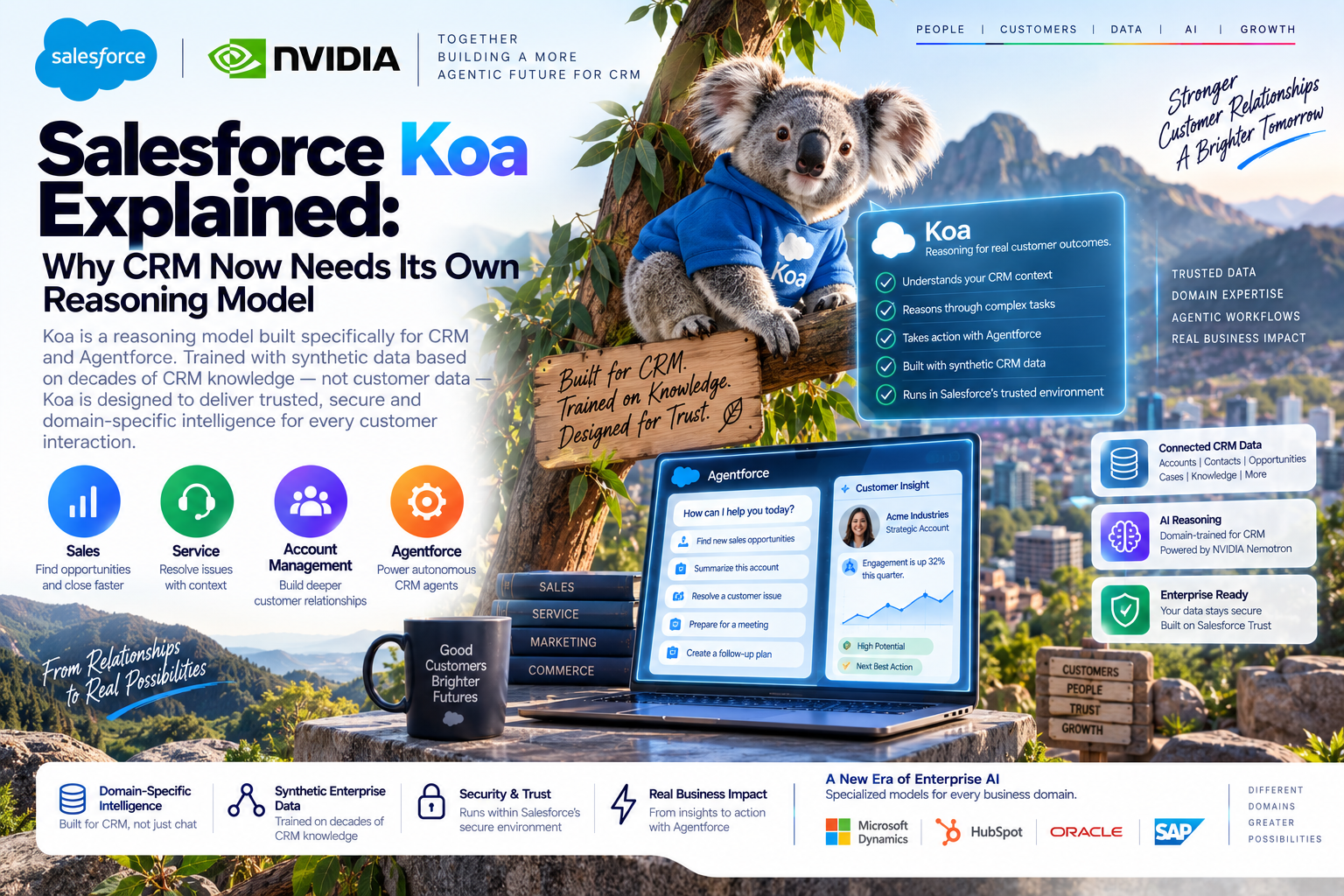
Salesforce Koa is a specialized reasoning model for Agentforce, built by adapting NVIDIA Nemotron 3 Super to the multi-step work inside customer relationship management. Its significance is larger than one model launch: enterprise software may be moving from general AI assistants toward domain-trained systems that understand the rules, tools, and consequences of a particular business function.
Quick Take
- Koa is Salesforce's first CRM reasoning model. It is based on NVIDIA Nemotron 3 Super and post-trained for multi-turn, tool-using Agentforce workflows.
- The training approach is synthetic. Salesforce says no customer data was used to train Koa; simulated workflows represent sales, service, commerce, and other enterprise tasks across more than 14 industries.
- The model stays inside Salesforce's trust boundary. Salesforce controls the weights and infrastructure, while customers decide which records, grounding data, and instructions an agent may use.
- Early results require caution. The published gains come from Salesforce's own CRM Bench and have not yet established independent, broad production performance.
- Koa signals a hybrid future. General models can handle broad language and knowledge, while domain-specific models manage repeatable processes that demand consistent tool use and policy compliance.
What Is Salesforce Koa?
Announced by Salesforce and NVIDIA on 15 September 2026, Koa is a reasoning model for Agentforce. Salesforce adapted NVIDIA's open Nemotron 3 Super model through supervised fine-tuning and reinforcement learning. The objective was governed CRM work, not universal intelligence.
A useful CRM agent must do more than draft an email. It may inspect an account, apply a qualification rule, choose an approved action, update an opportunity, schedule follow-up, and explain when an action is unavailable. Koa is intended to handle that sequence within Salesforce permissions and workflows.
Koa is used in Salesforce employee workflows and is moving through customer pilots. It can be selected as a managed model, enabled as an Agentforce provider, or assigned at agent and sub-agent level. Nemotron is open, but Salesforce has not said Koa's proprietary data or adapted weights are available for unrestricted use.
Why CRM Needs Specialized Reasoning
CRM work combines language with state, policy, permissions, and action. A lead must satisfy company criteria; a service case requires the correct record, entitlement, escalation, and follow-up. Small reasoning errors can create duplicate outreach, incorrect discounts, unauthorized refunds, or damaged relationships.
| Dimension | General-purpose LLM | Domain-specific CRM model |
|---|---|---|
| Strength | Broad knowledge, flexible writing, open-ended research, and unfamiliar tasks. | Repeated CRM processes, tool selection, policy-shaped decisions, and workflow consistency. |
| Reasoning pattern | Often reconstructs the task from instructions and context each time. | Post-training reinforces common sequences, boundaries, and recovery behavior. |
| Enterprise fit | Requires grounding, orchestration, permissions, and strong application controls. | Still requires those controls, but the model is optimized for the surrounding platform. |
| Main risk | Inconsistent action choice or confident improvisation in an unfamiliar process. | Over-specialization, hidden assumptions in synthetic data, and weaker performance outside its domain. |
| Best architecture | Use for broad analysis, content, and tasks requiring wide world knowledge. | Use for bounded, high-volume CRM actions, with routing between models when needed. |
How Synthetic Enterprise Training Works
Synthetic data lets a company rehearse business processes without copying real customer conversations into training. Salesforce modeled personas, requests, tools, policies, and expected outcomes, then let the model attempt workflows repeatedly. Scoring rewarded successful resolution and appropriate tool use.
Synthetic Does Not Automatically Mean Neutral
Simulations can preserve designers' assumptions about qualification, resolution, and escalation. Organizations should review scenario coverage, protected-group impacts, language diversity, exceptions, and whether rewards favor speed over fairness or customer welfare.
How Koa Fits Into Agentforce
Koa is a reasoning component, not a complete autonomous worker. Agentforce supplies identity, CRM context, instructions, tools, permissions, orchestration, guardrails, and escalation. Salesforce also uses smaller models for classification, evaluation, safety screening, and reranking. A router can send a narrow task to a narrow model, a CRM process to Koa, and an open problem to a frontier model.
Research an account, qualify a lead against an approved playbook, update an opportunity, recommend a next step, and schedule follow-up.
Gather case context, check entitlement and policy, call the right service action, document the outcome, or transfer with a useful summary.
Combine relationship history, open cases, product usage, and renewal milestones to prepare a review or flag an account for human attention.
Investigate order issues, coordinate approved remedies, route exceptions, and keep records synchronized across a multi-step process.
Data Security: What The Trust Boundary Does And Does Not Mean
Salesforce says no customer data was used to train Koa and that post-training and inference run inside infrastructure it operates. Customer data and reasoning traces are not used to improve the model, according to the company. This can reduce exposure to an external model provider and gives Salesforce control over weights, serving, and safety layers.
Koa can still process authorized customer records and grounding information at inference. Security depends on field-level access, least-privilege tools, tenant isolation, retention, regional processing, encryption, logs, and configuration. Salesforce says temperature-zero hosting makes responses more repeatable; that is not guaranteed correctness.
Benchmark Claims Need Independent Context
Salesforce reports that Koa matches or exceeds leading models on its CRM Bench tasks with three times fewer errors. It also publishes gains in action precision, context reliability, and long-conversation memory. These are promising signals because the benchmark includes practical actions such as updating an opportunity, routing a case, and scheduling a follow-up.
However, CRM Bench is a Salesforce-created evaluation and the public claims do not yet provide everything a buyer needs for comparison. Teams should ask for task definitions, comparator versions, error severity, latency, token and infrastructure cost, multilingual results, repeated-run variance, prompt-injection tests, and performance on their own permissions and custom objects. A pilot should measure completed business outcomes, not only answer quality.
What Koa Means For Microsoft, HubSpot, Oracle, And SAP
| Platform | Existing strategic advantage | Pressure created by Koa |
|---|---|---|
| Microsoft Dynamics 365 | Copilot, autonomous agents, Microsoft Graph context, and extensibility through Power Platform and Copilot Studio. | Show whether model routing and domain adaptation can deliver equally consistent CRM actions across Microsoft's business stack. |
| HubSpot | Breeze agents, Smart CRM data, accessible agent building, and strong usability for growing businesses. | Balance simplicity with deeper reasoning for multi-step sales and service work without making deployment costly or complex. |
| Oracle | Fusion CX, embedded AI, enterprise data, and links across finance, supply chain, service, and industry applications. | Turn cross-suite process knowledge into measurable domain intelligence with transparent controls and benchmarks. |
| SAP | Joule, Sales Cloud, and deep process context spanning ERP, supply chain, finance, and customer experience. | Demonstrate specialized reasoning that connects front-office decisions with the operational system of record. |
Koa does not prove that Salesforce has won enterprise AI. It changes the question vendors must answer: not only which frontier model they offer, but what proprietary process knowledge they can safely encode into models, how those models are evaluated, and when customers can choose another provider.
Production Readiness Checklist
- Start in shadow mode. Compare Koa's proposed actions with trained employees before permitting record changes.
- Define an action matrix. Separate read-only tasks, reversible updates, approval-required actions, and prohibited decisions.
- Test your own workflow. Include custom objects, sparse records, conflicting policies, multilingual inputs, and unavailable tools.
- Measure serious errors. Weight an unauthorized refund or discriminatory decision more heavily than a formatting mistake.
- Protect tools from injection. Treat customer text, emails, attachments, and retrieved web content as untrusted input.
- Preserve accountability. Log the model, instructions, data access, tool calls, approvals, outcome, and rollback path.
- Confirm commercial reality. Validate regional availability, pricing, latency, support, data terms, and exit options before scaling.
EU AI Act, GDPR, And Responsible CRM Agents
A CRM reasoning model is not automatically a high-risk AI system under the EU AI Act. Classification depends on the intended use. Routine sales assistance may carry lower regulatory risk, while workflows affecting employment, access to essential services, creditworthiness, insurance, healthcare, or public services can trigger stricter requirements or other sector rules.
- Disclose AI interaction. When a customer directly communicates with an AI agent, provide clear notice and a practical human route. Article 50 transparency rules apply from 2 August 2026.
- Map the legal role. Document whether the organization is a provider, deployer, or both after configuring an agent for a particular purpose.
- Apply GDPR controls. Establish a lawful basis, minimize CRM fields, restrict sensitive data, set retention, manage data-subject rights, and conduct a DPIA where risk warrants it.
- Review consequential decisions. Do not allow a sales or service agent to become an unexamined credit, eligibility, pricing, or employment decision system.
- Maintain human oversight. Give reviewers enough context and authority to challenge, stop, correct, or reverse an action.
Compliance depends on the full deployment, not the model name or vendor statement. Organizations should assess data flows, integrations, affected people, jurisdiction, contracts, and sector-specific duties with qualified advisers.
MaGeN-AI View
Specialized Models Will Complement General Models
Koa's strongest idea is not that every CRM task needs one Salesforce model. It is that enterprise AI should route work to the most appropriate intelligence: small models for classification and screening, a CRM reasoning model for governed actions, and general frontier models for broad analysis or unfamiliar problems.
The winners will be platforms that combine domain expertise with model choice, credible evaluation, secure execution, and human accountability. For buyers, the right test is simple: does specialization improve real outcomes without creating unacceptable lock-in, opacity, or risk?
FAQ
What is Salesforce Koa?
Salesforce Koa is a CRM reasoning model for Agentforce. It is built by post-training NVIDIA Nemotron 3 Super for multi-step enterprise workflows involving CRM context, policies, and tools.
Was Koa trained on Salesforce customer data?
Salesforce says no customer data was used to train Koa. Its post-training corpus uses synthetic scenarios designed to represent CRM processes across more than 14 industries.
How does Koa work with Agentforce?
Koa can be selected as a managed model, an organization-level Agentforce provider, or a model for an individual agent or sub-agent. Agentforce supplies data grounding, tools, permissions, and orchestration.
Is Salesforce Koa generally available?
As of 19 September 2026, Koa is available to select pilot customers. Salesforce expects general availability in U.S. regions during winter 2026, so organizations should confirm current availability before planning deployment.
Will Koa replace general-purpose AI models?
Probably not. Koa is optimized for governed CRM work, while general models remain useful for broad research, writing, and unfamiliar tasks. A hybrid routing architecture is the more likely enterprise pattern.