Claude for Biomolecular Modeling: How AI Sped Up 30 Scientific Models by 4×
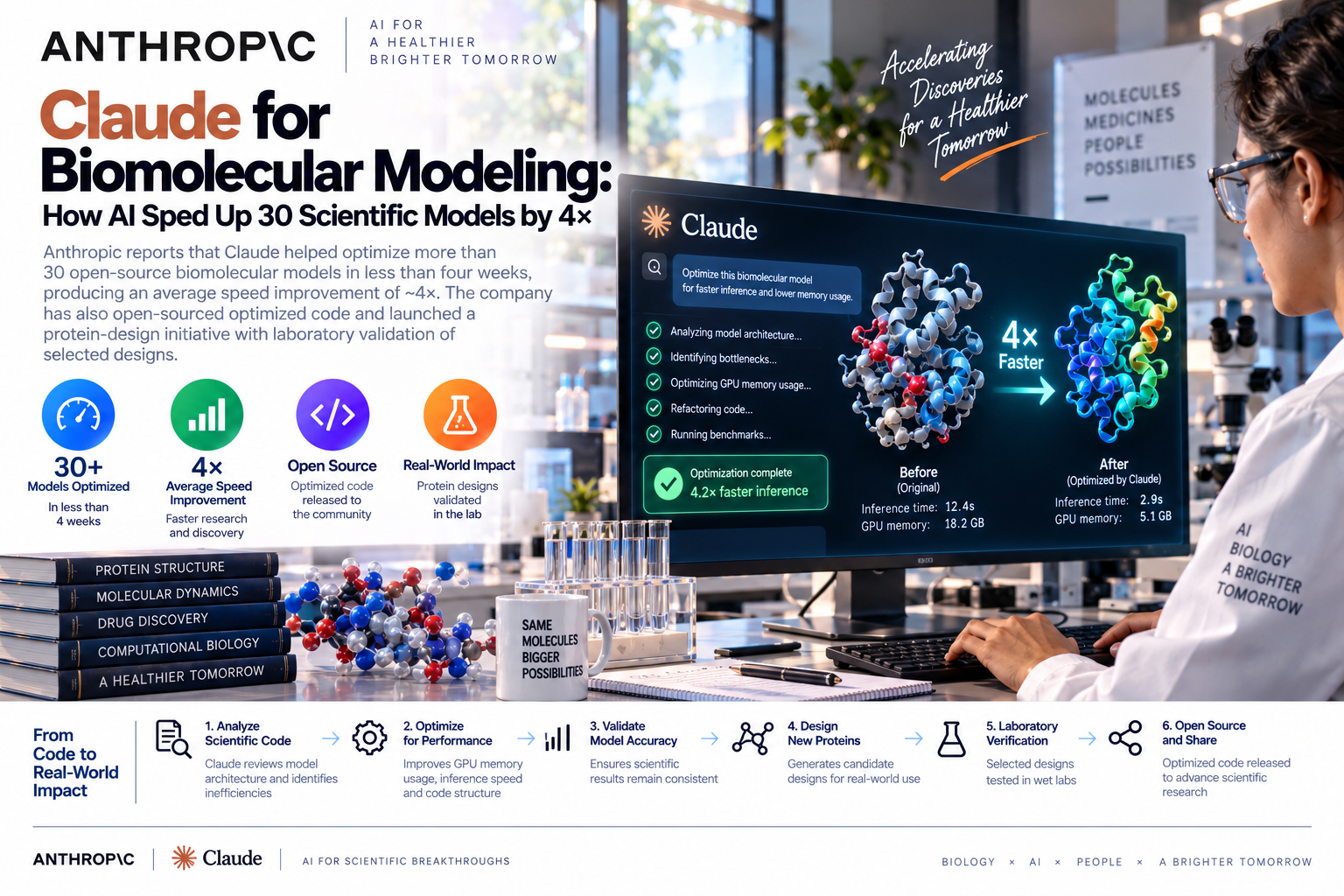
Claude biomolecular modeling is a practical example of AI improving the software that scientists already use. Anthropic reports that a supervised Claude research system optimized more than 30 open-source biology models in under four weeks, reducing inference time and GPU memory while exposing the limits that still require scientific and laboratory validation.
Quick Take
- This was an engineering project, not a drug discovery claim. Claude inspected scientific code, found bottlenecks, produced GPU kernels, and proposed model-specific inference changes under human supervision.
- The headline 4× improvement involves a trade-off. Anthropic reports roughly fourfold average acceleration with small numerical differences, while modes preserving identical outputs delivered closer to a twofold gain overall.
- Memory efficiency expanded the possible input size. A low-memory mode accurately modeled some systems above 10,000 molecular tokens on one GPU node, although much larger demonstrations completed without producing correct structures.
- The code is available, but reproducibility is not automatic. Hardware, drivers, model weights, numerical precision, seeds, upstream licences, and biological benchmarks must all be controlled.
- Wet-lab evidence remains decisive. A strong computational score can prioritize a protein design; it cannot prove binding, selectivity, stability, safety, or therapeutic benefit.
What Biomolecular Models Actually Calculate
Biomolecular AI models turn biological representations into predictions or new designs. They do not all solve the same problem, and faster execution has different scientific meaning for each model class.
| Model category | Typical calculation | Research value | Important limitation |
|---|---|---|---|
| Structure prediction | Estimates a three-dimensional protein or molecular complex from sequences and chemical inputs. | Helps researchers study binding sites, interactions, and candidate mechanisms. | A predicted structure is a hypothesis and can be wrong, especially outside training-like examples. |
| Protein design | Generates structures or amino-acid sequences intended to satisfy a target shape or function. | Can propose binders, enzymes, delivery components, or research reagents. | Computational confidence does not establish expression, folding, binding, or safety. |
| Protein language model | Learns statistical patterns across large collections of amino-acid sequences. | Supports sequence generation, representation, fitness estimation, and annotation. | Patterns in sequence data may not capture cellular context or experimental conditions. |
| Genomics model | Analyzes DNA sequence to predict regulation, expression, variants, or other biological signals. | Helps prioritize experiments and interpret large genomic datasets. | Population bias, privacy, tissue context, and causal interpretation remain difficult. |
Why These Models Are Computationally Expensive
Modern structure models reason over relationships between many molecular tokens: amino acids, nucleotides, atoms, ions, and ligands. Pair-based operations can grow rapidly as a complex becomes larger. Anthropic highlights triangle attention and triangle multiplication, where doubling the system size can require roughly eight times more time and memory because the operations scale cubically.
Cost also comes from repeated refinement steps, diffusion or flow-matching iterations, ensembles, large intermediate tensors, and transfers between GPU memory and compute units. A model may be scientifically capable but impractical for smaller laboratories if one prediction consumes scarce accelerator time or exceeds available memory.
How Claude Examined And Improved Scientific Code
Two Anthropic technical staff members with biomolecular-modeling experience supervised the work. Claude analyzed each codebase, profiled expensive paths, generated candidate changes, ran tests, and iterated when an optimization failed. The reported changes included caching work that was being recomputed, replacing dead branches with constant results, reducing memory pressure, and developing custom GPU kernels.
A key result was FlashPairformer, a set of kernels for triangle attention and multiplication. Anthropic reports gains of 2.7–2.9× for triangle attention and 1.7–3.2× for triangle multiplication against its chosen field-standard implementation, depending on configuration. These are component-level results; complete-model acceleration varies by architecture and workload.
Exact, Fast, And Big Modes
| Mode | Purpose | Scientific interpretation | Recommended use |
|---|---|---|---|
| Off | Runs the pinned upstream implementation without the optimization kit. | Provides the reference for speed, memory, and outputs. | Baseline reproduction and regression testing. |
| Exact | Accelerates inference while preserving outputs identical to the reference mode. | Reduces one validation concern, although software and hardware compatibility still matter. | Start here for sensitive or already validated scientific pipelines. |
| Fast | Uses more aggressive optimizations with documented numerical differences. | Requires evidence that differences remain within acceptable variability and preserve downstream metrics. | High-throughput screening after task-specific validation. |
| Big | Reduces peak GPU memory and can divide one prediction across GPUs on a single host. | Successful execution at a larger size does not prove that the model generalizes correctly. | Large complexes, capability testing, and carefully reviewed research workloads. |
Does Faster Inference Preserve Scientific Accuracy?
Anthropic reports roughly 4× average acceleration with minimal precision loss and nearly 2× overall when outputs remain identical. For structure prediction, it says pooled interface-quality results from fast mode were statistically indistinguishable from the defaults. Those findings are encouraging, but they are produced by the project team and should be independently reproduced.
The large-system experiments show why multiple validation levels matter. Big mode accurately predicted selected molecular machines above 10,000 tokens on one GPU node. It also completed inference for systems above 70,000 tokens, but those structures collapsed and were incorrect. The software succeeded at running; the scientific model failed to generalize at that scale.
Four Separate Claims Must Be Tested
- Computational: Is the measured wall-clock speedup real on the target hardware?
- Numerical: Are output changes absent, bounded, or documented under the selected mode?
- Scientific: Are structure, interface, sequence, and task-specific metrics preserved on representative data?
- Experimental: Does the prediction hold when molecules are synthesized and measured in the laboratory?
From Claude AI Protein Design To Wet-Lab Validation
Anthropic also used the optimized tools to design de novo protein binders. A single Claude model received one NVIDIA H200, a 24-hour budget, and access to scientific tools. Across 16 targets, Anthropic reports in-silico scores comparable with its earlier agentic campaign while using about 100 times fewer GPU hours. This is a compute-efficiency result, not proof that the designs bind successfully in living or laboratory systems.
The next evidence is planned through a competition with Adaptyv Bio. More than 5,000 selected designs are expected to be synthesized and characterized, with positive and negative results published. Wet-lab testing can measure expression, folding, affinity, specificity, stability, and failure modes that computational scores cannot settle. Any path toward a medicine would then require substantially more preclinical, clinical, manufacturing, and regulatory work.
Reproducibility Of AI-Generated Scientific Code
Anthropic's repository improves auditability by supplying 36 drop-in kits with pinned upstream versions, dependency locks, separate stock and optimized code, hardware configurations, change logs, weight digests, and Docker or Apptainer routes. A visible activation message prevents an optimization from silently falling back to stock behavior.
Important caveats remain. The repository is a reference release, is provided as-is, and is not planned as a maintained project. Its original code uses Apache 2.0, while bundled upstream projects retain their own licences. Research teams must review every dependency, reproduce benchmarks, scan generated kernels, test new drivers and GPUs, and maintain their own supported fork if the code enters a long-lived pipeline.
Production And Research Readiness Checklist
- Reproduce stock mode first. Confirm the pinned model, weights, data, metrics, seeds, and hardware before measuring an optimization.
- Begin with exact mode. Establish a low-risk baseline before accepting floating-point changes for additional speed.
- Benchmark representative inputs. Include short and long sequences, complexes, ligands, uncommon residues, and known failure cases.
- Validate downstream science. Compare domain metrics and rank ordering, not only tensor-level similarity or average runtime.
- Review the code independently. Inspect custom kernels for correctness, memory safety, race conditions, unsupported shapes, and silent overflow.
- Record full provenance. Preserve code commit, weights digest, container, driver, GPU, parameters, prompt, generated patch, reviewer, and results.
- Keep laboratory gates. Use computational output to prioritize experiments, not as a substitute for biological evidence.
EU AI Act, Data Protection, And Responsible Science
The EU AI Act excludes AI systems and models developed and used solely for scientific research and development, and it also excludes pre-market research, testing, and development activities. That exclusion is not unlimited: real-world testing, commercial deployment, or integration into a regulated medical product can change the legal analysis, while medical-device, medicinal-product, clinical-trial, biosafety, and product-liability rules may still apply.
- Define the intended purpose. Separate exploratory research from clinical, diagnostic, treatment, or product decisions.
- Protect personal data. Genomic and patient-linked information can be sensitive personal data under GDPR; minimize it, control access, document lawful use, and assess high-risk processing.
- Maintain human scientific oversight. Qualified researchers should approve code changes, benchmark design, biological interpretation, and experimental progression.
- Document failures and negative results. Reproducible science requires reporting where acceleration changes results or where designed proteins fail testing.
- Apply biosafety and biosecurity review. Screen targets, generated sequences, tool access, and sharing decisions for harmful or dual-use potential.
This is general orientation rather than legal, medical, or laboratory-safety advice. Organizations should assess the complete use case with relevant scientific, regulatory, data-protection, and biosafety experts.
MaGeN-AI View
The Breakthrough Is Faster Scientific Iteration
The most credible interpretation is not that a chatbot replaced computational biologists. Claude acted as an AI scientific coding collaborator that helped two domain specialists optimize many heterogeneous repositories unusually quickly. Open code now lets others test whether that productivity transfers beyond Anthropic's environment.
For AI drug discovery, faster models can screen more ideas, test larger systems, and reduce compute barriers. The value becomes scientific only when speed is paired with reproducible outputs, appropriate benchmarks, expert review, and wet-lab evidence.
FAQ
What is Claude biomolecular modeling?
It refers here to Anthropic's use of Claude to inspect, optimize, and orchestrate open-source models for protein structure prediction, protein design, protein language modeling, and genomics.
Did Claude make biomolecular models four times faster?
Anthropic reports roughly 4× average acceleration when small numerical differences are allowed. Output-identical modes delivered lower but still substantial gains, and results vary by model and hardware.
Is the optimized scientific code open source?
Anthropic released 36 reference optimization kits. Its original optimization code is under Apache 2.0, while included upstream tools remain subject to their respective licences.
Did Claude discover a new drug?
No. The reported work accelerated scientific models and generated computational protein designs. Drug discovery requires experimental validation and extensive preclinical, clinical, manufacturing, and regulatory work.
Why is wet-lab validation still required?
A computational model cannot fully establish whether a designed protein expresses, folds, binds selectively, remains stable, avoids harmful effects, or works in a biological system.