Artificial Intelligence is becoming more capable every year, but many advanced AI features require cloud computing. While cloud AI offers powerful capabilities, it also raises an important question:
How can users trust that their personal information remains private?
Apple addresses this challenge through Private Cloud Compute (PCC)—a security architecture designed specifically for Apple Intelligence. Rather than treating privacy as an afterthought, PCC extends Apple's device-level security principles into the cloud.
In this article, we'll explore how Apple Private Cloud Compute architecture compares with standard cloud security models, what makes PCC unique, and why it represents a significant shift toward privacy-focused AI infrastructure.
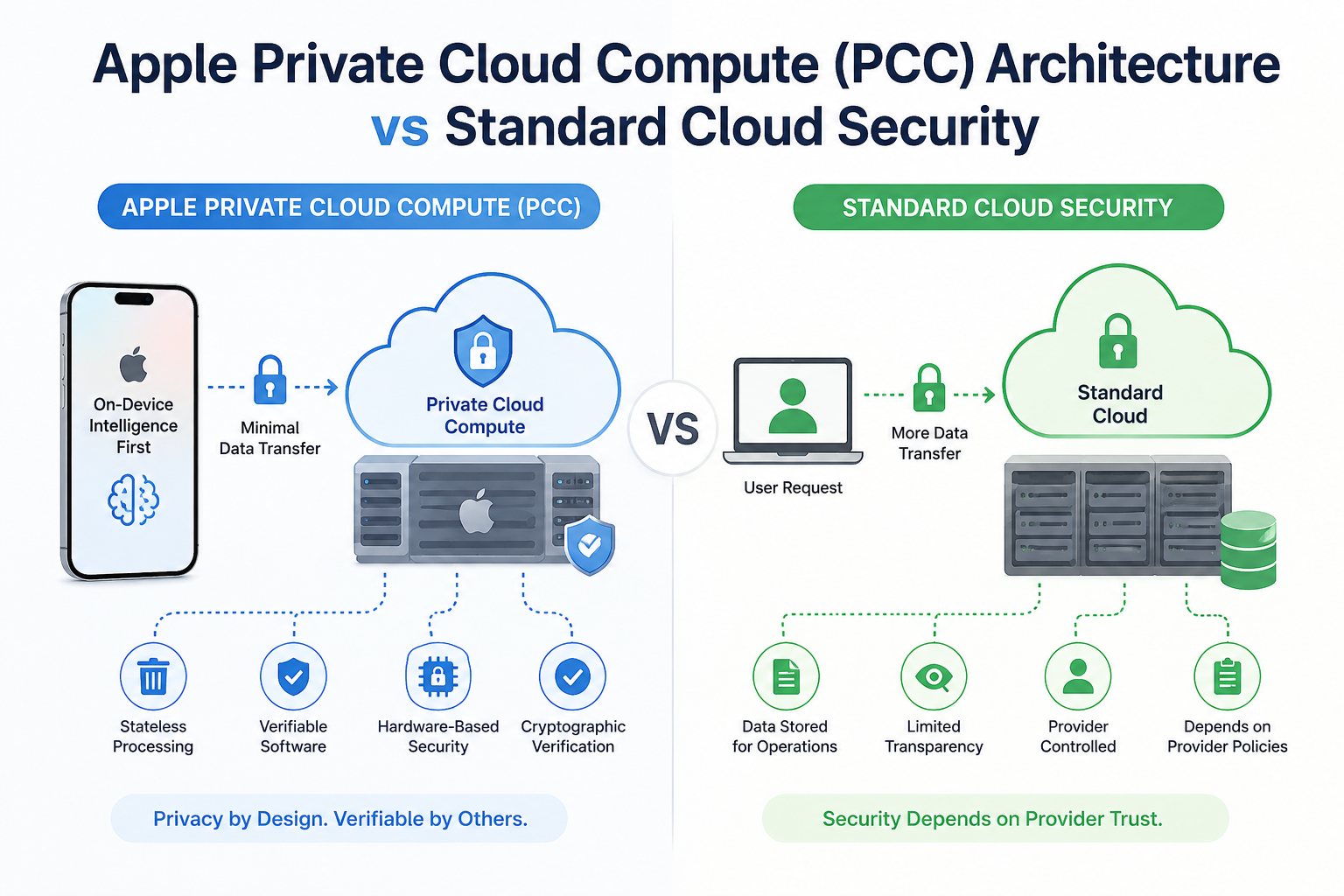
What Is Apple Private Cloud Compute?
Private Cloud Compute (PCC) is Apple's secure cloud infrastructure that processes complex AI requests when they cannot be handled directly on an iPhone, iPad, or Mac.
Instead of sending data to conventional cloud servers where it may be stored or analyzed, PCC is engineered to process information with minimal data exposure, verifiable software, and strong cryptographic protections.
The goal is simple:
Deliver cloud-scale AI performance without compromising user privacy.
Why Apple Created PCC
Modern AI assistants often require more computing power than mobile devices can provide.
Typical cloud services solve this by transferring user data to large data centers.
Apple wanted a different approach:
Keep as much AI processing on-device as possible
Send only necessary requests to the cloud
Prevent cloud operators from accessing user data
Allow independent experts to verify security claims
This philosophy resulted in Private Cloud Compute.
Standard Cloud Security Architecture
Most cloud platforms follow a familiar security model.
Typical Workflow
User sends a request.
Data travels to cloud servers.
Application processes the information.
Results are returned.
Logs, telemetry, or operational data may be retained according to service policies.
Most providers implement strong protections including:
Encryption in transit
Encryption at rest
Identity management
Access controls
Security monitoring
Compliance certifications
Threat detection
These are highly effective security practices.
However, the cloud provider generally controls:
Infrastructure
Operating systems
Processing environment
Administrative access
Data retention policies
Users must largely trust the provider's operational practices.
Apple PCC Architecture
Apple redesigns this trust model.
Instead of simply encrypting user data inside the cloud, PCC attempts to reduce how much trust users must place in the cloud itself.
Key principles include:
1. On-Device Processing First
Apple Intelligence always attempts to execute AI tasks locally.
Examples include:
Text rewriting
Image analysis
Notification summaries
Smart replies
Writing assistance
Only computationally intensive requests are sent to PCC.
This greatly reduces the amount of personal data leaving the device.
2. Minimal Data Transfer
PCC receives only the information necessary to complete a request.
Rather than uploading extensive user information, Apple aims to send the smallest possible dataset required for processing.
This reduces potential exposure if a request is intercepted or compromised.
3. Stateless Processing
A defining characteristic of PCC is stateless processing.
After completing an AI request:
user data is not retained for future processing,
the request is completed,
temporary processing data is discarded.
This differs from many cloud systems where logs or request metadata may be stored for operational purposes.
4. Verifiable Software
One of PCC's most distinctive features is software transparency.
Apple publishes information that allows independent security researchers to inspect and verify the software running on PCC servers.
This creates an additional layer of accountability beyond traditional security audits.
5. Hardware-Based Security
PCC servers use Apple-designed hardware security technologies that extend trusted execution concepts from Apple devices into cloud infrastructure.
These hardware protections help ensure that software executes in a controlled and secure environment.
6. Cryptographic Verification
Devices verify that they are communicating with genuine PCC servers before sending sensitive requests.
This helps prevent unauthorized infrastructure from impersonating Apple's cloud services.
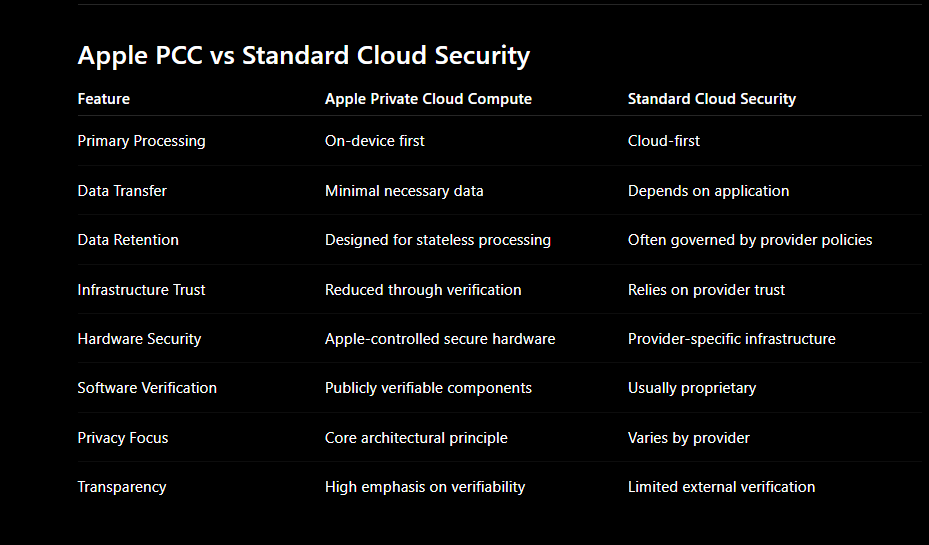
Security Advantages of PCC
Strong Privacy Protection
Sensitive information remains on the device whenever possible.
Cloud processing occurs only when required.
Reduced Attack Surface
Sending less information naturally lowers exposure to potential security risks.
Independent Verification
Researchers can inspect elements of PCC's software stack rather than relying solely on vendor claims.
This strengthens confidence in the platform.
Limited Data Persistence
Stateless request handling reduces the amount of user information available after processing is complete.
Where Standard Cloud Platforms Still Excel
Traditional cloud providers remain excellent choices for many enterprise workloads.
They offer:
Massive scalability
Multi-region deployments
Flexible APIs
Large AI ecosystems
Enterprise integrations
Data analytics platforms
Custom machine learning infrastructure
For organizations building AI products, these capabilities remain extremely valuable.
Potential Limitations of PCC
Like any architecture, PCC is designed for a specific purpose.
Potential considerations include:
Apple Ecosystem Focus
PCC primarily supports Apple Intelligence within Apple's ecosystem.
Limited Customization
Developers cannot deploy arbitrary workloads on PCC like they can on public cloud platforms.
Specialized AI Use Cases
PCC is optimized for privacy-sensitive AI tasks rather than general-purpose cloud computing.
Enterprise Implications
PCC introduces a new architectural pattern for AI systems.
Organizations developing privacy-sensitive applications may adopt similar principles:
Process data locally whenever possible
Minimize cloud transfers
Reduce data retention
Increase software transparency
Verify execution environments
Build security directly into system architecture
These ideas are increasingly relevant in regulated industries such as healthcare, finance, legal services, and government.
The Future of Privacy-Centric AI
As AI becomes more deeply integrated into everyday life, users expect both intelligent features and strong privacy protections.
Apple's Private Cloud Compute demonstrates that cloud AI does not necessarily require extensive data collection or long-term storage. By combining on-device intelligence with a privacy-focused cloud architecture, PCC offers a different model from conventional cloud computing.
While traditional cloud platforms continue to lead in scalability and flexibility, PCC highlights how security, transparency, and minimal data exposure can become foundational design principles for next-generation AI services.
The broader industry is likely to see more hybrid architectures that balance performance with stronger privacy guarantees.
Frequently Asked Questions
Is Apple Private Cloud Compute a public cloud?
No. PCC is a specialized cloud environment designed specifically for Apple Intelligence workloads and is not a general-purpose public cloud platform.
Does Apple store my AI requests in PCC?
PCC is designed around stateless processing principles, meaning requests are intended to be processed and then discarded rather than retained for future use.
How is PCC different from traditional cloud security?
Traditional cloud security focuses on protecting stored and processed data. PCC goes further by minimizing data transfer, reducing retention, and enabling independent verification of the software running in the cloud.
Can businesses use PCC for their own applications?
Currently, PCC is built to support Apple Intelligence rather than serving as a general cloud platform for third-party enterprise applications.
Final Thoughts
Apple Private Cloud Compute represents an evolution in cloud security architecture rather than simply another security feature. By prioritizing on-device intelligence, minimal data transfer, stateless processing, hardware-backed protection, and software transparency, PCC shifts the conversation from "trust the cloud" to "verify the cloud."
As AI adoption accelerates, architectures inspired by PCC may influence how future cloud services are designed—especially in sectors where privacy and trust are just as important as performance.
Tags
#Apple #AppleIntelligence #PrivateCloudCompute #PCC #CloudSecurity #CyberSecurity #AIInfrastructure #PrivacyFirstAI #SecureAI #ArtificialIntelligence #CloudComputing #DataPrivacy #ConfidentialComputing #EnterpriseAI #TechInnovation #AIArchitecture #FutureOfAI #MachineLearning #Technology #AISecurity