GPT-6 Sol vs GPT-6 Luna: OpenAI’s New Models Make Frontier AI Dramatically Cheaper
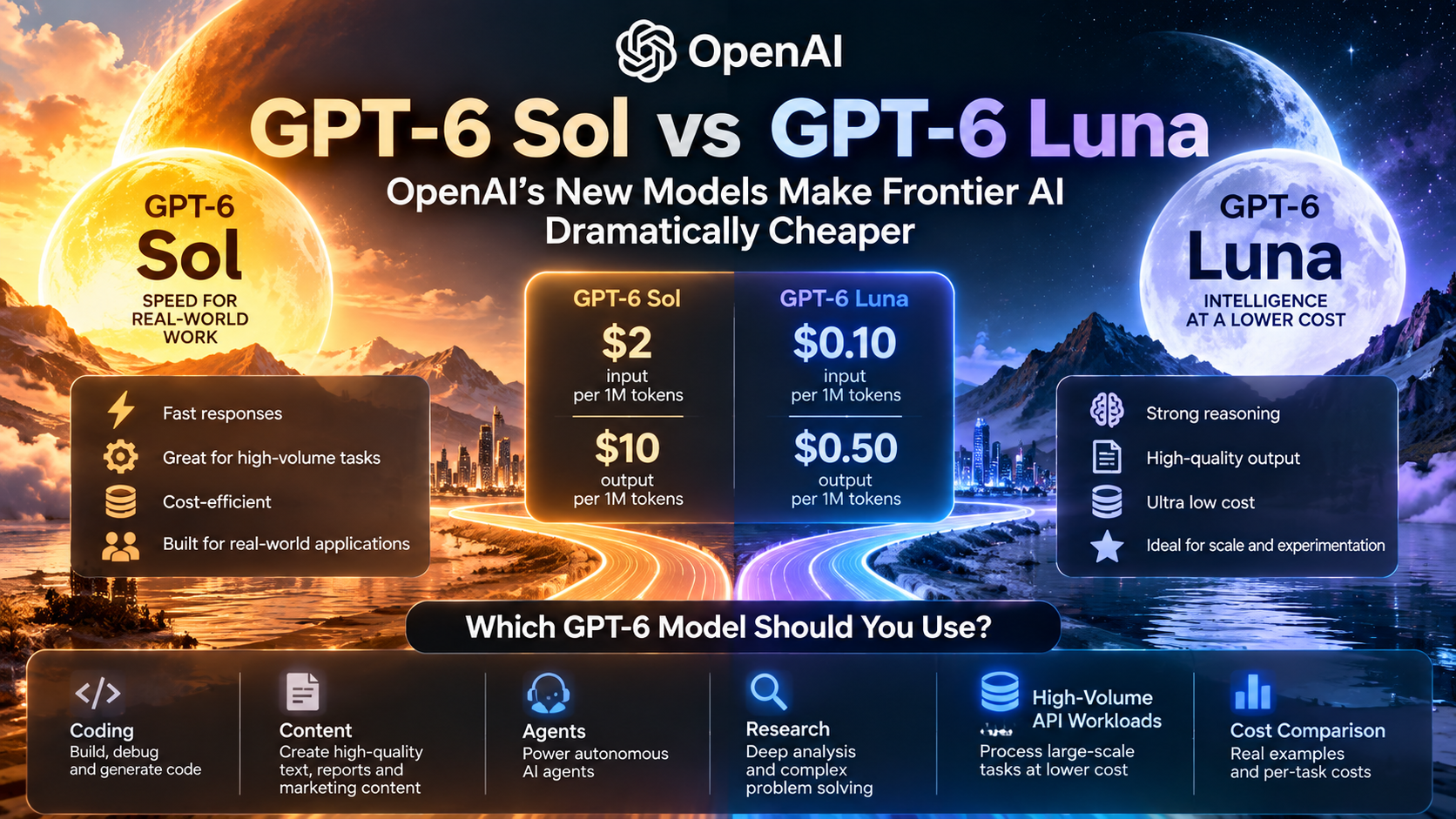
GPT-6 Sol and Luna make different trade-offs. Sol targets harder coding and agent work; Luna is the low-cost choice for repeatable, high-volume tasks. Here is how to choose using task quality and real API math.
Quick Take
- Choose Sol for complexity: code, longer agent runs and tasks where failure is costly.
- Choose Luna for throughput: classification, structured extraction, simple replies and first-pass triage, after evaluation.
- Standard short-context API rates: Sol $2 input / $10 output; Luna $0.10 / $0.50 per million tokens.
- Never use price alone: retries, human repair, caching, tool fees and long-context tiers change the final cost.
What Changed in the GPT-6 Lineup?
OpenAI’s September 22 model expansion gives developers clearer economic tiers. Its model catalog positions GPT-6 Sol for complex coding and agentic workflows, GPT-6 Luna for efficient, repeatable high-volume work and GPT-6 Astra for especially demanding tasks. These names are not quality guarantees; all three require workload-specific testing.
OpenAI’s API pricing page lists standard short-context input/output prices of $2/$10 for Sol, $0.10/$0.50 for Luna and $10/$50 for Astra, per million tokens. Prices can change; check the live rate card, processing tier, region and context length when budgeting.
Which GPT-6 Model Should I Actually Use?
| Workload | First model to test | Reason and fallback |
|---|---|---|
| Software debugging and larger code edits | Sol | Compare Astra if bug complexity or failed attempts make Sol expensive. |
| Simple content drafts and tagging | Luna | Use editorial review; promote ambiguous cases to Sol. |
| Research requiring careful synthesis | Sol | Use source retrieval and citations; consider Astra for difficult reasoning. |
| Customer-service triage at scale | Luna | Escalate sensitive or low-confidence cases to people or Sol. |
| Multi-step tool-using agent | Sol | Astra may win if reliability outweighs higher token cost. |
| Complex architecture or high-stakes analysis | Astra | Verify outputs with expert review; model capability does not confer authority. |
These are trial starting points, not automatic prescriptions. Content production still needs originality checks, claims verification and publisher approval. For agents, test actual completion, permissions and safe cancellation—not just whether the model appears fluent in a demo.
Cost-per-Task Example You Can Recalculate
Suppose a request uses 10,000 input tokens and produces 2,000 output tokens at standard short-context rates. Sol costs about $0.04 ($0.02 input plus $0.02 output). Luna costs about $0.002 ($0.001 plus $0.001). Astra costs about $0.20. For 10,000 identical tasks, that is approximately $400, $20 or $2,000 respectively.
This example excludes cached input, long-context rates, tools, background execution, retries, images, audio, regional uplifts and staff review. One failed Sol run followed by an Astra retry costs more than a single call. Equally, a cheap Luna response that needs manual correction can erase any token saving. Calculate cost per accepted outcome, not cost per generated answer.
What About GPT-5.6 and ChatGPT Subscriptions?
If you currently use GPT-5.6, do not assume the successor is an automatic drop-in replacement. Compare instruction following, output length, function calls, latency and tests on a frozen evaluation set. Pin model versions when possible, record migration changes and run a small controlled rollout before switching production traffic.
API usage charges are separate from ChatGPT plan pricing and availability. A model accessible in a paid ChatGPT workspace may have different limits and tools than the API version. Before committing to a vendor, confirm your organization’s data handling, region, access tier and whether the model supports the modalities or tool calls your application needs.
A Practical Routing Pattern for AI Agents
Classify a ticket, extract fields or generate a bounded summary with an auditable schema.
Handle code edits, multi-document questions and agent work that needs deeper reasoning.
Reserve premium capacity for complex recovery or cases with a measurable quality gain.
Require approval before sending messages, making purchases, modifying records or giving regulated advice.
Set a measurable threshold for escalation: validation failure, missing source, low confidence or an exceeded step budget. Do not create a silent retry loop that wastes tokens and hides errors. Preserve a log of which model processed a task, why it escalated and what action ultimately occurred.
Benchmarking Beyond a Pricing Chart
Build at least three representative test baskets: high-volume routine requests, difficult edge cases and complete agent workflows. Score factual accuracy, schema validity, latency, total cost, escalation and human correction. Keep tool access and retrieval sources identical where possible, or state clearly when a comparison includes different orchestration layers.
The model that wins on raw tokens may lose after operational costs. Conversely, a cheaper model can be the best choice for millions of simple decisions if failures are recognized and routed safely. Re-test as provider models, rate cards and your own product requirements change.
EU AI Act, Privacy and Responsible Deployment
When AI processes employee, customer or special-category data, assess GDPR lawful basis, minimization, retention and processor terms before optimizing model price. Under the EU AI Act, system duties depend on intended use and deployment context, not whether the model is called Sol, Luna or Astra. A low-cost model used for recruitment or healthcare requires a very different assessment from one formatting internal notes. Review transparency, human oversight and evidence of accuracy for consequential deployments.
For transparency requirements, see European Commission guidance on AI transparency. This overview is general information, not legal, medical or regulatory advice; assess the specific use case with qualified professionals.
MaGeN-AI View
The Takeaway
The interesting development is not simply that Luna is cheap. It is that teams can route work intelligently: Luna handles the routine flow, Sol handles the difficult middle and Astra handles truly expensive failures or novel tasks. The better the evaluation and escalation design, the more realistic the savings.
Frequently Asked Questions
How much does GPT-6 Sol cost?
The listed standard short-context API rate is $2 per million input tokens and $10 per million output tokens; check OpenAI’s current pricing page.
How much does GPT-6 Luna cost?
The listed standard short-context API rate is $0.10 per million input tokens and $0.50 per million output tokens, before other charges.
Is Sol always better than Luna?
No. Sol targets more complex tasks, but Luna may be sufficient and far cheaper for validated, repetitive work.
Does the API price include ChatGPT?
No. API rates and ChatGPT subscription prices, availability and usage limits are separate.
Which model is best for AI agents?
Start with Sol for complex workflows, then test Astra for hard cases and Luna for well-bounded subtasks; enforce tool permissions and approvals.