Claude Opus 5.5 Explained: Anthropic’s New Model Cuts Costs 40% While Taking on Massive Coding Projects
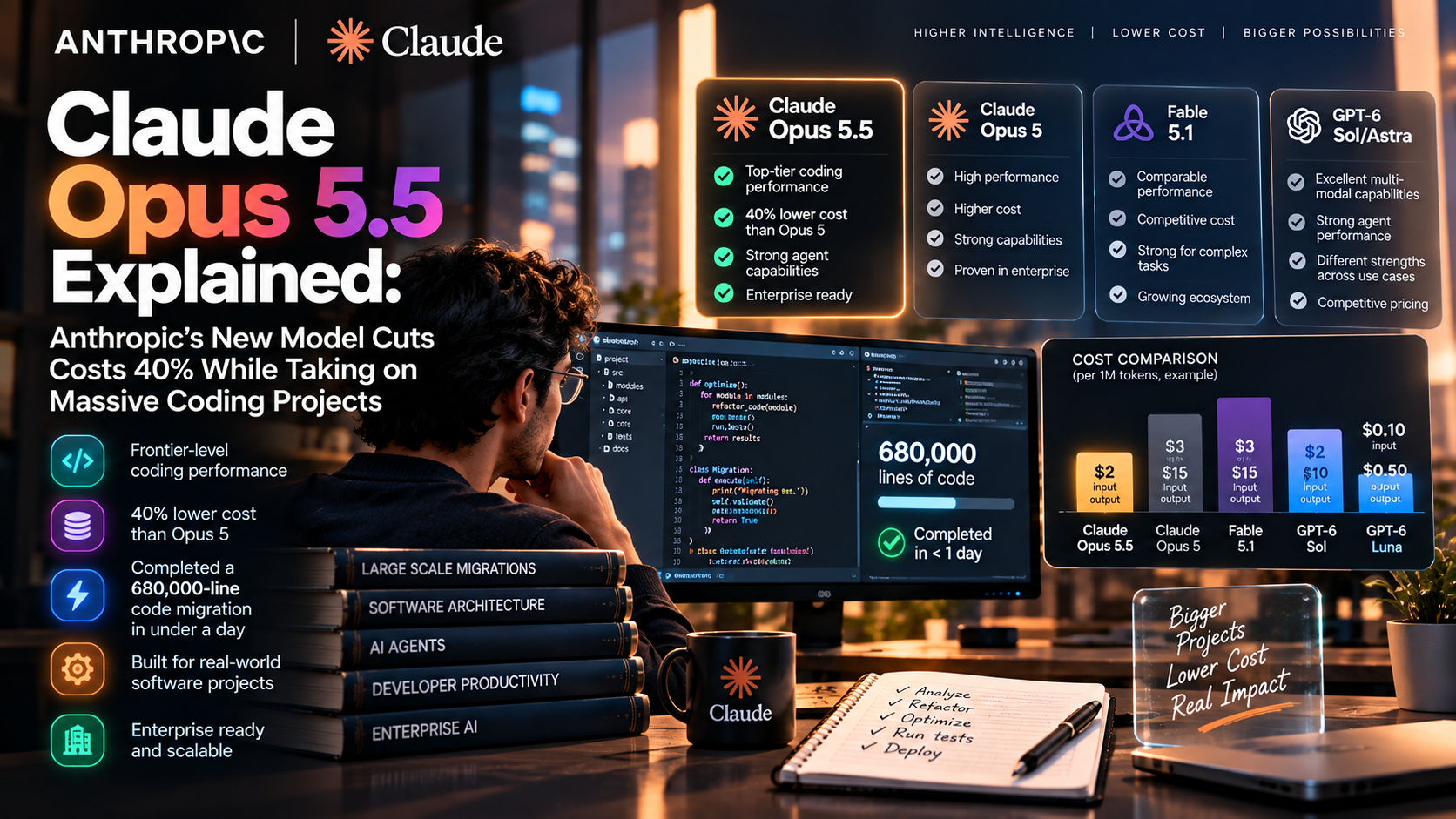
Claude Opus 5.5 makes a stronger case for large coding projects, but its widely repeated 40% savings figure describes a typical workload—not a 40% cut to every token price.
Quick Take
- Released September 22: Anthropic positions Opus 5.5 near Fable 5.1 on many tasks at a lower operating cost than Opus 5.
- Price and workload cost differ: listed Opus 5.5 rates are $4 input and $20 output per million tokens, versus Opus 5 at $5 and $25; Anthropic’s approximately 40% figure concerns typical work.
- A 680,000-line migration is an early-tester account: an impressive example, not a guarantee that every legacy repository can be migrated in one day.
- Buy by task: compare completion quality, review time, latency and tool expenditure rather than relying on a single benchmark.
What Is Claude Opus 5.5?
Anthropic introduced Claude Opus 5.5 as a frontier model for long, demanding engineering and agentic work. According to its company announcement, it approaches Claude Fable 5.1 on much of the tested work while offering a lower-cost route for teams that do not need the most expensive option on every request.
For a software team, the useful question is not “Which model won the leaderboard?” It is whether a model can identify the real dependency graph, modify the right files, run relevant tests and produce a reviewable change without exhausting its context or budget. Code migrations especially require multiple stages: map the repository, define the invariant, update modules, test behavior and inspect regressions.
Opus 5.5 vs Opus 5 vs Fable 5.1 vs GPT-6 Astra and Sol
| Model | Best candidate workload | What to validate locally |
|---|---|---|
| Claude Opus 5.5 | Large refactors, coding agents and long research-to-implementation tasks. | Compare end-to-end quality with its lower-priced predecessor. |
| Claude Opus 5 | Existing Claude workloads with stable prompts and evaluations. | Whether 5.5 maintains or improves your real outcomes. |
| Claude Fable 5.1 | The hardest workloads where additional quality may outweigh cost. | Incremental quality gain per successful task; check current rate card. |
| GPT-6 Astra | Hard coding and multi-step agent workflows in the OpenAI ecosystem. | Harness, tool permissions, latency and cost on the same tests. |
| GPT-6 Sol | Cost-sensitive coding or agents that still need substantial reasoning. | Success rate, retries and human repair time relative to premium models. |
Anthropic reports Terminal-Bench 4.0 scores of 66.4% for Opus 5.5, 55.8% for Fable 5.1, 52.3% for Opus 5 and 57.9% for GPT-6 Astra in its published comparison. These are vendor-reported results under particular testing settings; they do not establish a general ranking for every repository. Sol is not scored in that comparison, so do not invent a head-to-head benchmark.
How the Pricing Claim Actually Works
At the published standard rates, Opus 5.5’s $4 input / $20 output is 20% below Opus 5’s $5 / $25. Anthropic’s roughly 40% savings claim describes a typical workload; token count, tool calls, caching, retries and output length change the effective bill. A cheaper token can still produce a more expensive task if the agent loops or needs extensive human correction.
For example, a task using 100,000 input and 20,000 output tokens would cost approximately $0.80 at Opus 5.5’s listed rates versus $1.00 at Opus 5’s, excluding caching and tools. This arithmetic is illustrative—not a 40% end-to-end saving. Teams should add reviewer time, test infrastructure and failed attempts before comparing alternatives.
What the 680,000-Line Migration Shows—and Does Not
Anthropic highlights an early tester that used Opus 5.5 to complete a migration involving about 680,000 lines of code in under a day. The report suggests a capable agent can traverse large projects and coordinate many edits. It does not disclose enough about the starting state, test coverage, meaning of “complete” or later maintenance to guarantee equivalent outcomes elsewhere.
For a responsible pilot, select one service rather than the whole estate. Record migration acceptance criteria; freeze a representative regression suite; require a human to inspect security-sensitive changes; and compare both models on the same repository, instructions and tool limits. Preserve the before-and-after diff, failing tests, deployment rollback plan and total engineering hours.
Enterprise Deployment Checklist
Grant read access before write access; keep secrets and production credentials outside the agent workspace.
Run unit, integration and security tests, then compare runtime behavior before merging.
Cap tokens, agent turns, parallel workers and external tool calls; monitor cost per accepted pull request.
Confirm provider retention, region, cloud availability and contractual treatment of proprietary source code.
A model can explain a convincing change while altering behavior incorrectly. Keep human code ownership and review. If an agent can open pull requests, its permissions should not also allow unreviewed production deployment. Evaluate both code quality and organizational recovery after mistakes.
What Comes Next for Coding Models?
The important competition is moving from one-shot code generation to sustained, testable engineering work. Expect buyers to ask for evidence on multi-file edits, flaky tests, issue triage and deployment safety. It is an inference—not a published fact—that models with better tool discipline could reduce total project cost more than a cheaper price per token.
For teams deciding between Claude and GPT-6, run a task suite from their own backlog: a greenfield change, a dependency upgrade, a failing test and a migration. Measure accepted work, reviewer corrections and time-to-merge. A smaller model may be best for routine patches, while a premium model is reserved for architecture decisions or difficult failures.
EU AI Act, Privacy and Responsible Deployment
AI-assisted coding usually does not become a high-risk AI system simply because a model wrote software; intended use matters. Keep a record of prompts, code provenance, security checks and human approval. If generated software is later deployed in a regulated setting, reassess the finished system under applicable EU AI Act, GDPR and sector-specific duties. Do not send personal data, client code or credentials into a provider without checking lawful basis, contract terms and access controls.
For transparency requirements, see European Commission guidance on AI transparency. This overview is general information, not legal, medical or regulatory advice; assess the specific use case with qualified professionals.
MaGeN-AI View
The Takeaway
Opus 5.5 is interesting because Anthropic is trying to lower the cost of sustained, complex software work, not merely offer another chat model. The smart procurement metric is dollars and reviewer minutes per correct, merged change. Treat the 680,000-line story as a case to investigate, and the 40% as a qualified workload claim—not a universal discount.
Frequently Asked Questions
When was Claude Opus 5.5 released?
Anthropic announced Claude Opus 5.5 on September 22, 2026. Check the current product page before making availability or pricing decisions.
Is Opus 5.5 40% cheaper per token than Opus 5?
No. Anthropic’s published standard input and output token prices are about 20% lower. Approximately 40% refers to its typical-workload cost claim.
Is Opus 5.5 better than GPT-6 Astra?
That depends on the repository, agent harness and acceptance tests. One vendor-reported coding benchmark is not a universal winner.
Can Claude migrate 680,000 lines of code in a day?
Anthropic reports that result from an early tester. Scope, tests and definition of completion can vary, so replicate on your own project.
What is the safest first enterprise pilot?
Start with a bounded repository and non-production credentials; measure tests, review time, tool costs and revertability before broadening permissions.