GPT-5.6 August Update: What Changed and Why It Matters
OpenAI’s GPT-5.6 August 2026 update is an important evolution of the GPT-5.6 family introduced in July. Instead of simply releasing another model with higher benchmark numbers, OpenAI is refining how people interact with advanced AI in everyday situations.
The August update brings more focused answers, improved factual reliability, adjustable reasoning effort, broader GPT-5.6 access, and new options for faster AI inference.
For everyday ChatGPT users, this could mean fewer unnecessarily complicated answers and more control over when deeper reasoning is needed. For developers and businesses, GPT-5.6 is increasingly becoming a platform for building AI agents and automated workflows.
Here is what changed—and why it matters.
What Is GPT-5.6?
GPT-5.6 is OpenAI’s latest model family, originally introduced in July 2026.
The family includes three primary models:
GPT-5.6 Sol – the flagship model aimed at complex reasoning, coding, research, cybersecurity, science, computer use, and advanced professional work.
GPT-5.6 Terra – a balanced model designed to combine capability with lower operating costs.
GPT-5.6 Luna – the fastest and most cost-efficient model in the family, intended for high-volume and everyday AI workloads.
The broader strategy is clear: rather than relying on one model for every workload, OpenAI is creating different levels of intelligence, speed, and cost within the same generation.
The August GPT-5.6 update takes this approach further by changing how these models are presented and used inside ChatGPT.
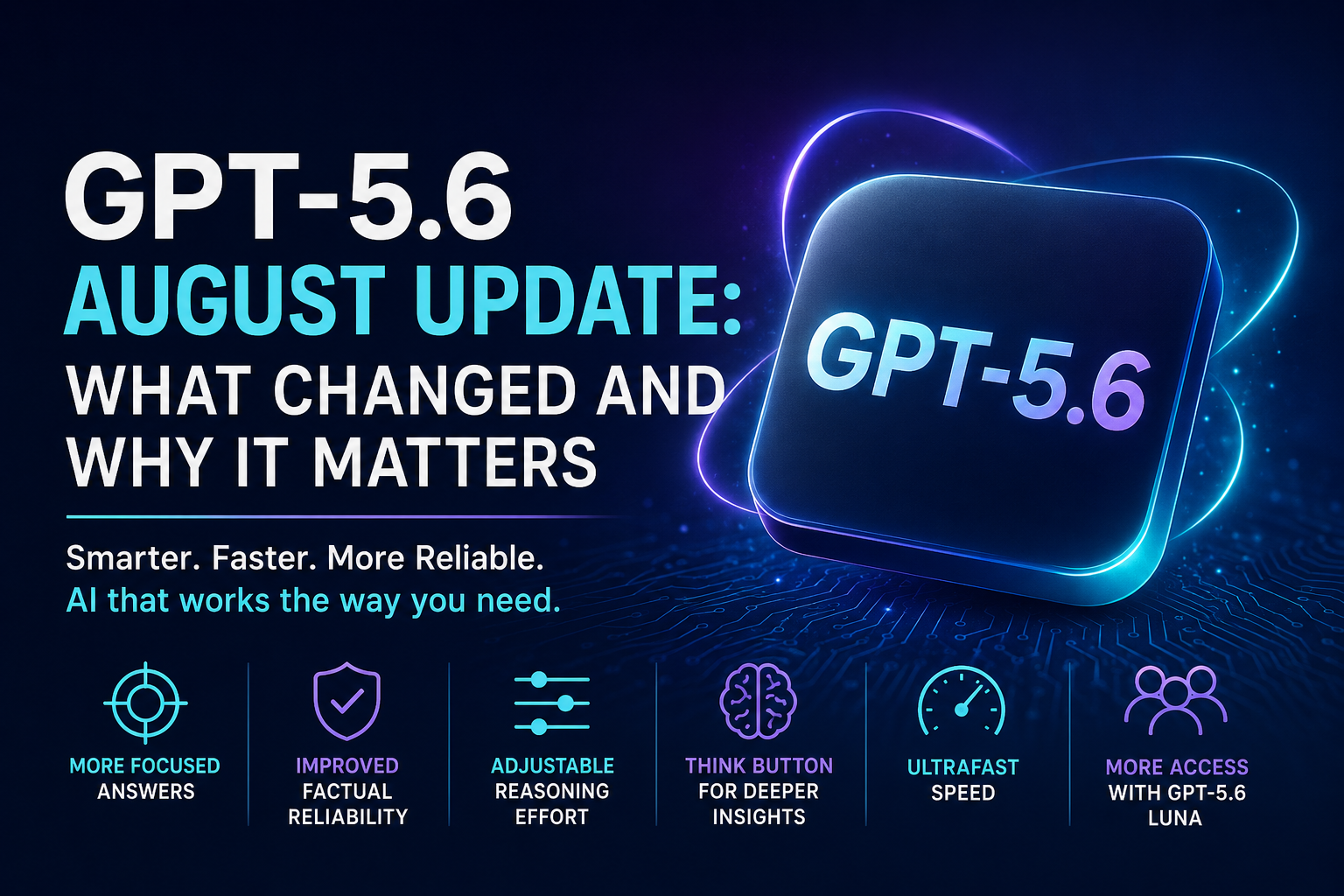
1. GPT-5.6 Sol Now Gives More Focused Answers
One of the most noticeable improvements is not about raw intelligence—it is about how that intelligence is communicated.
OpenAI says the updated GPT-5.6 Sol is designed to produce more focused responses and better adapt the amount of detail to the question being asked.
This addresses a common problem with advanced AI assistants.
A simple question does not always require:
a long introduction,
multiple sections,
extensive background information,
ten bullet points,
or a lengthy conclusion.
At the same time, complex research or planning questions may require substantial reasoning.
The August update attempts to make GPT-5.6 better at recognizing that difference.
Why it matters
AI quality is increasingly about more than generating correct information.
A useful AI assistant also needs to understand how much information is appropriate for the task.
For business users in particular, concise and relevant responses can reduce the time spent editing AI-generated material before it becomes usable.
2. Improved Factual Reliability
Another major focus of the GPT-5.6 August update is factual reliability.
OpenAI says the updated GPT-5.6 Sol is more reliable with facts.
This is particularly important because hallucination remains one of the biggest limitations of generative AI.
Large language models can sometimes generate information that sounds convincing even when the underlying claim is incorrect, outdated, or unsupported.
Improvements in factual reliability could therefore have significant implications for areas such as:
research,
technical documentation,
business analysis,
education,
coding,
data interpretation,
and decision support.
This does not mean users should assume every GPT-5.6 answer is automatically correct.
Important information should still be verified, particularly for financial, legal, medical, engineering, security, or other high-impact decisions.
The direction, however, is significant.
The AI industry is moving from simply asking “How intelligent is the model?” toward asking “How reliably can we use its output?”
3. A New Reasoning-Effort Slider
One of the most interesting changes is a new control that allows eligible ChatGPT users to choose how much thought GPT-5.6 Sol puts into a response.
This creates a more flexible interaction model.
Instead of treating every prompt the same way, users can effectively choose between faster responses and deeper reasoning depending on the task.
For example:
Lower reasoning effort
Useful for:
quick questions,
rewriting text,
brainstorming,
summaries,
simple explanations,
everyday productivity.
Higher reasoning effort
Potentially better for:
research,
complex coding,
strategic planning,
technical analysis,
comparing multiple options,
troubleshooting,
difficult decisions.
This may seem like a small interface change, but it represents a much larger shift in how AI systems are evolving.
AI Is Becoming Adjustable
Traditional software generally performs a predefined amount of computation for a task.
Reasoning models introduce another possibility:
Users can decide how much computational effort a problem deserves.
A simple question may need an almost immediate answer.
A complex engineering or research problem might justify considerably more processing.
The GPT-5.6 reasoning control makes this trade-off more visible to the user.
4. A More Consistent Experience Between Fast and Deep Reasoning
Previously, switching between fast AI responses and deeper reasoning could sometimes feel like interacting with different assistants.
Tone, structure, response length, and behavior could change.
The August GPT-5.6 update attempts to create a more consistent experience.
For Plus and Pro users, OpenAI says GPT-5.6 Sol now supports both quick responses and deeper reasoning within a more unified experience.
The goal is simple:
More thinking should improve the depth of the answer without unnecessarily changing the character of the assistant.
That could make reasoning models easier to use for everyday work.
5. GPT-5.6 Luna Expands Access to Advanced AI
The August update is not only about the flagship GPT-5.6 Sol model.
OpenAI is also significantly expanding access to GPT-5.6 Luna.
GPT-5.6 Luna becomes the default model for Free and Go users, alongside expanded text-chat access. OpenAI also introduced a Think button that allows these users to request additional reasoning for harder questions.
This is potentially one of the most important parts of the update.
Advanced reasoning capabilities are gradually moving from premium AI features toward mainstream computing tools.
Millions of users who previously interacted primarily with faster general-purpose models can increasingly access deeper reasoning when a task requires it.
That could accelerate AI adoption in:
education,
small businesses,
software development,
personal productivity,
research,
content creation,
and entrepreneurship.
6. The “Think” Button Makes Reasoning More Accessible
AI companies have spent years explaining model names, context windows, reasoning architectures, inference settings, and benchmark scores.
Most users do not want to manage that complexity.
They simply want better answers.
The Think button is an interesting attempt to simplify advanced reasoning into an understandable interaction.
Instead of asking:
Which reasoning model should I select?
A user can effectively say:
This question is difficult. Think harder about it.
That is a much more intuitive model for mainstream AI interaction.
It also suggests where ChatGPT and similar AI products may be heading.
Future AI interfaces may increasingly hide model complexity and instead expose controls based on user intent.
7. GPT-5.6 Is Becoming More Important for AI Agents
The August developments also extend beyond ordinary ChatGPT conversations.
OpenAI’s August guidance for developers highlights GPT-5.6 for production AI systems, including areas such as:
model selection,
programmatic tool calling,
multi-agent architectures,
prompt caching,
reasoning continuity,
and the Responses API.
This is important because the next major phase of generative AI is increasingly centered on agents rather than isolated prompts.
A chatbot waits for a question.
An AI agent can potentially:
Understand a goal.
Break the goal into tasks.
Select tools.
retrieve information.
execute actions.
evaluate results.
continue until the objective is completed.
GPT-5.6 is increasingly being positioned as an intelligence layer for these more complex systems.
8. Multi-Agent AI Becomes More Practical
Another important trend surrounding GPT-5.6 is the rise of multi-agent systems.
Instead of asking one AI model to handle an entire complex workflow sequentially, developers can create multiple specialized agents.
For example, a market-research system might contain:
Research Agent → Data Agent → Competitor Agent → Analysis Agent → Report Agent
Each agent performs a specialized task while sharing information with the larger workflow.
GPT-5.6's developer ecosystem increasingly supports this type of architecture.
This could be particularly useful for complex workflows involving:
software development,
financial analysis,
enterprise research,
customer support,
cybersecurity,
engineering,
supply-chain analysis,
and scientific research.
9. GPT-5.6 Sol Is Getting Much Faster
Speed is another major development around GPT-5.6.
On August 13, OpenAI previewed an Ultrafast service tier for GPT-5.6 Sol in the API.
OpenAI says the new tier, powered by Cerebras, can run GPT-5.6 Sol at up to 14 times the speed of Standard processing and generate up to 750 output tokens per second.
This could become important for applications where latency is critical.
Potential examples include:
real-time coding assistants,
interactive AI agents,
customer-support systems,
rapid document analysis,
live research tools,
enterprise copilots,
and automated operational workflows.
Historically, developers often faced a trade-off:
Fast model or intelligent model?
If frontier models can operate with dramatically lower latency, that distinction may begin to disappear.
10. Why GPT-5.6's August Update Matters for Businesses
For companies adopting generative AI, the August update highlights several important trends.
Better AI does not always mean bigger AI
The industry is increasingly optimizing models for efficiency, reliability, latency, and cost rather than focusing exclusively on raw model size.
Reasoning becomes a configurable resource
Businesses may eventually allocate more AI reasoning to important tasks and less computation to routine operations.
AI agents are becoming production infrastructure
Tool calling, multi-agent workflows, APIs, and persistent reasoning are turning generative AI from a conversational interface into an automation layer.
Speed matters
Faster frontier-model inference makes AI practical for workflows that previously could not tolerate long response times.
Advanced AI is becoming more accessible
Capabilities once associated with premium reasoning models are gradually reaching broader groups of users.
GPT-5.6 August Update: Key Changes at a Glance
Update Why It Matters
More focused GPT-5.6 Sol responses Less unnecessary information
Improved factual reliability More useful for professional tasks
Reasoning-effort control Users can balance speed and depth
More consistent reasoning experience Easier transition between simple and complex tasks
GPT-5.6 Luna for Free and Go users Advanced AI reaches more users
Think button Makes deeper reasoning easier to access
Stronger agent-development ecosystem Enables more sophisticated AI automation
Multi-agent capabilities Supports complex workflows
GPT-5.6 Sol Ultrafast preview Frontier AI can operate at much lower latency
GPT-5.6 vs Traditional Chatbots: The Bigger Shift
Perhaps the most important part of the GPT-5.6 August update is what it tells us about the future of AI.
The first generation of generative AI was largely based around a simple interaction:
Prompt → Model → Answer
The emerging architecture is much more sophisticated:
Goal → Reasoning → Tools → Agents → Actions → Verification → Result
GPT-5.6 represents part of this transition.
The model itself remains important, but the surrounding system—reasoning controls, tools, agents, APIs, files, search, and automation—is becoming equally important.
This means the AI competition may increasingly move beyond benchmark scores.
The more important question could become:
Which AI platform can reliably complete useful work from beginning to end?
What GPT-5.6 Means for Developers
Developers should pay particular attention to three areas.
First, model selection becomes increasingly important. Not every request needs the most powerful model or maximum reasoning effort.
Second, agent architecture is becoming a core AI-development skill. Developers need to think about tool access, context management, verification, orchestration, and failure recovery—not just prompt engineering.
Third, latency and economics could significantly expand the range of viable AI applications.
As frontier intelligence becomes faster and more affordable, AI can move from occasional assistance into continuous operational workflows.
What GPT-5.6 Means for Everyday ChatGPT Users
For most people, the changes are simpler.
You should increasingly be able to use ChatGPT quickly for simple tasks while requesting additional reasoning when the problem deserves it.
That means the same AI interface can potentially support everything from:
“Rewrite this email.”
to:
“Analyze these documents, compare the alternatives, identify risks, and recommend the best strategy.”
The difference is increasingly about the amount of reasoning and tooling applied to the task rather than simply choosing a completely different chatbot.
Final Thoughts
The GPT-5.6 August update is less about introducing another dramatic model name and more about making frontier AI easier to use.
More focused responses improve everyday interactions.
Better factual reliability increases practical usefulness.
Adjustable reasoning gives users more control over speed versus depth.
GPT-5.6 Luna expands access to advanced AI.
And developments around agents, multi-agent systems, developer APIs, and ultrafast inference point toward a much larger transformation.
AI is gradually evolving from a tool that answers questions into infrastructure that can reason, use tools, coordinate workflows, and complete tasks.
That may ultimately be the most important change behind GPT-5.6.
The future of AI is not simply about models that know more.
It is about systems that can turn intelligence into useful work.
Frequently Asked Questions
What is the GPT-5.6 August update?
The August 2026 update improves the ChatGPT experience around GPT-5.6, including more focused GPT-5.6 Sol responses, better factual reliability, adjustable reasoning effort, and expanded GPT-5.6 Luna access.
What is GPT-5.6 Sol?
GPT-5.6 Sol is the flagship model in the GPT-5.6 family and is designed for demanding tasks such as complex reasoning, coding, research, science, cybersecurity, computer use, and professional knowledge work.
What is GPT-5.6 Luna?
GPT-5.6 Luna is the fastest and most cost-efficient member of the GPT-5.6 family. In August 2026, OpenAI expanded its availability by making it the default model for Free and Go ChatGPT users.
What does the GPT-5.6 reasoning slider do?
The reasoning control allows eligible users to adjust how much computational effort GPT-5.6 Sol applies to an answer, making it possible to prioritize speed for simple tasks or deeper reasoning for complex problems.
Is GPT-5.6 better for AI agents?
GPT-5.6 is increasingly designed around agentic applications, with OpenAI highlighting capabilities and developer patterns involving tool calling, multi-agent architectures, reasoning continuity, prompt caching, and the Responses API.
What is GPT-5.6 Ultrafast?
Ultrafast is an API service tier previewed by OpenAI in August 2026. OpenAI says it can run GPT-5.6 Sol at up to 14× Standard processing speed and reach up to 750 output tokens per second.
Tags
#GPT56 #GPT56Update #ChatGPT #OpenAI #AI2026 #GenerativeAI #AIAgents #AgenticAI #ArtificialIntelligence #AIModels #AIUpdates #FutureOfAI