EU AI Act 2026: New AI Transparency and Content-Labelling Rules Explained
Artificial intelligence is entering a new regulatory era in Europe.
From 2 August 2026, important transparency requirements under the EU Artificial Intelligence Act (EU AI Act) started to apply. These rules affect AI providers, businesses using AI systems, generative AI platforms, publishers, content creators, and organisations deploying AI-generated or manipulated content.
The central principle is relatively simple:
People should be able to recognise when they are interacting with AI or encountering certain content that has been generated or manipulated by AI.
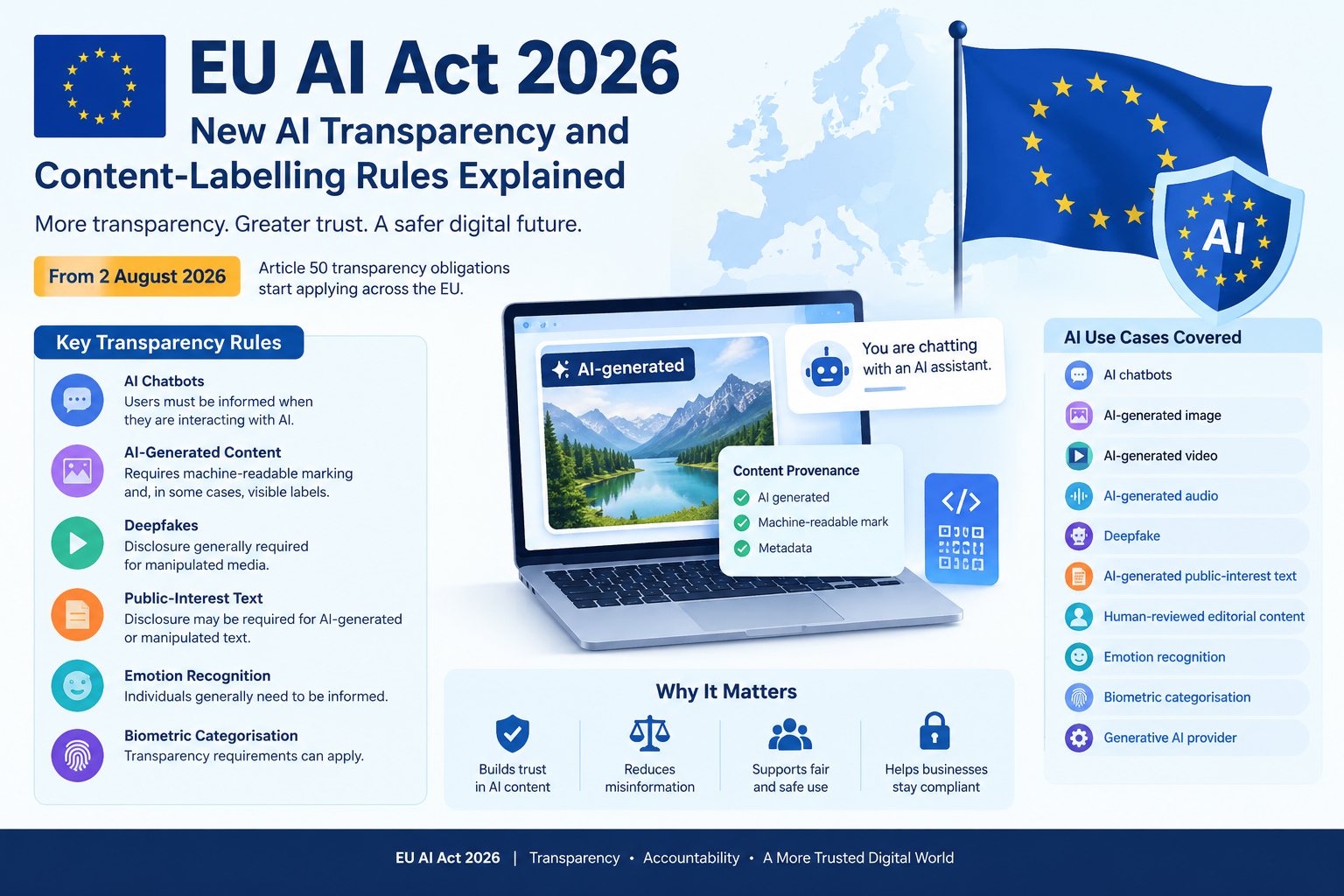
The new requirements introduce rules covering AI chatbots, AI-generated images, video, audio and text, deepfakes, machine-readable AI content marking, emotion-recognition systems, and biometric categorisation systems.
For businesses operating in Europe, this makes AI transparency more than a good practice.
In many situations, it is now a legal compliance requirement.
Here is what the EU AI Act transparency and AI content-labelling rules mean in 2026—and what organisations should consider doing next.
What Is the EU AI Act?
The EU Artificial Intelligence Act is the European Union's comprehensive regulatory framework for artificial intelligence.
Rather than regulating every AI application in exactly the same way, the legislation follows a risk-based approach.
Different AI systems face different requirements depending on how they are developed, deployed and used.
The framework covers areas ranging from prohibited AI practices and high-risk AI systems to general-purpose AI and transparency requirements.
One particularly important section for generative AI is Article 50.
Article 50 establishes transparency obligations for providers and deployers of certain AI systems.
From 2 August 2026, many of these requirements became applicable across the European Union.
Why August 2, 2026 Matters
August 2, 2026 represents a major milestone in the implementation of the EU AI Act.
The new Article 50 transparency obligations are designed to make it easier for people to understand when AI is involved in an interaction or piece of content.
The rules address several major areas:
AI systems interacting directly with people
AI-generated and AI-manipulated content
Deepfakes
AI-generated public-interest text
Emotion-recognition systems
Biometric categorisation systems
The European Commission has also published detailed Transparency Guidelines and a Code of Practice on Transparency of AI-Generated Content to help organisations understand and implement these requirements.
1. AI Chatbots Must Tell Users They Are Interacting With AI
One of the easiest rules to understand concerns AI chatbots and conversational AI systems.
When an AI system directly interacts with a person, providers generally need to ensure that the individual knows they are interacting with AI rather than a human.
For example, imagine an online retailer using an AI-powered customer-service assistant.
Instead of presenting the assistant in a way that could make customers believe they are communicating with a human employee, the service may need to clearly identify the interaction as AI-powered.
This could potentially appear through wording such as:
“You are chatting with an AI assistant.”
The disclosure should be clear enough for an ordinary user to understand.
There are exceptions, including circumstances where it is already obvious that the user is interacting with AI.
Why this matters
AI assistants are becoming increasingly human-like.
Modern systems can:
maintain long conversations,
understand context,
generate natural responses,
use realistic voices,
analyse documents,
and perform tasks.
As the distinction between human and machine communication becomes less obvious, transparency becomes increasingly important.
2. AI-Generated Content Needs Machine-Readable Marking
One of the most significant requirements concerns the technical marking of AI-generated content.
Providers of AI systems that generate synthetic:
text,
images,
audio,
or video
must generally ensure that their outputs are marked in a machine-readable format and can be detected as artificially generated or manipulated.
This requirement applies to providers of relevant AI systems, including certain general-purpose AI systems.
The technical solutions should, as far as technically feasible, be:
effective,
interoperable,
robust,
and reliable.
This could encourage greater use of technologies such as content credentials, metadata, provenance information, watermarking or other technical methods capable of signalling that AI was involved in producing content.
The exact implementation can vary depending on the content type and technology involved.
3. Machine-Readable Marking and Visible Labels Are Not the Same Thing
This distinction is particularly important.
Machine-readable AI marking and human-visible AI disclosure are related but different concepts.
Machine-readable marking allows software, platforms and verification systems to potentially detect that content was artificially generated or manipulated.
Visible labelling informs the person viewing the content.
For example, an AI-generated image could potentially contain technical provenance information while also displaying a visible notice such as:
“AI-generated image.”
Depending on the situation, the EU AI Act may impose obligations on different actors across this chain.
This means organisations should avoid assuming that adding a simple “Made with AI” label automatically solves every transparency requirement.
4. Deepfakes Must Be Disclosed
Deepfakes are one of the most important areas covered by the new rules.
Under the EU AI Act, deployers of AI systems that generate or manipulate image, audio or video content constituting a deepfake generally have to disclose that the content has been artificially generated or manipulated.
Deepfakes can include realistic AI-generated or manipulated representations of:
people,
voices,
places,
objects,
entities,
or events.
The concern is straightforward.
Generative AI can now create highly convincing media that may appear authentic even when the depicted event never happened.
This creates risks involving:
misinformation,
impersonation,
fraud,
political manipulation,
reputational damage,
fake endorsements,
and deceptive advertising.
Clear disclosure is intended to help viewers understand when they are seeing synthetic or manipulated media.
5. AI-Generated Public-Interest Text Can Require Disclosure
Text receives somewhat different treatment.
Deployers of AI systems that generate or manipulate text published for the purpose of informing the public about matters of public interest generally have to disclose that the text was artificially generated or manipulated.
This could potentially affect certain uses of AI in areas such as:
news,
public information,
politics,
economic reporting,
public policy,
health information,
environmental issues,
and other matters relevant to society.
However, there is an important exception.
Disclosure is not required under this specific provision where the AI-generated content has undergone human review or editorial control and a natural or legal person holds editorial responsibility for the publication.
That distinction is extremely important for publishers and businesses.
6. Human Review Becomes More Important
Generative AI has encouraged organisations to automate content production.
The EU AI Act creates another reason to think carefully about human oversight.
Consider two publishing workflows.
Workflow A
AI generates an article → article is automatically published.
Workflow B
AI assists with an article → human editor verifies it → editor modifies it → organisation takes editorial responsibility → article is published.
These workflows may have different implications under Article 50.
Human oversight is therefore becoming more than a quality-control mechanism.
It can also form part of an organisation's broader AI governance and compliance strategy.
7. Emotion-Recognition Systems Also Face Transparency Rules
The transparency requirements are not limited to generative AI.
Deployers of certain emotion-recognition systems must inform people when they are exposed to such systems.
These technologies attempt to infer or identify emotional states using signals that may include facial expressions, voice characteristics or other biometric information.
This is a particularly sensitive area because people may otherwise have no idea that an AI system is attempting to interpret their emotions.
Businesses using these technologies should therefore examine both the AI Act and other applicable European regulations carefully.
8. Biometric Categorisation Also Requires Attention
Certain biometric categorisation systems are also covered by transparency obligations.
Organisations using such technologies may need to inform people when they are exposed to them.
Biometric technologies can involve sensitive information and may also interact with other European laws, particularly data-protection requirements.
AI Act compliance should therefore not automatically be treated as equivalent to complete regulatory compliance.
An AI application may simultaneously need to satisfy requirements arising from:
the EU AI Act,
GDPR,
consumer-protection legislation,
copyright law,
sector-specific regulation,
and national legislation.
9. What About AI Images Used in Marketing?
This is where the rules become especially interesting for ordinary businesses.
Imagine a company creates advertising material using generative AI.
Examples could include:
AI-generated product backgrounds,
synthetic models,
fictional locations,
AI-generated spokespersons,
manipulated promotional videos,
synthetic voices,
or AI-created social-media campaigns.
Whether visible disclosure is legally required depends on the exact circumstances and whether the content falls within the relevant provisions of the AI Act.
At the same time, the underlying generative AI provider may have separate obligations concerning machine-readable marking.
Businesses therefore need to distinguish between:
AI tool-provider obligations
and
AI deployer/user obligations.
10. What About AI-Generated Social Media Content?
The same principle applies to social media.
Not every sentence drafted with AI automatically needs a giant “AI GENERATED” warning.
The legal requirements are more specific than that.
However, organisations should carefully evaluate content involving:
deepfakes,
synthetic people,
realistic AI voices,
manipulated video,
public-interest information,
deceptive representations,
and other situations where people could reasonably misunderstand the origin or authenticity of the content.
For marketing teams, transparency should increasingly become part of the content-production workflow rather than something considered only after publication.
11. The EU Has Developed AI Content-Label Icons
The European Commission has also developed a set of icons that organisations may use when labelling AI-generated content.
The idea is to make AI disclosures easier for users to recognise consistently.
Over time, we could potentially see AI-content indicators become as familiar as other digital symbols users already encounter online.
Instead of requiring consumers to understand technical metadata or model architectures, a standardised visual language could communicate:
“AI was involved in creating or manipulating this content.”
This could become particularly important as synthetic media becomes increasingly difficult to distinguish visually from authentic media.
12. The EU AI Transparency Code of Practice
To help companies implement Article 50, the European Commission published the Code of Practice on Transparency of AI-Generated Content in June 2026.
The Code contains two major sections.
Section 1 – AI Providers
This focuses on marking and detecting AI-generated or manipulated content.
Section 2 – AI Deployers
This focuses on disclosure and labelling requirements concerning deepfakes and certain AI-generated or manipulated text.
Following assessment by the European Commission and the AI Board, the Code has been recognised as an adequate voluntary tool for demonstrating compliance with relevant Article 50 obligations.
Importantly, however:
The Code is voluntary, but the underlying Article 50 legal obligations are not.
Organisations that do not follow the Code may use other appropriate methods to demonstrate compliance.
13. Around 190 Organisations Backed the Transparency Code
The transparency initiative has already received significant industry participation.
According to the European Commission, around 190 organisations signed the Code of Practice ahead of the transparency obligations becoming applicable.
This matters because AI transparency increasingly requires cooperation across the technology ecosystem.
A piece of AI-generated content might pass through several systems:
AI Model → Application → Business → Publishing Platform → Social Network → Consumer
Transparency can break down if provenance information disappears somewhere along that chain.
Industry-wide standards and interoperable marking systems could therefore become increasingly important.
14. What Does This Mean for AI Companies?
Companies developing generative AI systems for the European market should examine whether Article 50 applies to their products.
Potential considerations include:
Can generated content be identified as AI-generated?
Is machine-readable marking implemented where required?
Is the marking robust?
Can provenance information survive normal processing?
Are users clearly informed when interacting directly with AI?
Are transparency mechanisms documented?
Can the organisation demonstrate compliance?
These questions should increasingly become part of AI product design.
Transparency cannot simply be added at the end of development.
15. What Does This Mean for Small Businesses?
The EU AI Act is not relevant only to companies such as OpenAI, Google, Microsoft, Meta or Anthropic.
Small and medium-sized businesses increasingly use AI for:
marketing,
customer service,
website chatbots,
social media,
content generation,
recruitment,
training,
product imagery,
video creation,
and internal automation.
A small company might therefore simultaneously be an AI user, deployer and publisher of AI-assisted content.
SMEs should understand which obligations actually apply to their use cases rather than assuming that compliance is entirely the responsibility of the AI platform.
EU AI Act 2026 Transparency Rules at a Glance
AI UseMain Transparency ConsiderationAI chatbotUsers may need to know they are interacting with AIAI-generated imageProvider may need machine-readable markingAI-generated videoMachine-readable marking may applyAI-generated audioMachine-readable marking may applyDeepfakeDisclosure generally requiredAI-generated public-interest textDisclosure may be requiredHuman-reviewed editorial contentSpecific public-interest text disclosure exception may applyEmotion recognitionIndividuals generally need to be informedBiometric categorisationTransparency requirements can applyGenerative AI providerTechnical marking/detection obligations may apply
EU AI Act Compliance Checklist for Businesses
Businesses using generative AI should consider creating a basic AI transparency process.
1. Identify where AI is used
Create an inventory covering:
chatbots,
content tools,
image generators,
video generators,
voice tools,
marketing automation,
customer-support AI,
and other AI systems.
2. Determine your role
Ask whether your organisation is acting as a:
provider,
deployer,
distributor,
importer,
publisher,
or another relevant actor.
Your responsibilities may differ depending on your role.
3. Identify synthetic content
Determine whether your workflows create:
text,
images,
audio,
video,
deepfakes,
or other manipulated media.
4. Review machine-readable marking
Check whether your AI providers preserve appropriate provenance or technical marking information.
5. Create disclosure rules
Define when visible AI labels should be used.
6. Add human review
Introduce editorial or professional review for important AI-generated material.
7. Document decisions
Keep records showing how your organisation evaluates AI transparency requirements.
8. Train employees
Marketing, communications, product, legal and technology teams should understand the new requirements.
What Happens If Companies Ignore the Rules?
AI Act enforcement is no longer simply a future concern.
The European Commission announced that enforcement of the Act and the new transparency requirements began from 2 August 2026.
Enforcement responsibilities are shared across the European AI governance framework, with national competent authorities playing a major role.
For infringements covered by the relevant penalty provisions, fines can reach up to €15 million or 3% of the company's total worldwide annual turnover for the preceding financial year, depending on the circumstances.
Different limits can apply depending on the specific violation, and proportionality considerations apply, particularly for smaller companies.
The practical lesson is straightforward:
AI transparency should now be treated as part of operational compliance rather than an optional ethical policy.
AI Transparency Could Become a Competitive Advantage
Regulation is often discussed entirely in terms of compliance costs.
But transparency could also become a competitive advantage.
Imagine two AI services.
One produces synthetic content without explaining its origin.
The other provides:
clear AI disclosures,
content provenance,
human-review information,
trustworthy documentation,
and easy-to-understand transparency indicators.
Which system is a business customer more likely to trust?
As AI adoption expands, trust could become a product feature.
Companies that build transparent AI systems early may therefore gain advantages beyond simply satisfying regulation.
The Bigger Picture: The Internet Is Entering the Synthetic Content Era
The EU AI Act's transparency requirements address a much larger technological problem.
For most of internet history, people generally assumed that photographs, recordings and written material originated from humans.
Generative AI changes that assumption.
We are entering an environment where enormous quantities of:
text,
photographs,
voices,
music,
videos,
advertisements,
virtual influencers,
and digital personalities
can be generated synthetically.
Soon, the question may no longer be:
“Can AI create realistic content?”
It will be:
“How can we know where digital content came from?”
That makes content provenance, AI labelling and authenticity infrastructure increasingly important parts of the future internet.
Final Thoughts
The EU AI Act 2026 transparency rules represent one of the biggest changes yet in how AI-generated content is handled in Europe.
From 2 August 2026, important Article 50 transparency obligations became applicable.
The rules introduce greater transparency around:
AI interactions,
synthetic media,
AI-generated content,
deepfakes,
public-interest text,
emotion recognition,
and biometric categorisation.
For AI providers, this means designing transparency into their systems.
For businesses, it means understanding how AI is being used and when disclosure requirements apply.
For publishers and content creators, it means paying closer attention to AI-generated and AI-manipulated material.
And for consumers, it represents an attempt to preserve something increasingly valuable in the age of generative AI:
the ability to understand when AI is behind what we see, hear and read.
The next phase of AI adoption will therefore not be defined only by what artificial intelligence can create.
It will also be defined by how clearly we communicate that AI was involved.
Frequently Asked Questions
When did the EU AI Act AI transparency rules start?
The Article 50 transparency obligations discussed here started applying on 2 August 2026.
Does all AI-generated content need a visible label?
No. The AI Act contains different requirements depending on the type of content, the AI system, the provider or deployer's role, and how the content is used. Machine-readable marking requirements should not be confused with visible disclosure requirements.
Do AI chatbots need to identify themselves?
Providers generally need to ensure that people directly interacting with an AI system are informed that they are interacting with AI unless this is already obvious, subject to the exceptions in the Act.
Do deepfakes need to be labelled?
Deployers of AI systems that generate or manipulate content constituting a deepfake generally need to disclose that the content has been artificially generated or manipulated, subject to the Act's specific provisions and exceptions.
Does AI-generated text need to be labelled?
Certain AI-generated or manipulated text published to inform the public on matters of public interest requires disclosure. An important exception exists where the content has undergone human review or editorial control and a person or organisation holds editorial responsibility.
Is the EU AI Transparency Code mandatory?
The Code of Practice itself is voluntary. However, the relevant transparency requirements under Article 50 are legal obligations. Organisations that do not use the Code must demonstrate compliance through other appropriate means.
Do the rules apply to content created before August 2, 2026?
The European Commission states that AI-generated or manipulated outputs already generated and made available before 2 August 2026 do not need to be labelled retroactively.