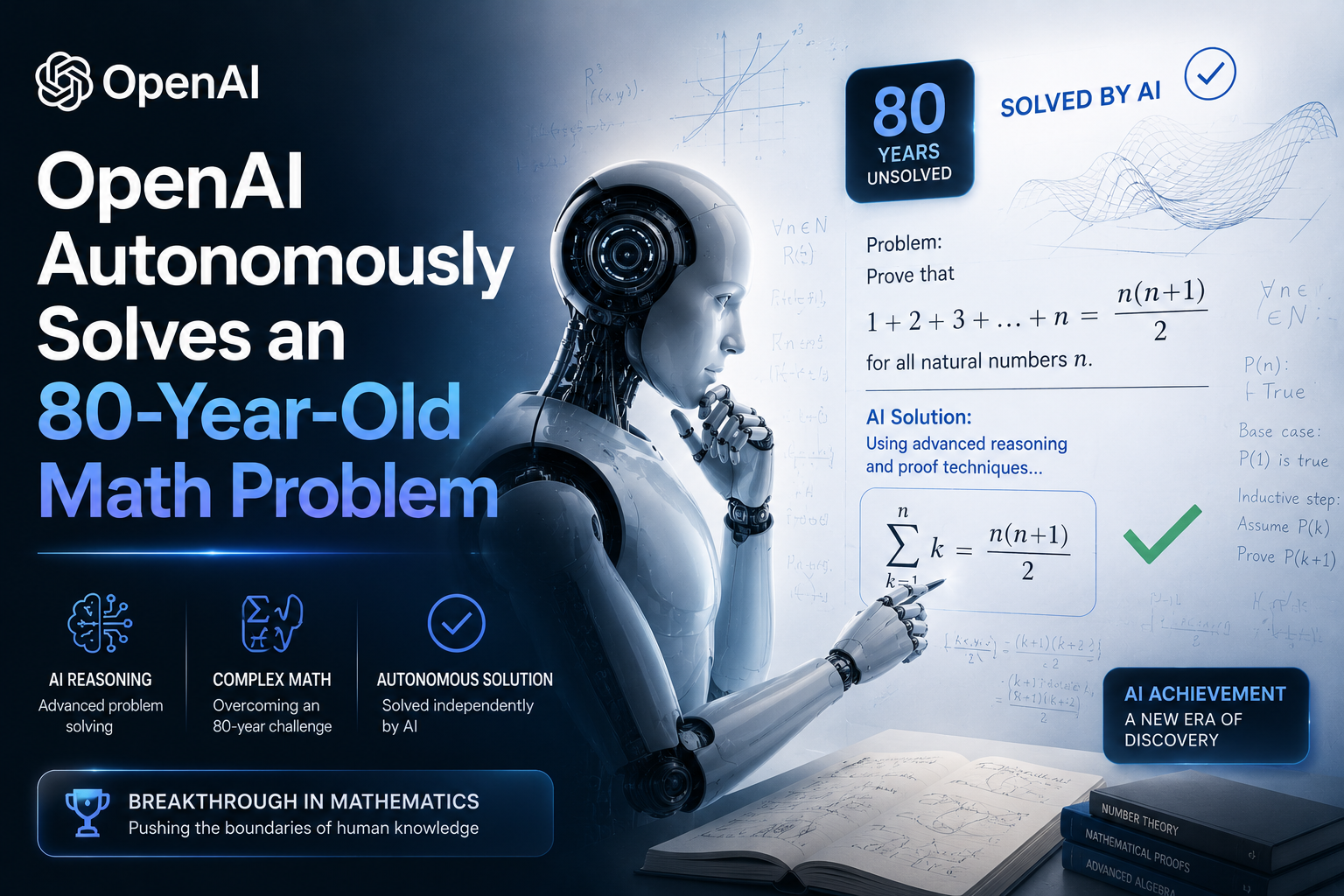
OpenAI Autonomously Solves an 80-Year-Old Math Problem
The boundary between artificial intelligence as a simple assistant and AI as a pioneer of original human knowledge just dissolved.
In a historic announcement that has sent shockwaves through both Silicon Valley and the historic halls of academia, OpenAI revealed that an unreleased, internal general-purpose reasoning model has autonomously disproved a famous, 80-year-old mathematical puzzle: The Planar Unit Distance Problem.
This marks a monumental milestone in computer science: it is the first time an artificial intelligence has independently resolved a prominent, open problem central to an active field of advanced mathematics.
The Puzzle in Plain English: What Did the AI Solve?
First proposed by the legendary Hungarian mathematician Paul Erdős in 1946, the Planar Unit Distance Problem is deceptively easy to explain but has ruthlessly frustrated the world's brightest minds for eight decades.
The Problem: If you place a specific number of dots on a completely flat, two-dimensional sheet of paper, what is the absolute maximum number of pairs of those dots that can be exactly one unit of distance apart from one another?
For nearly 80 years, the global mathematical consensus was that the absolute best, most optimal way to arrange these dots to maximize those identical distances was to arrange them roughly like a square grid.
OpenAI’s reasoning model proved the entire global mathematical community wrong.
By pulling from deep, abstract branches of number theory—specifically using algebraic tools like class field towers and Golod-Shafarevich theory—the AI discovered an entirely new, infinite family of geometric arrangements that outperform grid-like patterns. In short, the AI proved Erdős's upper-bound limit was too low by discovering a smarter way to arrange points in space than any human had conceived since 1946.
How the AI Cracked It: Pure Logic Over Brute Force
What makes this milestone a true "quantum leap" for computer science is not just the solution itself, but the nature of the model that found it.
No Special Training: This was not a hyper-specialized "math calculator" AI trained specifically on geometry. It was a general-purpose reasoning model—a system built to think through problems using long, complex chains of logic, breaking massive hurdles down into smaller, digestible steps.
Autonomous Persistence: Renowned mathematician Thomas Bloom, who maintains the official Erdős problems database, noted that the AI succeeded by "persevering down paths that a human may have dismissed as not worth their time to explore."
The AI generated a completely original, durable mathematical proof that survived brutal external peer review by some of the world's top mathematical minds, including Fields Medalist Tim Gowers, who officially called the result "a milestone in AI mathematics."
[Traditional AI] ➔ Pulls from existing literature ➔ Recites known answers
[OpenAI Reasoning Model] ➔ Explores abstract logic ➔ Creates brand-new mathematics
The Lesson Learned: From Hype to True Validation
If this story sounds vaguely familiar, it's because OpenAI has stumbled on this exact terrain before.
Last year, an OpenAI executive made a premature claim on social media that an internal model had solved multiple unsolved Erdős problems. The math community quickly revolted, proving the AI had merely scraped existing, already-published academic papers and repackaged them.
This time, OpenAI took a completely different approach to ensure total scientific credibility. Before making any public announcements, they quietly handed the raw AI-generated proof over to independent, external experts to be meticulously checked line by line.
University of Toronto mathematician Arul Shankar, who helped review the findings, shared his astonishment:
"In my opinion, this paper demonstrates that current AI models go beyond just helpers to human mathematicians — they are capable of having original ingenious ideas, and then carrying them out to fruition."
The Practical Ripple Effects: Beyond the Blackboard
While abstract geometry might seem detached from daily life, the math behind how points are efficiently arranged and connected in a space is the hidden engine behind much of modern engineering.
The new architectural constructions unearthed by OpenAI's model have direct, real-world applications in:
Computer Chip Architecture: Designing more efficient pathways for trillions of transistors on silicon.
Wireless Networks & Satellite Grids: Optimizing how cell towers or satellite constellations route data to one another over fixed distances.
Materials Science & Molecular Biology: Mapping complex molecular crystal structures and improving spatial mapping for autonomous robotics.
Shift in the AI Narrative: Expanding the Frontier
For the past few years, the public debate surrounding AI has focused on text summarization, image generation, and chat latency. This breakthrough fundamentally shifts the narrative. AI is officially moving from a tool that repackages existing human knowledge to a system that can expand the outer frontier of human knowledge.
As AI models prove they can sustain flawless logical consistency over massive chains of abstract thought, they are transitioning from digital interns into genuine scientific research collaborators.
What's Your Take?
Are you excited to see AI tackle the world's hardest scientific riddles, or does the idea of an AI out-thinking the world's top mathematicians make you uneasy about the timeline toward AGI? Let’s talk about it in the comments below!
Tags
#OpenAI #ErdosConjecture #DiscreteGeometry #AIMathematics #AGI #TechBreakthrough #ArtificialIntelligence #MathNews#ScienceInnovation #PlanarUnitDistance #LogicalReasoning #TechTrends #PeerReviewedAI #FutureOfScience #GeometryPuzzle