Previewing Announcements from GTC 2026: The Rise of Physical AI
The AI industry is converging on San Jose this month for NVIDIA’s GTC 2026, and the atmosphere is electric.
For years, GTC has been the premier venue for groundbreaking hardware and software announcements that shape the trajectory of artificial intelligence. In 2024, the Blackwell architecture redefined the limits of data center compute. In 2025, we saw the maturation of agentic software ecosystems.
As we stand on the cusp of GTC 2026 (March 16–19), the central theme is clear: AI is leaving the digital realm and entering the physical world. While incremental gains in LLM performance are guaranteed, the most significant breakthroughs will focus on deploying intelligence into factories, robots, and the physical infrastructure that powers our society.
Here is a preview of the most anticipated announcements.
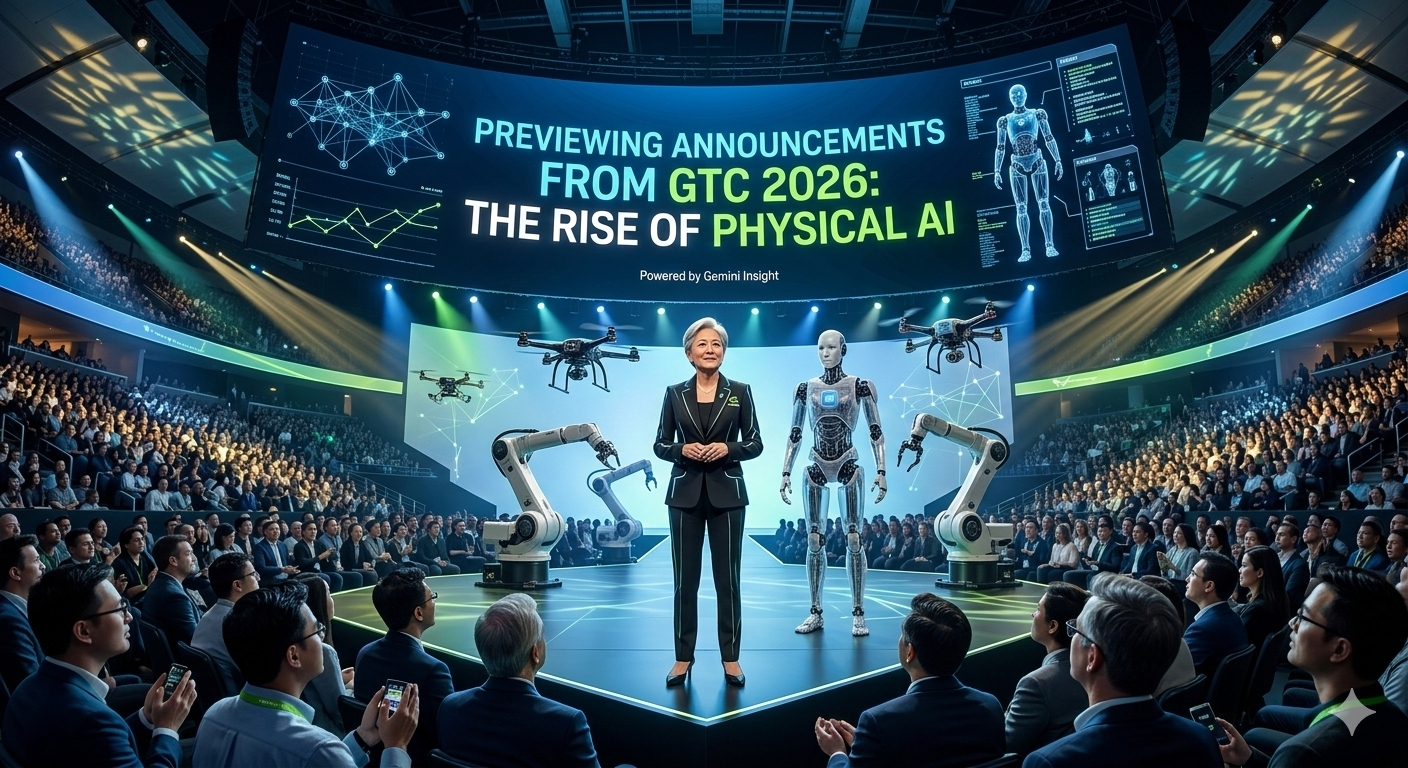
1. The Core Keynote: Beyond Blackwell and Toward "Physical AI"
CEO Jensen Huang’s keynote is expected to be a masterclass in vertical integration. The hardware spotlight will shine brightly on the successor to the Blackwell platform.
Rumors point to the unveiling of the "Rubin" architecture. This platform is expected to fully embrace 3D chip-stacking, moving memory and compute closer than ever before to shatter the memory bandwidth wall. This radical increase in density and efficiency is crucial for powering the next order of magnitude in foundation models.
Crucially, the hardware will be presented alongside its digital twin: NVIDIA Omniverse. Jensen is expected to demonstrate how Omniverse, serving as the "operating system for physical AI," allows companies to design, train, and operate autonomous factories and robot fleets entirely within a photorealistic, physically accurate simulation before deploying a single piece of hardware. The image below perfectly captures this synthesis: a complex robotic hand, trained in simulation, learning to interact with a liquid-cooled rack in a hyper-efficient, next-generation data center.
2. Project GR00T and the Humanoid Explosion
Last year, NVIDIA introduced Project GR00T, a foundation model for humanoid robots. At GTC 2026, we expect to see the fruits of that initiative.
GR00T 2.0 is rumored to offer significant advancements in "generalizable dexterity"—allowing robots to handle unstructured objects with human-like precision. Key partners, including Figure, Apptronik, and Tesla, are expected to demonstrate how GR00T-powered humanoids are moving beyond simple pilot programs and into actual assembly line production.
Look for announcements regarding the Jetson Thor robotics SoC (System on a Chip), optimized to run these massive GR00T models efficiently at the edge.
3. Sovereign AI and the "Data Center as the Unit of Compute"
Another critical theme will be Sovereign AI—the push by nations to develop their own domestic AI capabilities using local data and infrastructure.
NVIDIA is expected to announce major partnership expansions with countries across Europe, Asia, and the Middle East that are building localized GPU clouds. To support this, look for new reference architectures that further push the "Data Center as the Unit of Compute." The new NVLink 7.0 and high-density liquid cooling manifolds (visible in the transparent systems of our preview image) are essential components for building the unified supercomputing fabrics required for sovereign AI initiatives.
GTC 2026 promises to show that the future of AI isn't just about faster chatbots; it’s about making the entire physical world intelligent.