Multimodal AI Convergence: Text, Vision, Audio, and Action in One System
The field of Artificial Intelligence is standing on the precipice of its next great leap. For years, we have built powerful, specialized AIs—systems that can read text, recognize faces, or transcribe speech with incredible accuracy. But these systems were often siloed, capable of processing only one type of data.
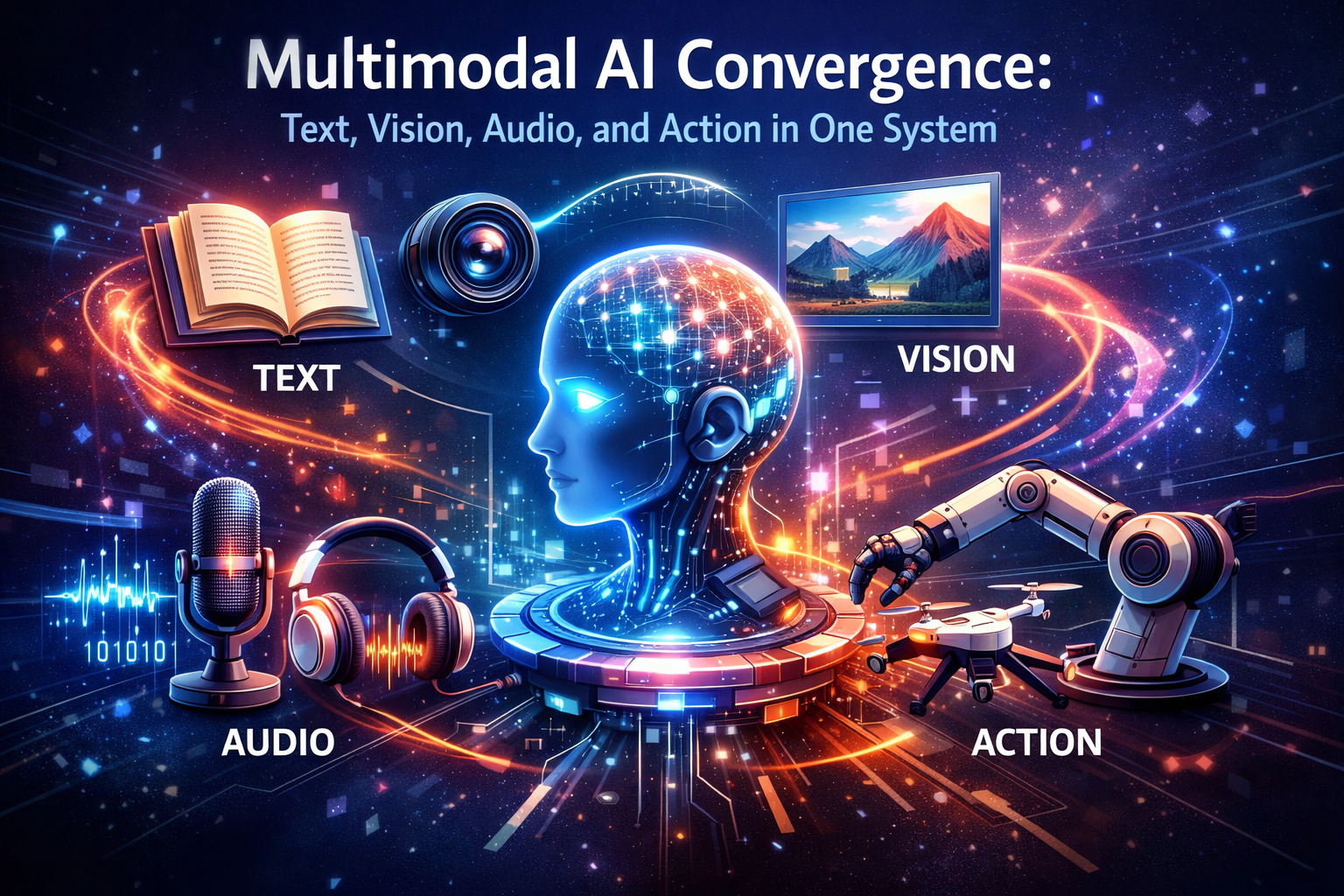
Today, we are witnessing the dawn of Multimodal AI Convergence. This is the shift from single-purpose models to unified systems capable of understanding and generating information across multiple sensory modalities simultaneously: Text, Vision, Audio, and Action.
This isn't just an incremental update; it’s a paradigm shift that aims to create AI that perceives the world more like humans do.
The Architecture of the New AI
To understand this convergence, we must look at how these previously disparate modalities are being integrated. The standard architecture for a Multimodal AI system can be broken down into five key components:
1. The Core: A Unified Understanding
At the center of this revolution is a specialized neural architecture designed for cross-modal translation. We can think of this as the "Convergence Core." It doesn’t just store information; it creates a shared semantic space where a visual pixel can be mapped to a descriptive word, and an audio frequency can be linked to a physical action.
2. Cross-Modal Understanding
A converged system is more than the sum of its parts. It achieves a deeper level of intelligence by fusing data types:
Multimodal Training Data: To build these models, we feed them massive, diverse datasets. This includes videos with synchronized audio and subtitles, medical images paired with diagnostic text, and text descriptions of physical movements. This teaches the AI the relationships between different inputs.
Sensor Fusion: In real-world applications (like robotics), the AI performs "Seamless Sensor Fusion." It takes live input from cameras, microphones, Lidar, and other sensors, processing them collectively to build a comprehensive view of its environment. For example, a robot could use vision to identify a cup, audio to hear if it's being tipped, and text understanding to read "Fragile" written on it.
3. Generative Multi-Tasking
The true power of this convergence is realized in its output. A unified system isn't limited to a single task type. It can perform:
Text Generation: Generating coherent summaries, translations, or creative writing.
Image/Video Synthesis: Creating or editing visual content based on text descriptions or other inputs.
Audio Synthesis: Transcribing speech, generating text-to-speech, or composing music.
Action Execution: Controlling robotic hardware or digital interfaces to perform physical or digital tasks.
4. The Action Layer
The inclusion of "Action" is a critical advancement. Convergence doesn't just stop at perception; it enables execution. This is where AI moves from being a passive observer to an active participant.
Through techniques like Generative Flow, the AI can plan and execute complex, multi-step tasks. It can take a text instruction ("Go to the breakroom and get a glass of water") and generate a sequence of low-level robotic actions to accomplish it, using vision and audio for real-time navigation and object manipulation.
5. Real-World Applications
The possibilities for this unified AI architecture are revolutionary:
Advanced Robotics: Robots that can understand and respond to the complex, unscripted human world.
Enhanced Virtual Assistants: Assistants that can "see" your screen, "hear" your voice and tone, and interact with applications on your behalf.
Accessibility Tech: Tools that can seamlessly translate visual information into audio for the visually impaired, or vice-versa.
Automated Content Creation: Systems that can generate a short video complete with a script, visual scenes, and voiceover from a simple text prompt.
Key Industry Drivers and Adoption
This technological convergence is not happening in a vacuum. It is being driven by a powerful ecosystem of players who recognize its transformative potential.
The "Integrated Partners" are the research labs and major technology corporations—companies like DeepMind, OpenAI, and a strong contingent of Eastern tech giants including Tencent, Alibaba, and Baidu—who are investing heavily in the fundamental research and development of these massive, multi-billion parameter multimodal models.
The "Industry Adopters" represent every other sector—from automotive and healthcare to manufacturing and media—that will integrate these unified AI models into their core products. They are the companies that will build the actual self-driving cars, diagnostic assistants, and content creation tools that bring the power of Multimodal AI to the world.
Conclusion
Multimodal AI Convergence is not just about making smarter computers; it's about building systems that can genuinely understand and interact with the physical and digital world. By breaking down the silos between text, vision, audio, and action, we are moving towards a future of AI that is more capable, more intuitive, and ultimately, more human-centric. The pieces are coming together, and the potential is boundless.