Mobile World Congress (MWC 2026) – AI in Smartphones
The Mobile World Congress (MWC) 2026, held in Barcelona, once again proved why it is the world’s most influential event for the mobile industry. This year, one theme dominated the conversation across exhibition halls, keynote stages, and product launches: Artificial Intelligence in smartphones.
From AI-powered cameras to on-device assistants and smarter battery management, manufacturers showcased how AI is becoming the core engine of modern smartphones rather than just a feature.
AI Becomes the Heart of the Smartphone
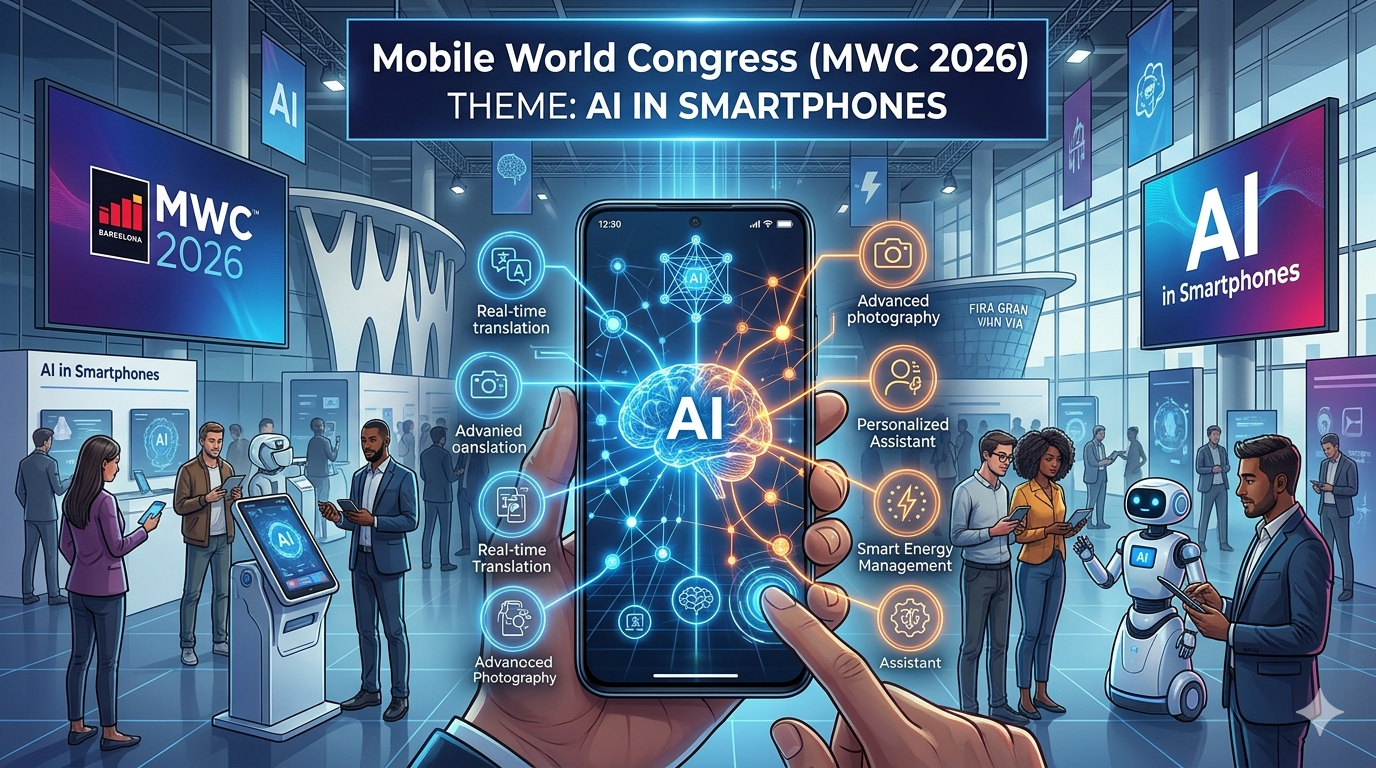
In previous years, smartphone innovation focused heavily on hardware improvements like faster processors and better displays. At MWC 2026, the narrative has shifted.
Now, the real innovation lies in AI-driven experiences that transform how users interact with their devices.
Modern smartphones are increasingly equipped with:
Dedicated AI processing units (NPUs)
On-device generative AI models
Real-time language translation
Intelligent automation features
These advancements allow smartphones to learn from user behavior, predict needs, and perform complex tasks locally without relying on the cloud.
On-Device AI: Faster, Private, and Smarter
One of the biggest trends at MWC 2026 was on-device AI processing.
Instead of sending data to cloud servers, smartphones can now process many AI tasks directly on the device.
Benefits of On-Device AI
Faster performance
Improved privacy
Reduced internet dependency
Lower latency for real-time tasks
Companies highlighted how their devices can now summarize documents, generate messages, and perform image editing directly on the phone.
AI-Powered Smartphone Cameras
Smartphone photography continues to be one of the biggest areas where AI shines.
At MWC 2026, brands demonstrated AI features such as:
Real-time scene detection
AI portrait enhancement
Automatic object removal
AI-powered video stabilization
These capabilities allow even casual users to capture professional-quality photos and videos without manual adjustments.
Some manufacturers also introduced AI video editing tools, enabling users to automatically create highlight reels and short-form content.
Personal AI Assistants on Smartphones
Another major focus at MWC 2026 was the evolution of AI-powered personal assistants.
Unlike traditional voice assistants, new AI assistants can:
Understand complex commands
Manage tasks across multiple apps
Generate emails or messages
Summarize notifications and documents
These assistants act more like digital companions that help users stay organized and productive.
AI and Battery Optimization
AI is also helping improve battery life, one of the most critical aspects of smartphones.
AI systems can now analyze user behavior and dynamically optimize power usage.
Examples include:
Predicting which apps will be used next
Adjusting CPU and GPU performance
Reducing background activity
Managing charging patterns to protect battery health
This means smartphones can last longer while maintaining high performance.
AI for Real-Time Translation and Communication
Several smartphone makers showcased real-time language translation, powered by advanced AI models.
This allows users to:
Translate phone calls
Convert speech into subtitles during conversations
Translate messages instantly
Such features are particularly useful for travel, business communication, and international collaboration.
The Role of AI Chips in Smartphones
To support these advanced capabilities, chip manufacturers unveiled next-generation mobile processors with powerful AI engines.
These chips include:
Dedicated Neural Processing Units (NPUs)
Improved machine learning acceleration
Energy-efficient AI computing
This hardware is essential for running large AI models directly on smartphones.
What This Means for Smartphone Users
The innovations revealed at MWC 2026 suggest that smartphones are evolving into AI-first devices.
Instead of simply being communication tools, smartphones are becoming:
Intelligent productivity assistants
Creative content tools
Personal knowledge hubs
Real-time translators
For users, this means more personalized, efficient, and intuitive experiences.
The Future of AI in Smartphones
Looking ahead, AI will likely continue to shape the future of mobile technology.
Experts predict that future smartphones will feature:
More powerful on-device AI models
Context-aware assistants that understand user habits
Advanced AI-powered security
Deeper integration with AR and wearable devices
As AI technology evolves, smartphones will become even more capable of assisting users in everyday life.
MWC 2026 highlighted a major shift in the smartphone industry: AI is no longer optional—it is essential.
From smarter cameras to powerful on-device assistants, AI is redefining what smartphones can do. As manufacturers continue to push the boundaries of mobile AI, users can expect devices that are not only faster and more powerful but also more intelligent and adaptive than ever before.
The smartphone of the future is not just a device—it’s an AI-powered personal companion.