Gemini 3.7 Flash Explained: Google’s New AI Model for Coding and Agents
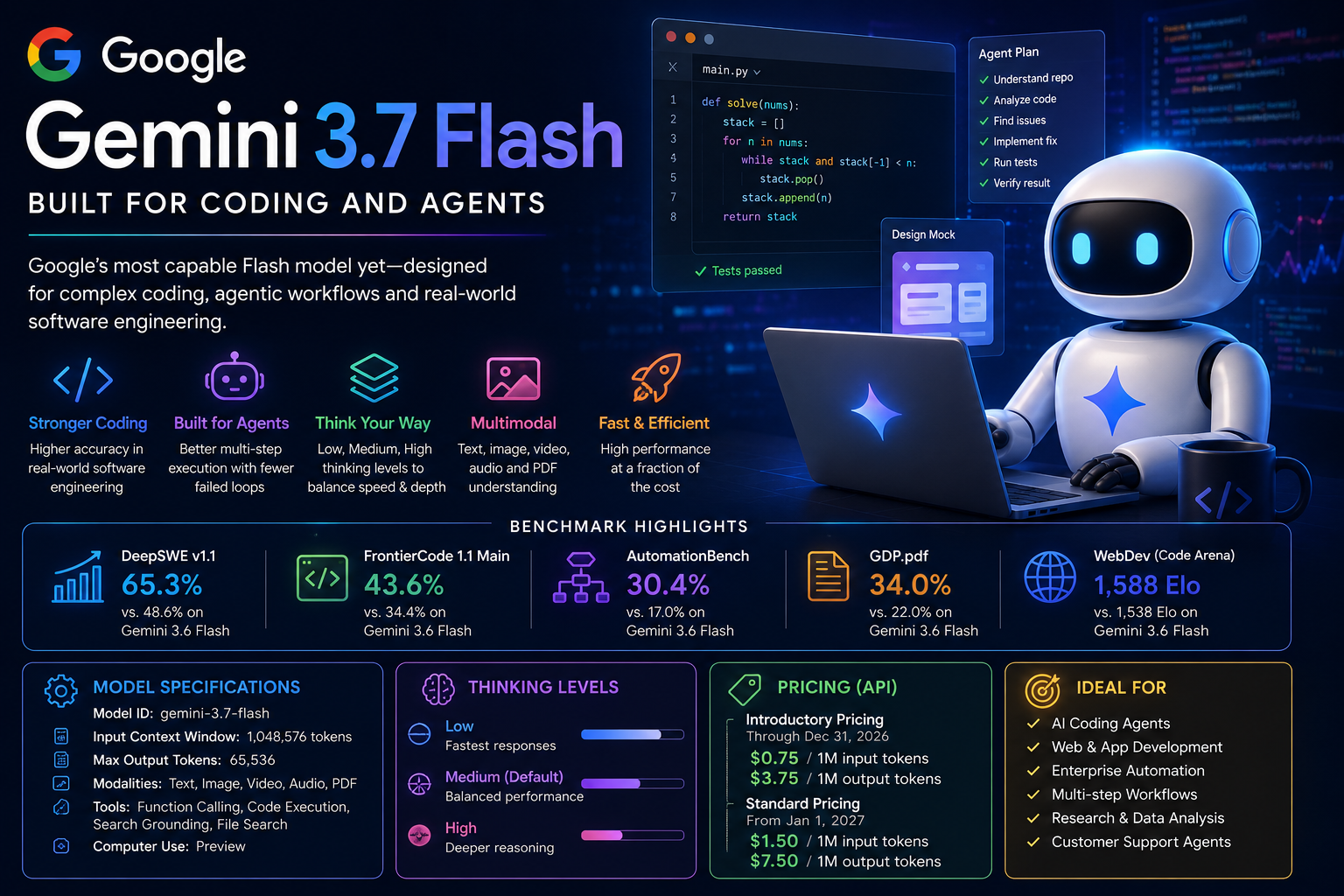
Google has introduced Gemini 3.7 Flash as a practical workhorse AI model for coding, agents, web development, multimodal workflows, and enterprise automation. The release matters because it is not only about higher benchmark numbers. It is about making capable AI easier to use in real software and business workflows.
For developers, Gemini 3.7 Flash is a model to watch for code generation, debugging, planning, tool use, and agentic execution. For business leaders, it is a signal that advanced AI is moving from experimental demos into everyday productivity systems.
Quick Take
- Gemini 3.7 Flash is Google's new generally available Flash model, released for coding, agents, software engineering, web development, and enterprise workflows.
- The model supports text, image, audio, and video inputs, with up to a 1M token context window and 64K text output according to the model card.
- Google positions 3.7 Flash as a stronger workhorse model, not only a premium frontier model for rare tasks.
- The release improves the case for AI agents that can plan, use tools, process files, and complete multi-step business work.
- For European SMEs, the most useful path is to test Gemini 3.7 Flash on narrow workflows before scaling it into production.
The main value of Gemini 3.7 Flash is practical: better AI performance for coding and agents at a cost level that can support real production use.
What Is Gemini 3.7 Flash?
Gemini 3.7 Flash is part of Google's Gemini 3 model family. It is designed as a fast, capable, cost-conscious model for developers, enterprises, and AI products that need more than a basic chatbot response.
In simple terms, Gemini 3.7 Flash is built for work that involves steps. That includes debugging code, generating web pages, summarizing complex documents, using tools, coordinating agent tasks, and handling long-context information.
Google describes the model as a workhorse for coding and agents. That wording is important. A workhorse model is not only meant for occasional high-end reasoning. It is meant to run often, inside products and business processes, where cost, latency, and reliability matter.
| Parameter | Specification |
|---|---|
| Model Name | Gemini 3.7 Flash |
| Model Family | Gemini 3 |
| Model Type | Workhorse AI model for coding, agents, software engineering, and enterprise workflows |
| Inputs | Text, images, audio, and video |
| Input Context Window | Up to 1M tokens |
| Output | Text, up to 64K tokens |
| Thinking Controls | Customizable thinking configurations to balance quality, cost, and latency |
| Availability | Gemini API, Google AI Studio, Gemini Enterprise, Gemini Enterprise Agent Platform, Spark, and Google Antigravity |
| Introductory Pricing | $0.75 per 1M input tokens and $3.75 per 1M output tokens through 31 December 2026, according to Google |
Why It Matters Now
The AI market is shifting from single-prompt assistants to agentic systems. A normal chatbot answers a question. An AI agent can plan a task, call tools, inspect files, generate code, update documents, and ask for review when needed.
That shift makes model quality more demanding. An agent must stay focused across multiple steps. It must recover from roadblocks. It must understand context, use tools correctly, and avoid producing confident but wrong outputs.
Gemini 3.7 Flash matters because Google is aiming at that middle layer: capable enough for complex work, practical enough for repeated use, and integrated enough to fit developer and enterprise environments.
For SMEs, the practical opportunity is not to replace employees with autonomous systems. The opportunity is to reduce repetitive work, speed up engineering tasks, improve document handling, and help teams make better use of their existing knowledge.
Key Capabilities for Developers
Gemini 3.7 Flash is especially relevant for developers because Google highlights improvements across software engineering, web development, and agentic workflows. That places the model in the same practical category as coding assistants, repo-aware agents, automated test helpers, and app prototyping tools.
Coding Assistance
Gemini 3.7 Flash can support code generation, debugging, issue resolution, refactoring suggestions, and test creation when connected to the right development workflow.
Agentic Planning
The model is designed for tasks that need planning and tool use, which makes it useful for multi-step workflows rather than only short answers.
Web Development
Google positions the model as stronger for building functional layouts, app interfaces, and web development workflows from design or text prompts.
Large Context Work
The 1M token context window can help with long documents, codebases, knowledge bases, transcripts, and multi-file analysis when used carefully.
The important point is that developers should not treat this as magic code generation. The best results will still come from clear requirements, project context, tests, code review, and controlled tool access.
Agent Use Cases for Business
Gemini 3.7 Flash is not only a developer story. Google also links the model to Spark, Gemini Enterprise, the Gemini Enterprise Agent Platform, AI Studio, and Google Antigravity. That makes it relevant for business workflows where AI agents need to handle information, tools, and documents.
| Use Case | How Gemini 3.7 Flash Can Help | Human Review Needed? |
|---|---|---|
| Software Development | Draft code, explain errors, create tests, inspect logs, and support issue resolution. | Yes, before merge or deployment. |
| Customer Support | Summarize tickets, suggest replies, search knowledge bases, and route cases. | Yes, for sensitive or customer-impacting replies. |
| Document Review | Process long PDFs, compare policies, extract key clauses, and summarize changes. | Yes, especially for legal, finance, HR, or compliance documents. |
| Sales Operations | Draft follow-ups, summarize account notes, prepare meeting briefs, and update status documents. | Recommended for external communication. |
| Internal Knowledge | Search across procedures, files, transcripts, and project history to answer employee questions. | Needed when answers affect policy, safety, or decisions. |
| Workflow Automation | Coordinate multi-step tasks such as file consolidation, draft creation, and status updates. | Yes, when tools can modify systems or send messages. |
Why the 1M Context Window Is Important
A large context window means the model can receive much more information in one task. That can include documentation, code files, logs, transcripts, customer history, technical specifications, or business procedures.
For developers, this can support codebase understanding. For business teams, it can help with long reports, product manuals, policy documents, tender materials, and meeting notes.
But context size alone does not guarantee quality. A model can still miss details, misunderstand instructions, or rely on outdated information. The better approach is to combine large context with good information design:
- Use authoritative source files instead of random document dumps.
- Separate background context from instructions.
- Ask the model to cite which section or file it used.
- Test answers against a small human-reviewed benchmark set.
- Limit access to sensitive files based on user permissions.
Large context is most valuable when the business already knows which information is trusted, current, and safe to use.
How Gemini 3.7 Flash Compares to Earlier Flash Models
Google says Gemini 3.7 Flash builds on Gemini 3.6 Flash and includes algorithmic improvements to its core reasoning foundation. The company also highlights better developer experience, stronger instruction following, improved planning, and fewer retries across engineering workflows.
The practical shift is this: Flash models are no longer only about speed and cost. They are increasingly being positioned as serious models for work that requires coding, tool use, and agentic planning.
| Area | Why It Matters | What To Test |
|---|---|---|
| Coding | Better software-engineering performance can reduce developer friction. | Bug fixes, unit tests, small features, pull-request review, and documentation updates. |
| Agentic Workflows | Agents need planning, persistence, and tool-use discipline. | Multi-step tasks with checkpoints, tool limits, and replayable logs. |
| Web Development | AI-generated interfaces are useful only when they are functional and maintainable. | Layout quality, responsiveness, accessibility, and code cleanliness. |
| Knowledge Work | Business users need accurate summaries and document reasoning. | Policy comparison, PDF extraction, report summaries, and meeting-note actions. |
| Cost Control | High-volume AI use becomes expensive without careful routing and measurement. | Cost per completed task, retries, latency, and escalation rate. |
Production Readiness Checklist
Before using Gemini 3.7 Flash in a real business workflow, teams should run a controlled pilot. This is especially important when the model can access files, call tools, or generate outputs used by customers or employees.
- Choose one workflow: start with a clear use case such as ticket triage, code review, document summarization, or sales brief creation.
- Create a test set: prepare examples with known good outputs, edge cases, and common failure patterns.
- Measure completion quality: evaluate whether the model finishes the whole task, not only whether the first response sounds good.
- Track cost and latency: monitor token use, tool calls, retries, and total time per task.
- Add human approval: require review before sending messages, changing records, merging code, or making decisions.
- Limit tool permissions: give the agent only the tools and files it needs for the task.
- Log model behavior: record prompts, model version, retrieved sources, tool calls, and final outputs where appropriate.
- Review vendor documentation: keep the model card, API terms, safety notes, and deployment records in your AI governance folder.
EU AI Act and Responsible AI Considerations
For European SMEs, Gemini 3.7 Flash should be treated like any other powerful AI system: useful, but not automatically low-risk in every context. The risk depends on the use case, not only the model name.
This article is not legal advice, but these practical controls are worth applying before production use:
- Use-case screening: check whether the AI workflow touches employment, education, healthcare, credit, safety, legal decisions, or other sensitive areas.
- Transparency: tell users when AI is generating or assisting with content that affects them.
- Human oversight: require approval where AI output influences customers, employees, finances, safety, or compliance.
- Data governance: define which documents, recordings, images, and customer data the model can process.
- Audit trail: keep records of model version, prompts, inputs, retrieved sources, tool calls, and human approvals where needed.
- Synthetic media care: if Gemini tools are used with generated images, audio, or video, avoid deceptive content and label illustrative AI media clearly.
Responsible adoption is not a brake on innovation. It is what lets companies use AI with confidence, especially when agents move from answering questions to taking actions.
Best Fit Recommendation
Gemini 3.7 Flash is a strong model to evaluate if your team needs a practical AI system for coding, agents, multimodal input, long-context work, or Google ecosystem integration.
It is especially relevant for teams that already use Google Cloud, Google Workspace, AI Studio, Gemini API, or agent platforms. The model's value will be highest when it is connected to real workflows with clear tests and human review.
For European SMEs, the best starting point is simple: select one workflow, build a small evaluation set, compare results against your current process, and measure cost, quality, and risk before scaling.
Do not adopt Gemini 3.7 Flash because it is new. Adopt it where it completes a real workflow better, faster, or cheaper than your current approach.
FAQ
What is Gemini 3.7 Flash?
Gemini 3.7 Flash is Google's generally available Gemini 3 model designed as a workhorse for coding, agents, software engineering, web development, multimodal input, and enterprise workflows.
Is Gemini 3.7 Flash good for coding?
Google positions Gemini 3.7 Flash strongly for software engineering and web development. Teams should still test it on their own repositories, coding standards, and review process before relying on it in production.
What is the context window of Gemini 3.7 Flash?
According to the Google DeepMind model card, Gemini 3.7 Flash supports up to a 1M token input context window and up to 64K tokens of text output.
Can Gemini 3.7 Flash power AI agents?
Yes. Google describes the model as suitable for agentic workflows, coding tasks, and enterprise workflows. It is available through channels such as Gemini API, Google AI Studio, Gemini Enterprise Agent Platform, Spark, and Google Antigravity.
Should small businesses use Gemini 3.7 Flash?
Small businesses should consider it for targeted workflows such as document review, customer support triage, sales operations, coding support, and internal knowledge search. Start with a controlled pilot and human review.