Gartner’s Supply Chain Revolution: AI as the Lead Orchestrator
The era of "firefighting" is officially coming to a close. For years, Chief Supply Chain Officers (CSCOs) have operated in a state of permanent crisis management, reacting to global disruptions after the damage was already done. But as we look toward the 2026 landscape, Gartner’s latest insights reveal a fundamental shift: we are moving from reactive response to Autonomous Orchestration.
In this new paradigm, AI isn't just a tool in the shed—it’s the conductor of the entire orchestra.
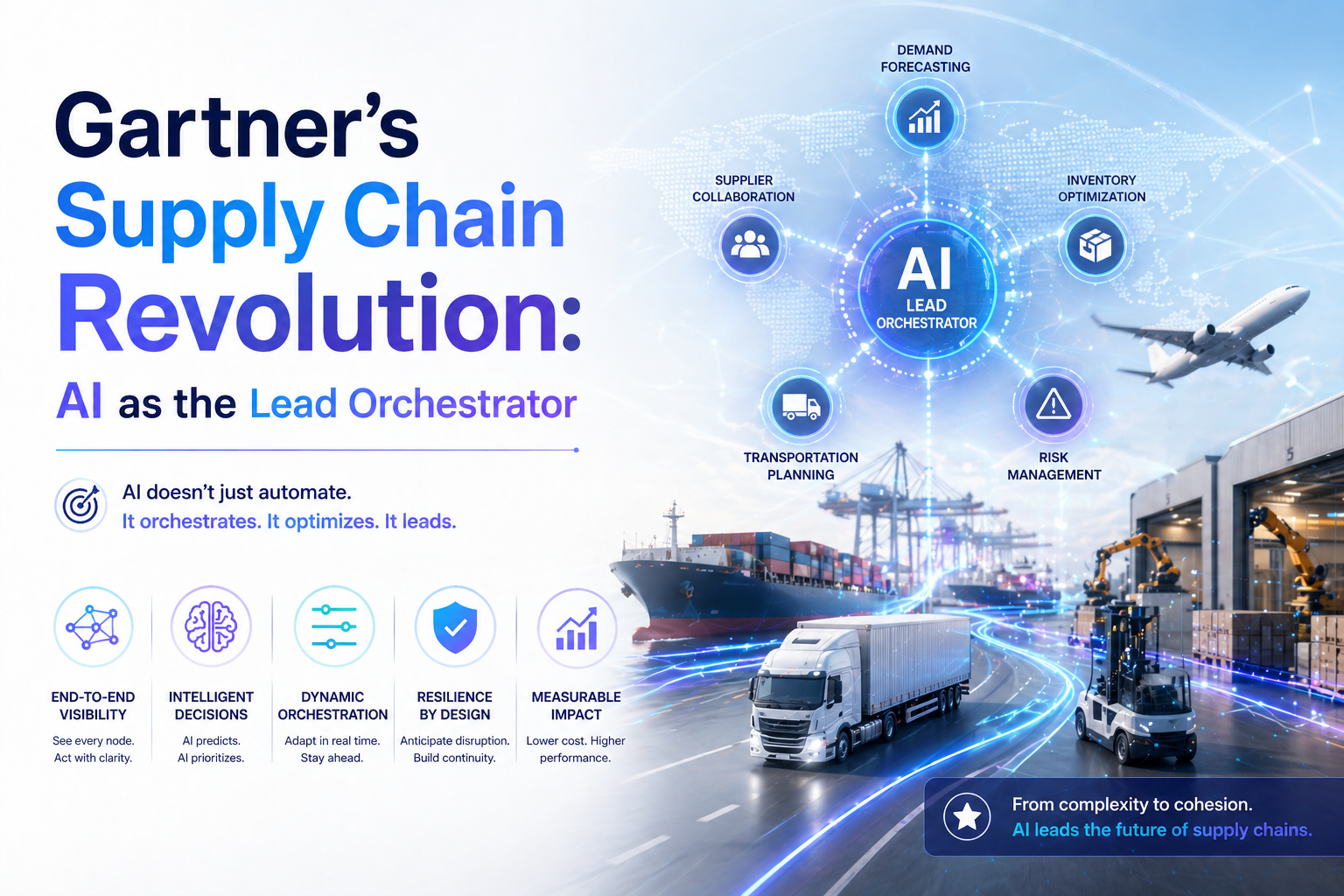
From Silos to Symphony
Traditionally, supply chains have functioned as a series of disconnected silos: procurement, planning, manufacturing, and logistics. When a disruption hit—be it a port strike or a sudden spike in demand—each department made isolated decisions that often inadvertently harmed the others.
AI Orchestration changes the game by creating a "central intelligence" that connects these silos on a real-time data foundation.
Synchronized Execution: Instead of weekly planning cycles, AI enables continuous, end-to-end synchronization from demand sensing to last-mile delivery.
Impact Analysis: Before a decision is even made, AI-driven simulations can predict the upstream and downstream consequences, making the trade-offs between cost, service, and risk explicit.
The Rise of the Agentic Supply Chain
Gartner predicts that by 2026, the focus will shift from simple "Copilots" to Agentic AI. While a Copilot waits for you to ask a question, an AI Agent takes the initiative.
These agents are becoming specialized "digital colleagues":
The Planner Agent: Monitors inventory levels and automatically triggers reorders based on predictive weather patterns.
The Logistics Agent: Detects a shipping delay and autonomously reroutes cargo to a secondary port.
The Procurement Agent: Onboards new suppliers and verifies compliance using "outside-in" data hierarchies.
"The supply chain of 2026 will be defined as much by the quality of its digital colleagues as by the skills of its human workforce." — Gartner Strategic Trend Report
The Human Factor: Leaders, Not Operators
With AI handling the routine "heavy lifting" of data analysis and task execution, the role of the human professional is undergoing a radical transformation. Gartner’s research shows that 55% of supply chain leaders expect Agentic AI to reduce the need for traditional entry-level roles.
However, this isn't a story of replacement, but of elevation.
Human-on-the-Loop: Humans are moving from being "operators who do tasks" to "leaders who supervise systems."
Strategic Governance: The new priority for CSCOs is designing guardrails. We are shifting from managing people to managing the Multiagent Systems (MAS) that run the business.
Preparing for the Orchestrated Future
To thrive in this revolution, organizations must move beyond "AI experiments" and focus on three pillars:
Clean Data: Move away from messy, disconnected files and toward high-quality, real-time information.
Smart Agents: Use specialized AI that actually understands your specific industry and business rules.
Safety Guards: Set up "AI Security" to watch over your digital agents and make sure they stay on track and act ethically.
The Bottom Line
The "Supply Chain Revolution" isn't just about faster computers; it’s about a new way of thinking. In 2026, the most competitive companies won't be those with the biggest fleets or the largest warehouses—they will be those with the most harmonized AI orchestration.
The baton has been passed to the machines. Are you ready to lead the conductor?
How is your organization preparing for the shift from human-in-the-loop to human-on-the-loop orchestration?