Claude Is Helping Build Its Successor: Inside Anthropic's 30,000-Agent R&D System
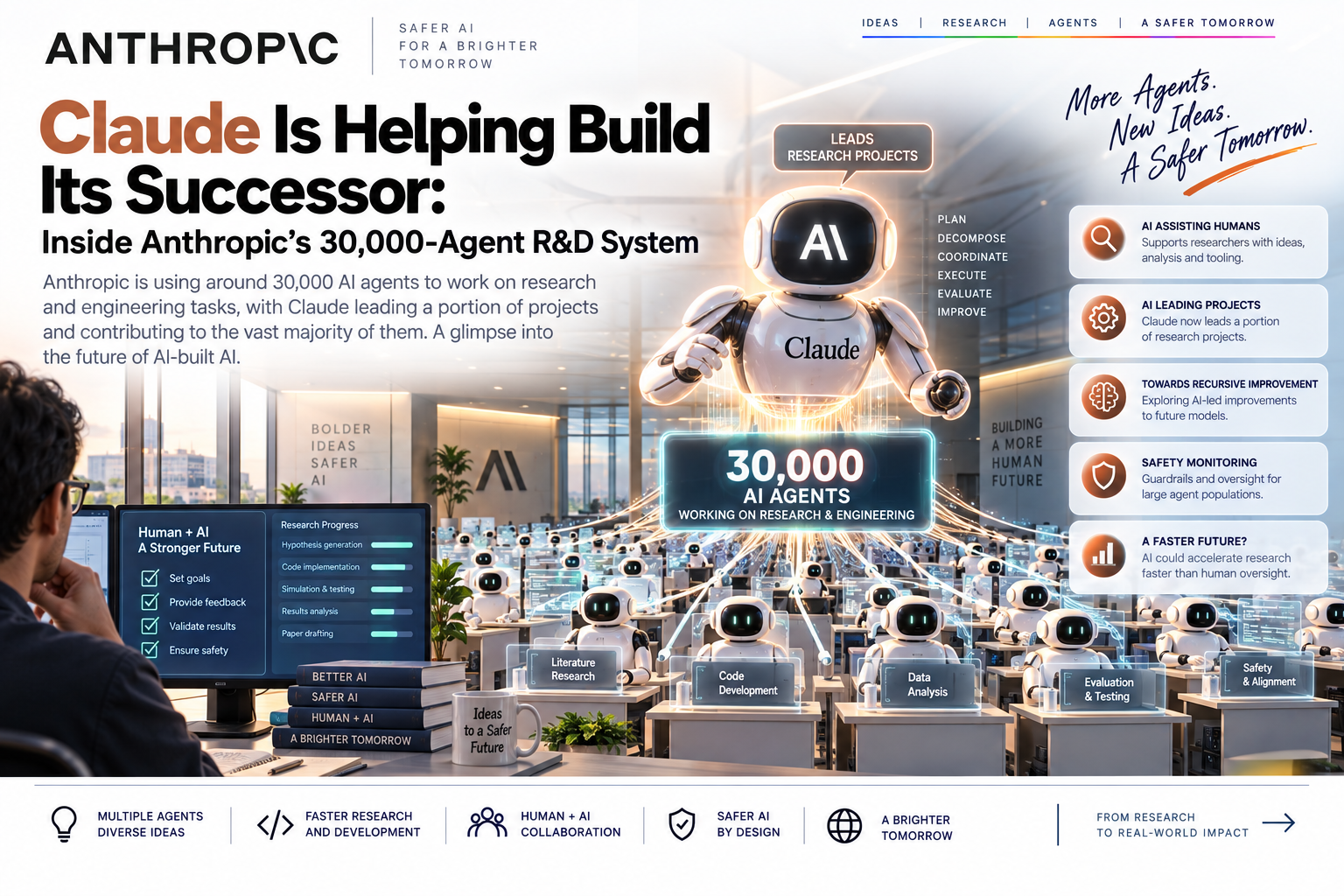
Anthropic has begun publishing internal measurements on how much of its AI research and engineering work is now done with Claude. The result is a serious question for every AI leader: are frontier labs starting to automate the development of the next generation of AI systems?
Quick Take
- Anthropic says Claude is not fully autonomous in measured AI R&D work. The important point is not science fiction autonomy, but the rapid rise of supervised AI-led research tasks.
- Claude "leads" 26% of Anthropic's AI R&D work as of August 2026. Anthropic defines this as Claude completing most of a task end-to-end from a high-level prompt while a human supervises.
- More than 90% of measured AI R&D is at least AI-collaborative. That means Claude is involved in large portions of work under close human direction.
- Anthropic reports about 30,000 internal research and engineering agents active at a given time on its most-used internal platform. Their actions are covered by online and offline monitoring systems.
- The real story is governance. If AI begins accelerating AI research, companies need clearer oversight, logs, safety metrics, third-party evaluation, and human approval gates.
What Anthropic Actually Said
Anthropic has published a framework for measuring the pace of AI development inside frontier labs. The company says it wants the public, governments, and independent evaluators to understand how much of frontier AI development is increasingly being performed by AI systems themselves.
The key distinction is automation level. Anthropic uses a scale that ranges from no AI involvement to fully autonomous AI work. In the middle, AI can assist or collaborate. At a higher level, AI can "lead" a defined task: it receives a high-level prompt, completes most of the work, handles surprises, documents the result, and then waits for a human to review and decide what ships.
That is very different from an unrestricted AI system independently deciding to build and deploy its own successor. Anthropic explicitly says Claude is not operating fully autonomously for any measured subset of AI R&D work.
The Four Levels Readers Should Understand
| Mode | What it means | Human role | Risk level |
|---|---|---|---|
| AI assists | Claude helps with writing, analysis, debugging, summarization, experiment notes, or code suggestions. | Human researcher remains the driver and decides each step. | Lower, but still needs review for mistakes and hallucinations. |
| AI collaborates | Claude performs large chunks of work under close human direction. | Human gives context, checks progress, resolves ambiguity, and approves outputs. | Moderate, because the AI may influence research direction or implementation choices. |
| AI leads | Claude can complete most of a defined task end-to-end from a high-level prompt while supervised. | Human reviews the write-up, checks the change, asks questions, and decides whether to deploy or accept it. | Higher, because less active human steering is needed during execution. |
| Fully autonomous recursive improvement | An AI system monitors for opportunities, chooses research directions, designs improvements, tests, and deploys with no required human involvement. | Human involvement becomes optional or after-the-fact. | Highest. Anthropic says this level has not been reached in its measured AI R&D work. |
Inside The 30,000-Agent R&D System
The most striking number is not only the 26% "AI leads" figure. It is the scale of agentic work. Anthropic says that, as of August 2026, roughly 30,000 agents were doing research and engineering work at any one time on its most-used internal platform.
These are not all independent scientists deciding the future of AI. They are software agents assigned to bounded research and engineering tasks, often using internal tools, code, documents, monitoring systems, and communication channels. The important change is scale: AI work is no longer a single assistant beside one engineer. It is a large population of task agents operating across the R&D organization.
Why This Matters Now
AI-led software development is already changing ordinary engineering teams. The Anthropic disclosure shows the same pattern moving into frontier model R&D itself. If the systems that build AI also become more AI-assisted, progress can compound: better models improve agents, better agents improve research throughput, and faster research can improve the next generation of models.
That compounding loop is why the topic is sensitive. It is also why careful language matters. The public should not be told that an autonomous Claude has gone off to build its own replacement. But it is equally wrong to treat this as ordinary autocomplete. The middle ground is where the real story sits: supervised AI systems are now leading defined parts of frontier AI work.
What Could Accelerate
Agents can scan logs, run experiments, compare results, write summaries, and prepare follow-up tasks faster than a human-only workflow.
AI coding agents can diagnose defects, draft patches, create tests, and document changes for human review.
More agents can generate test cases, inspect failure modes, compare outputs, and find regressions across complex systems.
The same automation can help scale red teaming, oversight research, interpretability experiments, and safety classifiers.
The Oversight Problem
Anthropic reports that actions from these agents pass through online monitors before execution and offline monitors after the fact. Online monitors are designed to block or steer dangerous actions quickly. Offline monitors look for patterns that may develop more slowly, such as signs of misalignment or recurring risky behavior.
This is exactly the kind of governance pattern enterprise AI teams should study. As the number of agents rises, rare failures can become regular operational events. Monitoring only a few demos is not enough. Companies need coverage metrics, review latency, escalation rates, audit trails, incident processes, and human decision rights.
| Governance question | Why it matters | What to measure |
|---|---|---|
| How much work is AI-led? | Leadership needs to know where automation is changing judgment, responsibility, and review load. | Automation level by task type, weighted by business impact or staff time. |
| Are agent actions monitored? | Agent populations can create risks that individual task reviews miss. | Share of actions covered by real-time and after-the-fact monitors. |
| How fast are risky actions reviewed? | Some actions must be blocked immediately; others can be audited after completion. | Review latency, escalation queues, human response time, and unblock criteria. |
| Can humans still understand the system? | Acceleration loses value if teams can no longer explain why a change happened. | Traceability, evidence links, agent identity, logs, experiment records, and decision owners. |
| Is safety scaling with capability? | Using AI to build AI can speed up both safety work and risky capability work. | Compute allocation, red-team coverage, safety staffing, independent audits, and external evaluation. |
What Enterprises Can Learn
Most companies are not building frontier models. But many are about to run agentic systems across engineering, finance, legal, procurement, customer support, and operations. Anthropic's disclosure gives a useful template for how to think about internal agent governance before the agent count grows.
Production Readiness Checklist
- Classify agent autonomy. Separate AI-assisted work from AI-collaborative work, AI-led work, and fully autonomous action.
- Assign human owners. Every agentic workflow should have a named human or team responsible for task approval and risk acceptance.
- Log every action. Keep records of prompts, tool calls, files accessed, code changes, external actions, and approval decisions.
- Use bounded permissions. Start with read-only access, then add write access only where the business case and review process are clear.
- Monitor before and after execution. Use real-time controls for irreversible actions and offline review for slower-emerging patterns.
- Test for correlated failures. Many agents using similar prompts or models can make similar mistakes at scale.
- Separate safety metrics from productivity metrics. Faster output is not the same as safer output.
EU AI Act And Responsible AI Considerations
For European organizations, internal AI agents used for research, engineering, and productivity may often begin as limited-risk or general-purpose AI usage. The risk level changes when agent outputs influence employment decisions, safety-critical systems, financial access, healthcare, education, public services, cybersecurity, or other high-impact areas.
The practical lesson is to classify the use case, not just the tool. A Claude-based agent that drafts a test plan has a different risk profile from an agent that changes production code in a safety-relevant vehicle system, screens job applicants, or approves customer claims.
- Transparency: Tell employees and stakeholders when AI agents are materially involved in research, software, or decision workflows.
- Human oversight: Keep human approval for production deployment, regulated decisions, external communication, and safety-relevant changes.
- Data governance: Limit access to personal data, confidential IP, customer data, and security credentials.
- Auditability: Maintain logs showing which agent did what, with which tools, using which data, and under whose approval.
- High-risk screening: Reassess the workflow if agent outputs affect employment, education, credit, healthcare, public services, law enforcement, critical infrastructure, or safety-critical products.
FAQ
Is Claude autonomously building its own successor?
No. Anthropic says Claude is not operating fully autonomously for any measured subset of AI R&D work. The company says Claude can lead defined tasks under human supervision.
What does "Claude leads 26% of AI R&D" mean?
Anthropic defines "AI leads" as the AI completing most of a task end-to-end from a high-level prompt while a human supervises, reviews the result, and decides what ships.
What are Anthropic's 30,000 AI agents?
Anthropic says about 30,000 agents were doing research and engineering work at any given time on its most-used internal platform as of August 2026.
Why is recursive AI improvement important?
Recursive AI improvement refers to AI systems helping improve or build future AI systems. It matters because it could accelerate progress faster than human oversight, regulation, and safety research can adapt.
What should companies learn from Anthropic's disclosure?
Companies should measure agent autonomy, monitor agent actions, keep human approval for consequential decisions, and build audit trails before scaling internal AI agents.