Astra for Law Explained: How OpenAI Is Building Legal AI Around GPT‑6
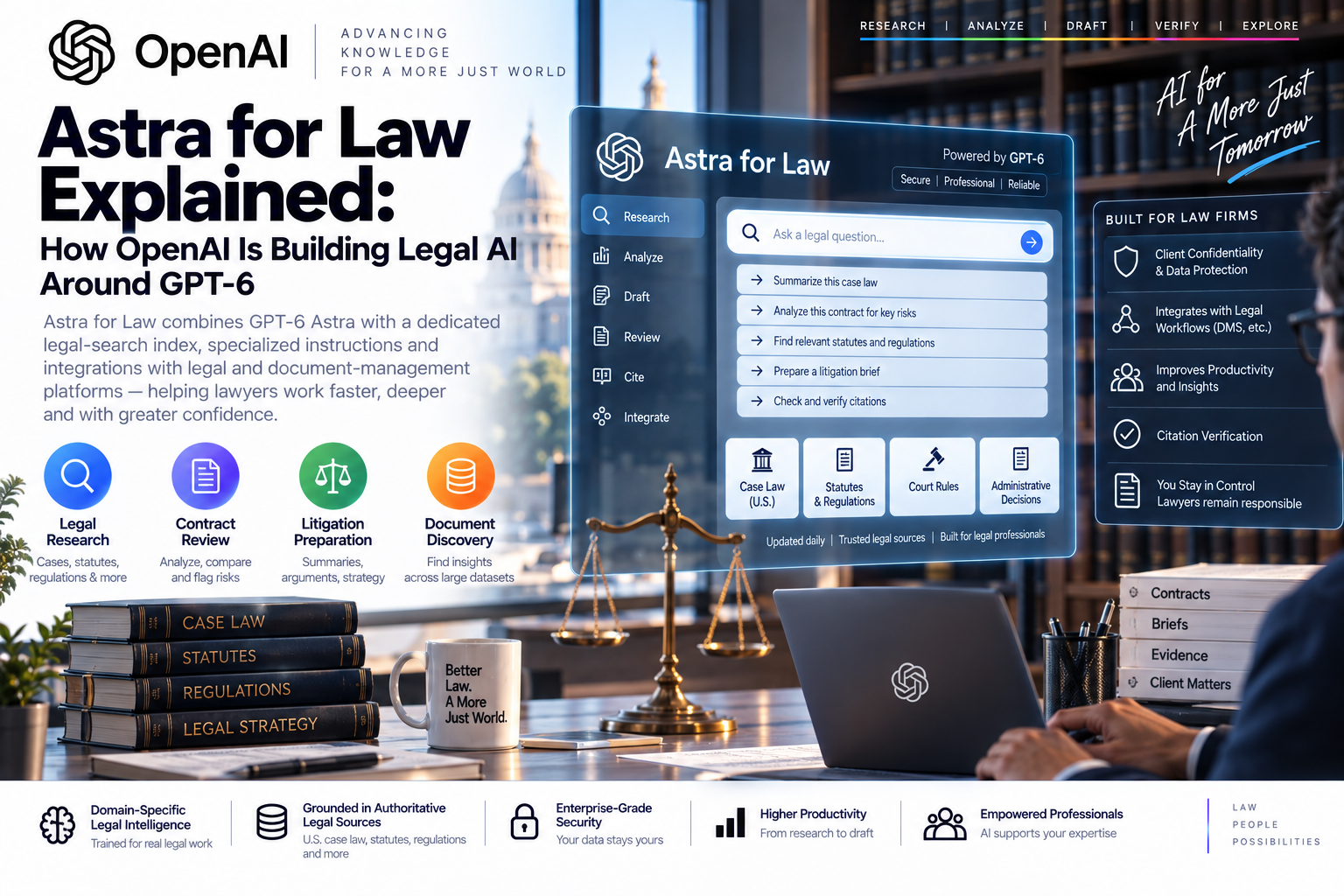
Astra for Law combines GPT-6 Astra with a dedicated U.S. legal-search index, specialist legal instructions, firm knowledge, and integrations. The opportunity is faster legal work with better grounding; the non-negotiable requirement is still qualified human verification.
Quick Take
- Astra for Law is a configured legal foundation, not a robot lawyer. It combines GPT-6 Astra with legal retrieval, legal-writing instructions, enterprise controls, and connectors.
- The initial legal index is U.S.-focused. OpenAI says it covers case law, statutes, regulations, court rules, and administrative decisions, with sources added daily.
- The strongest value is workflow composition. Firms can join public authority, client documents, internal precedents, drafting tools, and approval steps inside one governed process.
- The benchmark improvement is promising but not dispositive. OpenAI reports stronger results than GPT-6 Astra with ordinary web search, but the evaluation is vendor-run and cannot replace matter-specific testing.
- Lawyers remain responsible. Every authority, quotation, procedural rule, deadline, and client-facing conclusion must be checked by a qualified professional.
What Is Astra for Law?
Announced on 17 September 2026, Astra for Law is OpenAI's legal configuration of GPT-6 Astra. Instead of asking a general model to solve a legal problem from its internal knowledge or the open web alone, the system can use a dedicated legal index and instructions designed around professional research, analysis, and writing.
OpenAI says the index searches more than 230 million URLs across U.S. case law, statutes, regulations, court rules, and administrative decisions. CourtListener material is included through work with Free Law Project. This improves the starting point, but it does not make every answer correct or every retrieved source controlling.
Where Legal Teams Could Use It
| Workflow | Useful AI contribution | Required human control |
|---|---|---|
| Legal research | Generate research paths, locate authorities, compare fact patterns, and summarize competing lines of argument. | Confirm jurisdiction, date, precedential weight, negative treatment, quotation accuracy, and completeness. |
| Contract review | Compare clauses with a playbook, identify linked risks, draft redlines, and prepare negotiation questions. | Check commercial context, defined terms, cross-references, regulatory requirements, and client risk appetite. |
| Litigation preparation | Build issue maps, chronologies, witness or deposition themes, document summaries, and draft argument structures. | Validate facts against the record, preserve privilege, supervise discovery duties, and approve every filing. |
| Citation verification | Return linked authorities and flag potentially unsupported claims or inconsistent citations. | Open the primary source and verify the case, passage, pin cite, treatment, and proposition manually. |
| Document discovery | Classify documents, extract issues, answer repeatable questions, and prioritize material for review. | Use validated protocols, quality sampling, defensible audit logs, access controls, and specialist e-discovery review. |
What The Benchmark Does - And Does Not - Prove
OpenAI tested the complete Astra for Law configuration on 200 U.S. legal-research questions from a private validation set of Vals AI's Legal Research Bench. At the highest reasoning level, OpenAI reports 54.0% overall correctness, compared with 38.7% for GPT-6 Astra using web search alone. It also reports finding 24% more reference cases on case-law questions and retrieving up to 54% more relevant passages from the correct opinions in an audited subset.
The figures suggest specialized retrieval and legal instructions improved the tested tasks. They do not establish universal accuracy, non-U.S. coverage, or readiness for unsupervised advice. Firms should run representative matters, known-answer questions, red-team tests, and citation checks against documented acceptance criteria.
Astra for Law vs. Harvey, Legora, CoCounsel, and ChatGPT
These products overlap, but they are not identical substitutes. OpenAI explicitly presents Astra for Law as composable, and says API customers including Harvey and Legora will be able to build on it. A firm could therefore use Astra capabilities inside another legal platform rather than choose only one brand.
| Product | Core position | Best fit | Main diligence question |
|---|---|---|---|
| Astra for Law | GPT-6 legal foundation with a U.S. legal index, specialist instructions, ChatGPT/Codex access, and a plugin ecosystem. | Firms wanting frontier-model capability, custom workflows, and connections to existing legal systems. | Does its present jurisdictional coverage, access model, governance, and integration depth match the firm's work? |
| Harvey | Purpose-built legal and professional-services platform spanning research, document analysis, contract intelligence, knowledge, and agents. | Firms seeking a mature vertical workspace and structured legal workflows across practices. | How will its platform controls, model choices, retention, ethical walls, and firm knowledge operate in the proposed deployment? |
| Legora | Collaborative legal workspace and agentic operating system with research, review, drafting, monitoring, and workflow tools. | Legal teams prioritizing collaboration, configurable workflows, and end-to-end execution in one environment. | Which authorities, integrations, review stages, and jurisdiction-specific capabilities support each intended use? |
| CoCounsel Legal | Legal AI grounded in Westlaw, Practical Law, organizational knowledge, and connected document systems. | Teams that value deep Thomson Reuters content and traceable research-to-drafting workflows. | Does the content coverage, licensing, workflow integration, and verification model justify the total cost? |
| General ChatGPT | Broad general-purpose assistant for drafting, analysis, files, web research, and custom workflows, depending on plan and configuration. | Low-risk ideation, plain-language explanation, internal drafting, and non-specialist productivity. | Is the task safe without a dedicated legal index, legal configuration, matter controls, and specialist validation? |
Confidentiality, Privilege, and Firm Governance
OpenAI says eligible firms can use Zero Data Retention on the API, while ChatGPT Enterprise use is excluded from human review by default. It is also developing information permissions, ethical walls, client instructions, and firm oversight. Firms still need their own legal, security, and procurement review.
Minimum Deployment Controls
- Confirm the contract. Document data use, retention, deletion, subprocessors, hosting region, incident terms, audit rights, and model-training exclusions.
- Mirror matter permissions. Enforce need-to-know access, ethical walls, client restrictions, and role-based controls in every connector.
- Separate environments. Do not mix public experimentation, internal knowledge, and confidential client work in the same uncontrolled workspace.
- Log the chain of work. Preserve the question, sources retrieved, output, edits, reviewer, approval, and final use where professional or regulatory obligations require it.
- Define prohibited uses. Block unsupervised filings, final legal advice, invented citations, automated privilege decisions, and autonomous external communications.
Hallucinations and Legal Liability
Better retrieval does not eliminate hallucinations. Legal AI can still cite the wrong jurisdiction, rely on outdated authority, misread a holding, mix facts, omit an exception, or sound more certain than the evidence permits.
OpenAI's own help guidance tells users to review answers and cited sources before relying on them. The American Bar Association's Formal Opinion 512 likewise emphasizes existing duties including competence, confidentiality, communication, supervision, candor, and reasonable fees. Local bar rules differ, but the practical principle travels well: using AI does not transfer professional responsibility from the lawyer to the tool.
A Five-Point Verification Rule
Before any AI-assisted legal work leaves the firm, verify: (1) the source exists, (2) the quoted passage says what the draft claims, (3) the authority is current and applicable, (4) material counterauthority and uncertainty are disclosed, and (5) a qualified lawyer approves the final work product.
EU AI Act, GDPR, and European Law-Firm Use
European firms should classify the intended use, not the product name. A private law firm's research or drafting assistant is not automatically a high-risk AI system merely because it handles legal material. However, the EU AI Act can classify systems as high-risk when their intended purpose falls within a listed area - including certain systems used by or on behalf of judicial authorities to research and interpret facts and law, or to apply law to concrete facts. Exact obligations therefore depend on the deployment and the role of each organization.
GDPR analysis runs separately. For personal data, firms need a lawful basis, minimization, retention rules, access controls, processor terms, transfer safeguards, and proportionate security. A data-protection impact assessment is required where processing is likely to create high risk. Privilege, professional rules, and court obligations also require separate assessment.
- Maintain human oversight: reserve legal conclusions, filings, advice, and consequential decisions for competent professionals.
- Build AI literacy: train users on retrieval limits, citation checking, confidentiality, prompt hygiene, escalation, and approved use cases.
- Record the purpose: document why the system is used, which data it may access, the expected benefit, and the foreseeable harm.
- Test each jurisdiction: a U.S.-focused index cannot be assumed to provide complete EU, UK, or member-state legal coverage.
- Review high-impact uses: obtain specialist advice before using AI in judicial, employment, immigration, criminal, or other regulated decision processes.
How A Firm Should Pilot Astra for Law
Start with a repeatable, reviewable task such as first-pass research, clause extraction, chronology building, or citation checking.
Use completed matters and lawyer-approved outputs to measure authority recall, citation precision, omissions, time saved, and correction effort.
Connect only approved repositories, mirror permissions, set retention rules, and require named reviewers before broader access.
Expand only when quality, confidentiality, user behavior, and economics meet documented thresholds across representative matters.
MaGeN-AI View
The Competitive Advantage Is The Governed Workflow
Astra for Law matters because it moves legal AI beyond a clever chat interface toward a configurable stack: frontier reasoning, authoritative retrieval, firm context, specialist applications, and review. Yet the winning system will not necessarily be the model with the highest headline score. It will be the workflow that gives lawyers the right source at the right moment, preserves client trust, shows its evidence, and makes verification easier than blind acceptance.
For most firms, the best next step is a controlled evaluation rather than a firm-wide rollout. Compare Astra for Law with existing tools on real work, measure corrected output rather than raw output, and treat human judgment as part of the system architecture.
FAQ
What is Astra for Law?
Astra for Law is OpenAI's legal configuration of GPT-6 Astra. It combines a dedicated U.S. legal-search index, legal-analysis and writing instructions, enterprise controls, and integrations for professional legal workflows.
Can Astra for Law replace a lawyer?
No. It can accelerate research, review, analysis, and drafting, but a qualified lawyer must verify authorities, facts, reasoning, confidentiality, and the final work product.
How is Astra for Law different from general ChatGPT?
It adds legal-specific retrieval, instructions, access controls, and ecosystem integrations. General ChatGPT is broader, but it does not by itself provide the same dedicated legal configuration.
Is Astra for Law better than Harvey, Legora, or CoCounsel?
There is no universal winner. The products differ in content, workflow design, integrations, governance, jurisdictional coverage, and deployment model. Firms should test them against their own matters and controls.
Does the EU AI Act classify all legal AI as high-risk?
No. Classification depends on intended purpose and deployment. Certain judicial or comparable decision-support uses may be high-risk, while ordinary law-firm research or drafting support is not automatically high-risk. GDPR and professional duties may still apply.