Beyond Chatbots: How "Agentic" AI is Becoming Your Digital Workforce in 2026
For years, the promise of AI centered around intelligent chatbots and predictive analytics. While impressive, these systems often required constant human supervision or were limited to answering questions. Fast forward to 2026, and the AI landscape has profoundly shifted. We are no longer just interacting with AI; we're collaborating with it as it transforms into a proactive, autonomous "Agentic" workforce.
This isn't science fiction anymore. Agentic AI refers to systems capable of understanding complex goals, breaking them down into sub-tasks, executing those tasks across various applications, and even self-correcting along the way. Think of them not as tools you operate, but as digital coworkers that take initiative.
What Defines Agentic AI in 2026?
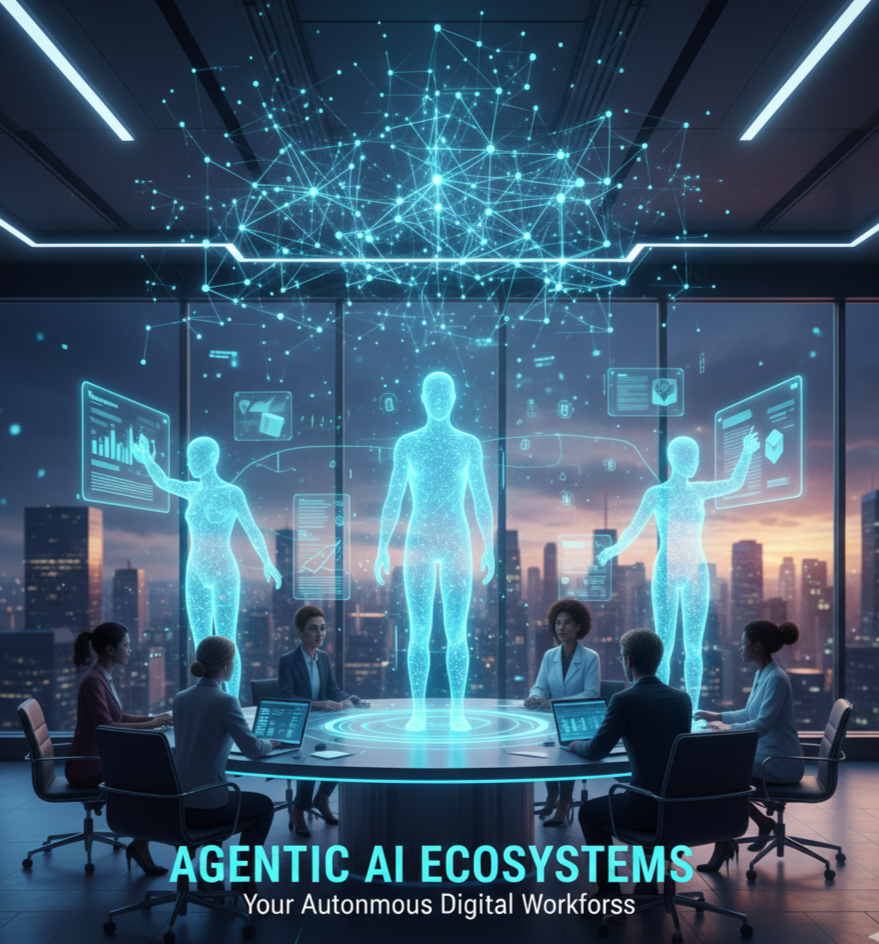
Goal-Oriented Autonomy: The core shift is from reactive (answering a prompt) to proactive (achieving a goal). You don't just ask an agent for information; you give it an objective like, "Research optimal marketing strategies for our Q3 product launch, draft a campaign plan, and schedule a review meeting with the team." The agent then orchestrates the entire process.
Multi-Agent Collaboration: The most sophisticated Agentic AI systems aren't single entities. Instead, they operate as teams of specialized agents. Imagine:
A "Planner Agent" that breaks down the main goal.
A "Research Agent" that gathers data from various internal and external sources.
A "Execution Agent" that interacts with your CRM, project management tools, or even design software.
A "Critic Agent" that evaluates the output and suggests improvements before final delivery. This collaborative intelligence enables far more complex and robust outcomes.
"Write Access" and Digital Execution: This is perhaps the most significant differentiator. While previous AI could suggest an email, Agentic AI has the authorization (and the security protocols) to draft and send that email. It can update your database, create entries in your financial ledger, or even initiate code changes in your development environment. This moves AI from an advisory role to an execution layer.
World Models and Physical AI: The intelligence isn't confined to digital spaces. In 2026, Agentic AI is increasingly powering robotics and autonomous systems in the physical world. These agents leverage sophisticated "World Models" – internal representations of physics, objects, and environments – allowing them to plan, navigate, and interact with the real world (e.g., in logistics, manufacturing, or even advanced personal robotics).
The Impact: From Productivity to Strategic Advantage
Supercharged Productivity: Imagine teams being freed from mundane, repetitive tasks. Sales reps focus on building relationships while AI agents handle lead qualification and follow-ups. Engineers spend more time innovating while AI assists with debugging and routine code generation.
Faster Innovation Cycles: The ability to rapidly prototype, test, and iterate with autonomous agents dramatically shortens development cycles across all industries.
Democratization of Complex Tasks: Expertise can be encapsulated within agents, making advanced capabilities accessible to a broader workforce.
New Business Models: Companies are emerging that offer "AI-as-a-Service" in a new way – providing entire teams of digital agents tailored to specific business functions.
Navigating the Agentic Future
While the potential is immense, embracing Agentic AI requires careful consideration of:
Robust Security and Governance: Granting "write access" means rigorous security protocols and clear governance frameworks are paramount.
Human-in-the-Loop Oversight: Even autonomous systems need oversight. Establishing clear human review points and fail-safes is crucial.
Ethical AI Development: Ensuring agents adhere to ethical guidelines and avoid bias is more important than ever as they gain more autonomy.
In 2026, Agentic AI isn't just improving existing processes; it's fundamentally reshaping the nature of work. It’s no longer about whether AI can do a task, but how effectively we can orchestrate these intelligent agents to achieve our most ambitious goals. Get ready to welcome your new digital coworkers!