Beyond the Prompt: The Dawn of Agentic Engineering
The evolution from "chatting" with AI to building autonomous systems.
For the past few years, the tech world was obsessed with Prompt Engineering—the art of coaxing a Large Language Model (LLM) into giving a useful answer through trial, error, and "vibes." But as of May 2026, the industry has fundamentally pivoted. We have officially entered the era of Agentic Engineering.
If 2023 was the year of the Chatbot, 2026 is the year of the Agent.
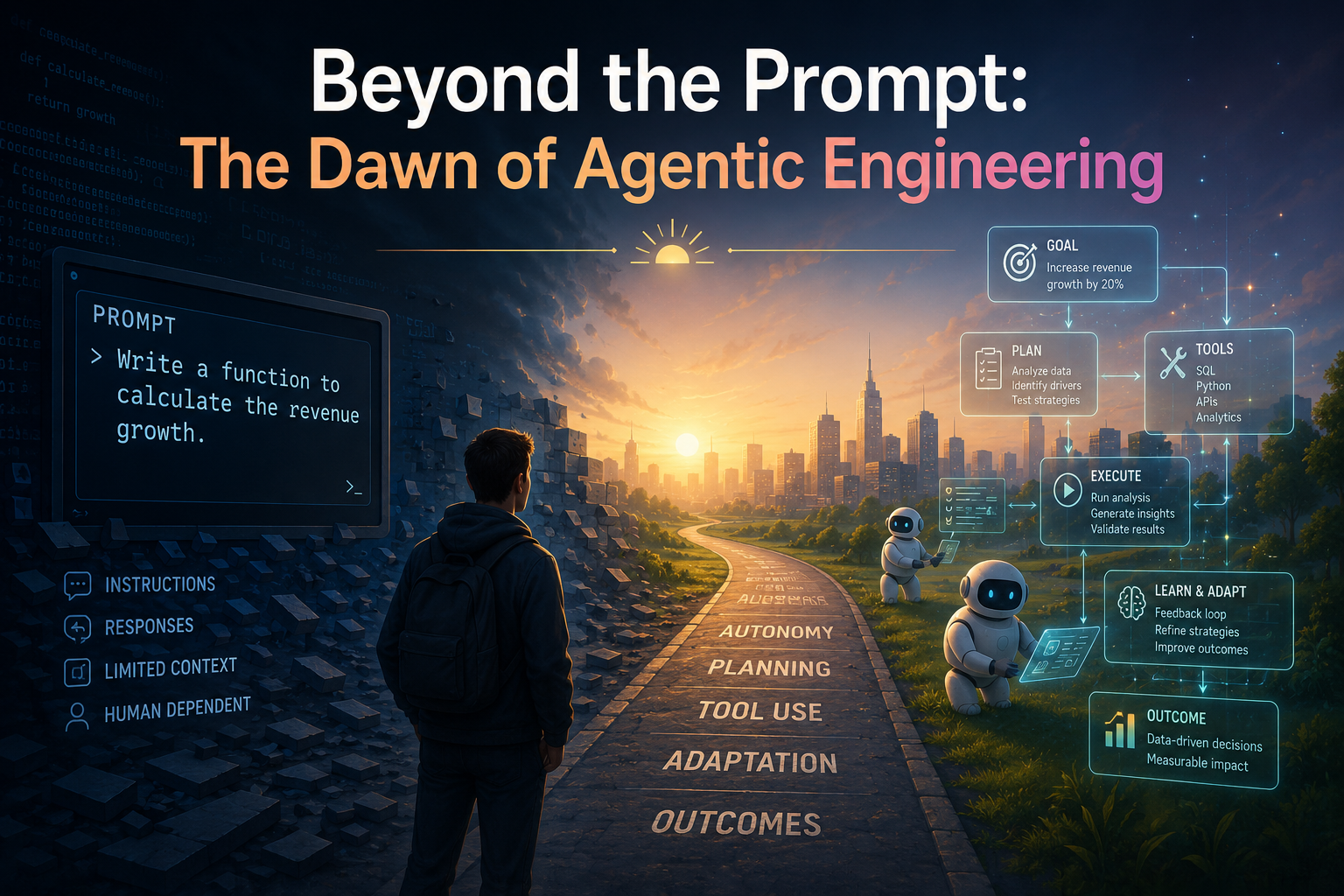
1. What is Agentic Engineering?
Agentic Engineering is a discipline focused on designing systems where AI operates as an autonomous agent. Unlike a chatbot that waits for a prompt to provide a single response, an "Agentic" system is designed to:
Reason: Break complex goals into smaller sub-tasks.
Act: Use external tools (browsers, code compilers, databases).
Observe: Evaluate the results of its actions.
Iterate: Correct its own mistakes until the goal is achieved.
We are moving away from "Vibe Coding" (writing prompts until the code looks right) toward System Architecture, where the human’s role is to define the boundaries and objectives for an AI that does the heavy lifting.
2. The Shift: From Conversations to Workflows
The major breakthrough this week—highlighted by updates from industry leaders like Anthropic and the rebranding of development cycles by experts like Andrej Karpathy—is the move toward "Agentic Loops."
In a traditional setup, if an AI writes buggy code, the human has to find the bug and ask for a fix. In an Agentic Workflow, the system:
Writes the code.
Runs a test suite automatically.
Reads the error logs.
Rewrites the code to fix the error.
Repeats until the tests pass.
This is why companies like Airbnb are reporting that over 60% of their new code is now generated and verified by AI agents before a human ever sees it.
3. The Three Pillars of the Agentic Era
Self-Healing Systems: We are seeing the rise of software that maintains itself. When a cloud server goes down or an API changes, agents detect the failure and deploy a patch in real-time.
Compound Reasoning: Modern agents can now manage tasks that span weeks. They can "dream" or reflect on past patterns during idle compute time, optimizing their strategy for the next day's work.
The Compute War: This shift requires massive power. With the current $200 billion scramble for data centers, the world is essentially building the "brain" that these agents need to inhabit.
4. Why This Matters for You
Whether you are a developer, a business owner, or a casual tech observer, the message is clear: The barrier to creation has collapsed. The challenge is no longer knowing how to code or how to write the perfect prompt. The challenge is orchestration. Success in 2026 belongs to those who can manage a fleet of digital agents to solve complex, multi-step problems.
The Bottom Line
The era of "talking" to your computer is ending. The era of "delegating" to your computer has begun. It’s time to stop prompting and start engineering.
Tags: #AI #AgenticEngineering #TechTrends2026 #FutureOfWork #SoftwareDevelopment