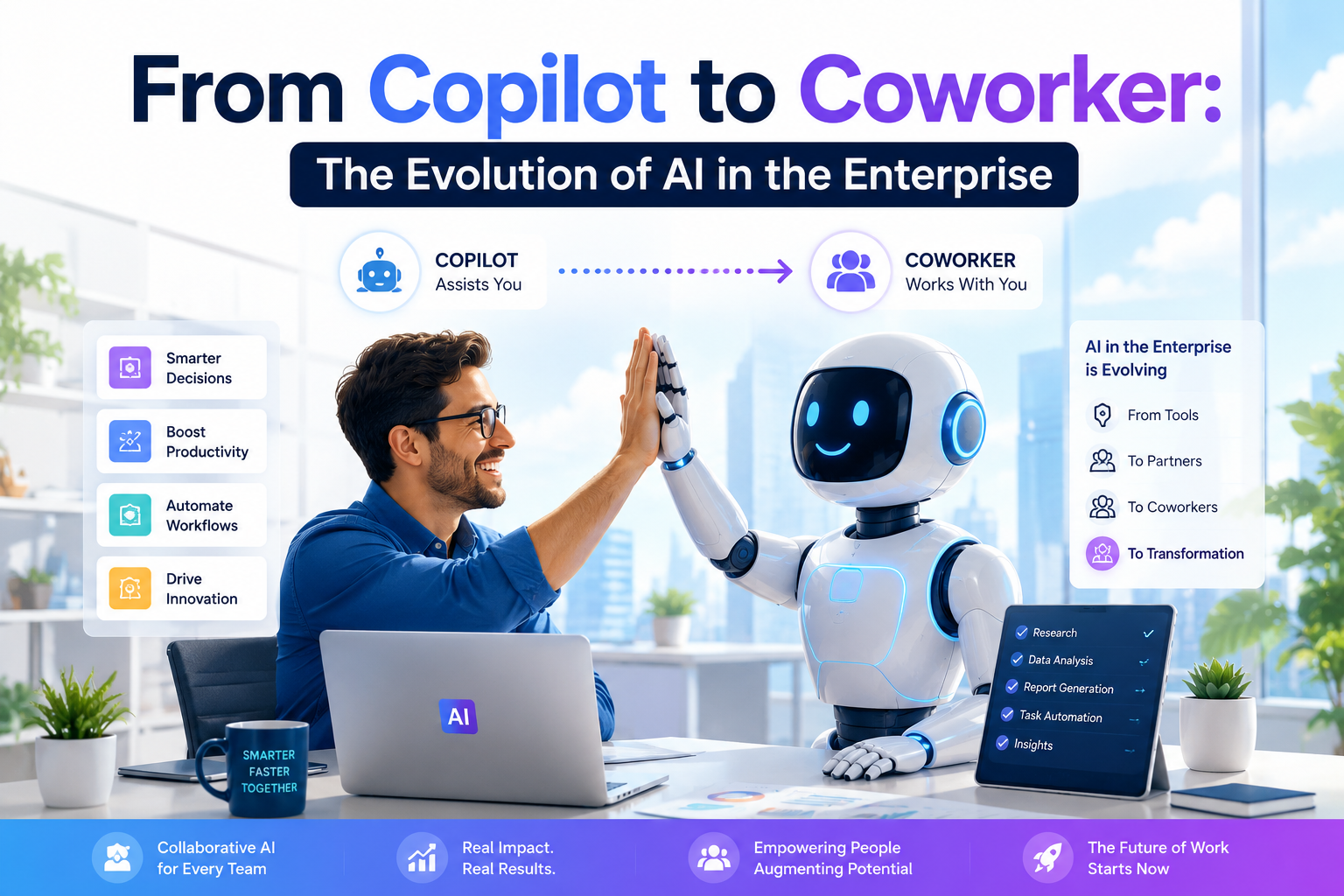
From Copilot to Coworker: The Evolution of AI in the Enterprise
The Shift from "Assisting" to "Executing"
The Great Hand-Off
For the better part of the last decade, the corporate world has viewed Artificial Intelligence through the lens of the Copilot. It was a comforting metaphor—one that kept the human firmly in command while the machine handled the navigation. Like a GPS in a car, these early AI systems provided directions, mapped out routes, and flagged potential hazards. But the relationship was strictly hierarchical: the human always had their hands on the wheel and their foot on the gas. If the human stopped "driving" (prompting), the work stopped moving.
However, we are currently witnessing a fundamental shift that is re-writing the social contract between humans and machines. We are moving away from Reactive Tools—which sit idle until spoken to—and toward Autonomous Agents.
This is the transition from AI as a "Copilot" to AI as a "Coworker."
This evolution represents more than just a software update; it is a shift in Agency. While a Copilot assists you with a task, a Coworker shares the responsibility for an outcome. We are moving from an era of Micro-management (telling an AI how to write a single sentence) to an era of Orchestration (assigning an AI a project and reviewing the results).
In this new enterprise landscape, the competitive advantage no longer goes to those who can use AI tools the fastest, but to those who can build, manage, and trust a digital workforce that thinks, acts, and iterates on its own.
1. Defining the Difference: Agency vs. Assistance
The primary difference between a tool and a coworker is Agency.
The Copilot Era (Reactive): You provide a prompt; the AI provides a response. It is a "one-and-done" interaction. If the output is wrong, the human must manually intervene to correct it.
The Coworker Era (Proactive): You provide a goal; the AI builds a plan. These "Agentic" systems use reasoning loops to check their own work, use external software tools, and only "ping" their human counterparts when they hit a roadblock they cannot solve.
2. The Three Pillars of the AI Coworker
To function as a true coworker, AI systems are now being built on three architectural pillars:
Tool Use (Action): Unlike early chatbots that could only "talk," modern enterprise agents can "do." They can interface with CRMs, update spreadsheets, and trigger API calls to external services.
Self-Correction (Reasoning): A coworker doesn't just hand in a first draft without looking at it. New AI frameworks allow models to "critique" their own output, running invisible internal cycles to ensure accuracy before presenting results.
Long-Term Memory (Context): A copilot forgets the conversation once the window is closed. A coworker remembers the project goals from last week, the tone of the brand, and the specific preferences of the team.
3. Changing the Management Paradigm
When you have an AI Coworker, your job description shifts from "Doer" to "Orchestrator." Managing a digital workforce requires a different skillset than traditional software use. It requires:
Defining Objectives: Learning how to set clear, high-level goals rather than micro-managing step-by-step instructions.
Evaluating Logic: Instead of just checking the final answer, humans must now audit the "chain of thought" the AI used to get there.
Ethical Oversight: Ensuring that as agents become more autonomous, they remain aligned with company values and security protocols.
4. The Competitive Edge
The enterprises that will lead the next decade are not those that simply "use AI," but those that re-architect their workflows to accommodate digital colleagues. This means moving past the chat box and building "Agentic Workflows" where AI and humans pass tasks back and forth seamlessly.
The "Copilot" was our introduction to the power of AI. The "Coworker" is the reality of how work gets done.
The transition from Copilot to Coworker marks the end of AI as a mere utility and the beginning of AI as a strategic partner. Success in this new era requires shifting our focus from perfecting prompts to architecting autonomous workflows. Ultimately, we aren't just adopting new software; we are evolving our roles from digital operators to visionary orchestrators of a hybrid workforce.
Key Takeaways for Leadership:
Stop thinking about prompts; start thinking about processes.
Invest in "Agentic" infrastructure that allows AI to access your internal tools securely.
Upskill your team in AI orchestration, moving them from "users" to "managers of digital talent."
Tags: #EnterpriseAI #ArtificialIntelligence #FutureOfWork #AIStrategy #Leadership