Apple Intelligence vs Galaxy AI: Which On-Device AI Is Better?
Artificial intelligence has become one of the biggest selling points for modern smartphones. Instead of relying entirely on cloud servers, companies are increasingly running AI models directly on the device. This approach offers faster responses, better privacy, and the ability to perform many AI tasks even without a stable internet connection.
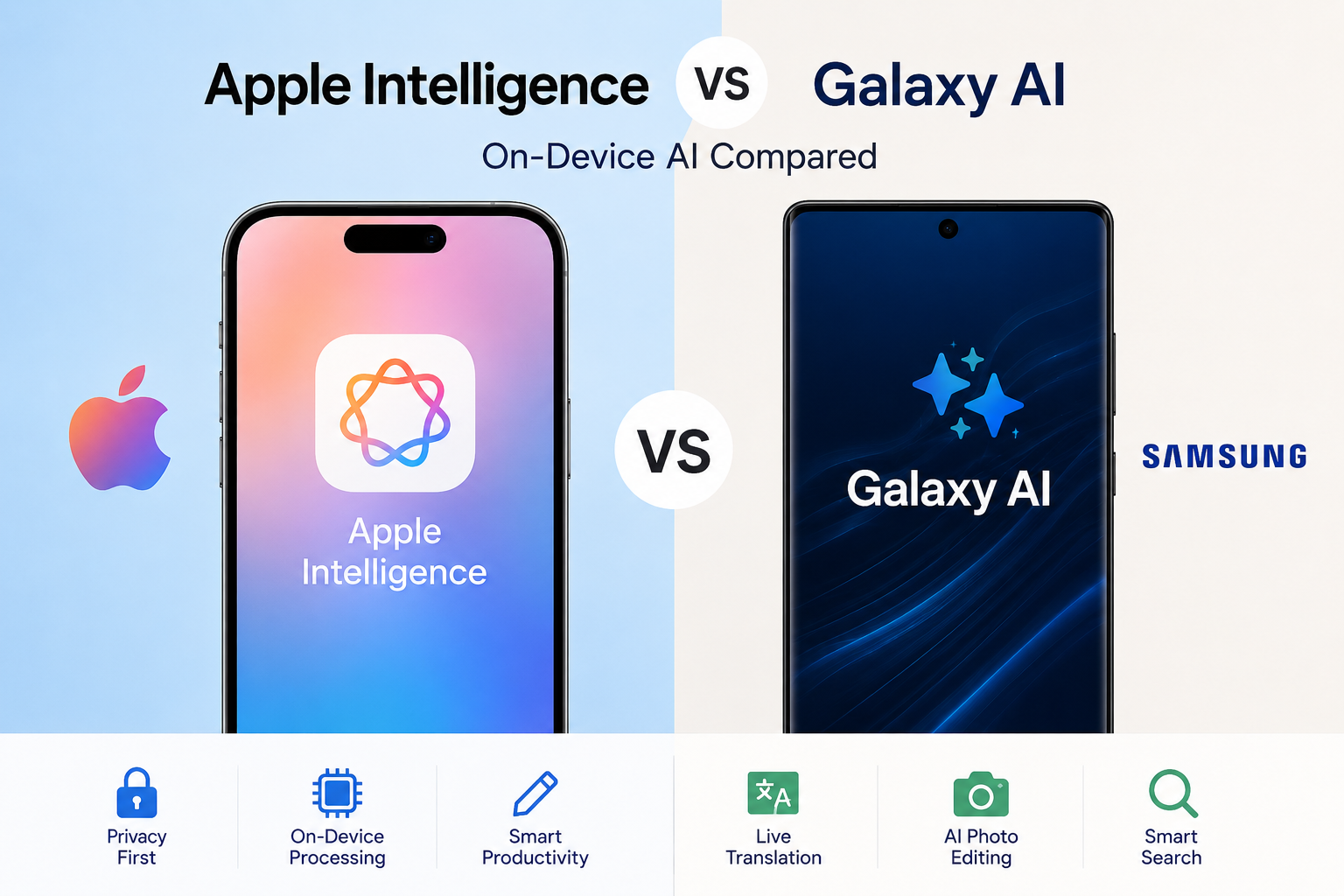
Two of the biggest names leading this shift are Apple Intelligence and Samsung Galaxy AI. Although both aim to make smartphones smarter, they follow different strategies when it comes to privacy, ecosystem integration, and AI-powered features.
In this article, we compare both platforms to help you understand which one is better suited for your daily workflow.
Table of Contents
What Is On-Device AI?
Apple Intelligence Overview
Galaxy AI Overview
Feature Comparison
Privacy and Security
Productivity Features
Photography and Creativity
Performance
Which One Is Better?
Final Thoughts
Frequently Asked Questions
What Is On-Device AI?
Traditional AI services send your request to cloud servers where the processing happens remotely.
On-device AI works differently.
Instead of uploading your data, the AI model runs directly on your smartphone using specialized hardware such as neural processing units (NPUs). This approach offers several advantages:
Faster responses
Reduced internet dependency
Better privacy
Lower latency
Improved battery efficiency for many AI tasks
As smartphone chips continue to improve, more AI features can now run locally without sending sensitive information to external servers.
Apple Intelligence Overview
Apple Intelligence is Apple's personal AI system designed for iPhone, iPad, and Mac devices. It focuses on integrating AI into everyday tasks rather than introducing AI as a separate application.
Its primary design goals include:
Privacy-first architecture
Deep integration with Apple apps
Context-aware assistance
Writing assistance
Image creation tools
Notification summaries
Enhanced Siri capabilities
Apple combines local processing with secure cloud computing when more computing power is required, aiming to minimize exposure of personal data.
Galaxy AI Overview
Galaxy AI is Samsung's suite of AI-powered features available across many Galaxy devices.
Instead of focusing only on productivity, Galaxy AI emphasizes communication, creativity, and multimedia experiences.
Popular features include:
Live language translation
AI photo editing
Note summarization
Circle to Search
AI writing assistance
Voice transcription
AI-powered camera enhancements
Samsung combines on-device AI with cloud-based processing depending on the feature and device capabilities.
Privacy Comparison
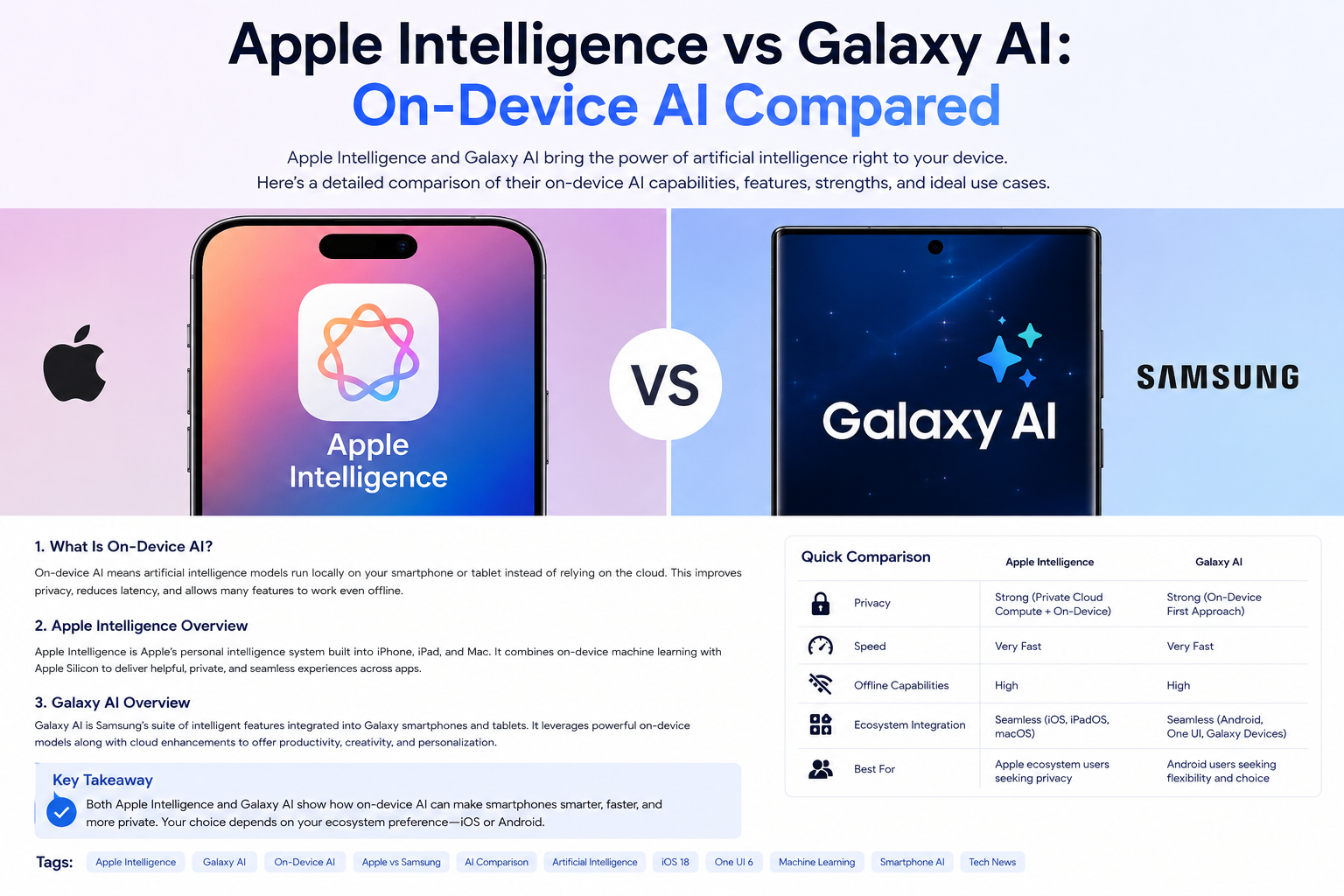
Privacy is one of the biggest differences between the two platforms.
Apple Intelligence
Apple places privacy at the center of its AI strategy.
Many AI requests stay on the device whenever possible. For tasks requiring larger models, Apple uses secure cloud infrastructure designed to limit unnecessary data collection.
Advantages include:
Minimal data sharing
Local processing
Secure architecture
Tight integration with Apple hardware
Galaxy AI
Samsung also supports on-device processing for many features.
However, some advanced AI functions may use cloud services depending on the task.
Advantages include:
Flexible AI services
Integration with Google AI
Powerful language features
Wide Android compatibility
Productivity Features
Apple Intelligence
Apple focuses heavily on helping users complete everyday tasks.
Examples include:
Email rewriting
Text summarization
Writing suggestions
Notification summaries
Calendar assistance
Smart search
These tools work naturally inside Apple applications.
Galaxy AI
Samsung offers a broader set of productivity tools for Android users.
Popular examples include:
Note summarization
Meeting transcription
Live translation during calls
AI document formatting
Browser summarization
These features are particularly useful for professionals who work across multiple devices.
Photography and Creativity
Both companies have invested heavily in AI-powered photography.
Apple Intelligence
Apple focuses on:
Smart photo organization
Natural language photo search
AI image generation
Memory creation
Object cleanup
The emphasis is on preserving natural-looking images.
Galaxy AI
Samsung offers:
Generative photo editing
Object removal
Image expansion
AI-powered zoom enhancement
Portrait improvements
Instant photo remastering
Galaxy AI generally provides more creative editing options for users who frequently modify photos.
Performance
Modern smartphone chips include dedicated AI processors capable of handling billions of operations every second.
Because many AI tasks now execute locally, users benefit from:
Faster responses
Better battery optimization
Reduced waiting time
Lower network usage
Performance depends on the specific device model, available memory, and hardware generation rather than the AI platform alone.
Which One Is Better?
The answer depends on your priorities.
Choose Apple Intelligence if you:
Already use the Apple ecosystem
Prioritize privacy
Prefer seamless software integration
Want AI built naturally into daily workflows
Choose Galaxy AI if you:
Use Android devices
Need advanced AI photo editing
Frequently translate languages
Prefer customization and flexibility
Neither platform is objectively better for every user. Instead, each excels in different scenarios.
The Future of On-Device AI
The smartphone industry is moving toward larger AI models running directly on consumer devices.
Future improvements may include:
Faster personal assistants
Offline language translation
Better video generation
AI-powered health insights
Smarter productivity tools
Personalized learning experiences
As mobile processors become more powerful, the distinction between cloud AI and local AI will continue to shrink.
Final Thoughts
Apple Intelligence and Galaxy AI represent two different approaches to the same goal: making smartphones more helpful without requiring users to constantly rely on cloud services.
Apple emphasizes privacy, simplicity, and ecosystem integration, while Samsung focuses on versatility, creative tools, and communication features.
If you are deeply invested in the Apple ecosystem, Apple Intelligence is likely the better fit. If you prefer Android and value advanced AI editing tools and broader customization, Galaxy AI offers an impressive experience.
The competition between these platforms is driving rapid innovation, and users stand to benefit as on-device AI becomes faster, smarter, and more capable.
Tags
#AppleIntelligence #GalaxyAI #AppleVsSamsung #OnDeviceAI #ArtificialIntelligence #GenerativeAI #AppleAI #SamsungAI #SmartphoneAI #MobileAI #AIComparison #AIProductivity #AICamera #AIWriting #MachineLearning #TechNews #ConsumerTech #FutureTech #AIInnovation #MagenAI #iPhoneAI #AndroidAI #AI2026 #TechTrends #DigitalInnovation