NVIDIA LeRobot: Open-Source Physical AI Explained
Artificial Intelligence has already transformed how computers generate text, images, and software. The next major shift is bringing AI into the physical world, where robots can understand, learn, and interact with their surroundings.
This is where NVIDIA LeRobot is gaining attention.
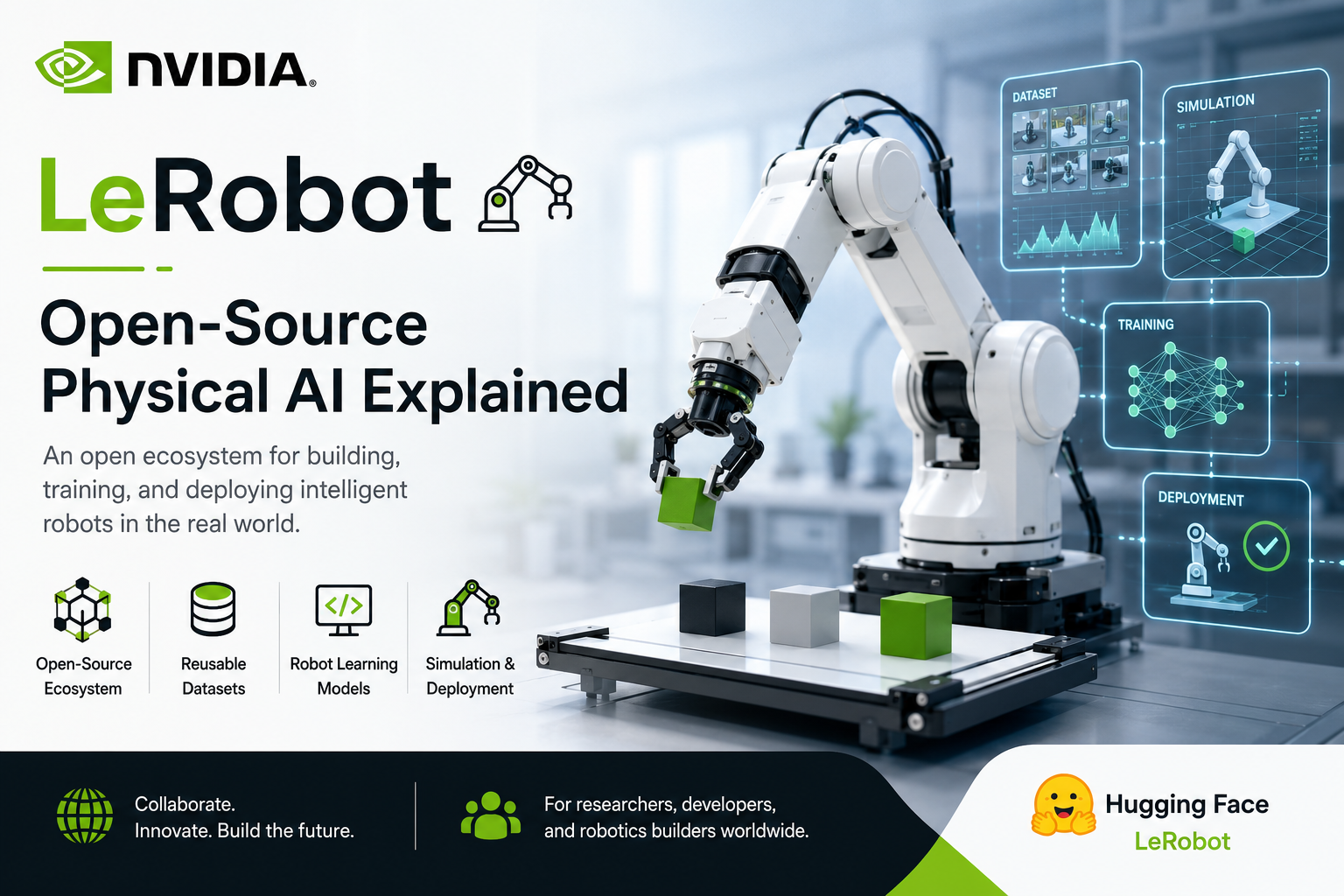
Rather than creating another closed robotics platform, NVIDIA is helping expand an open ecosystem that allows researchers, developers, startups, and enterprises to build intelligent robots using shared datasets, simulation environments, and reusable AI models.
Instead of every company starting from zero, developers can build on common foundations—similar to how open-source software accelerated cloud computing and modern AI.
In this guide, we'll explain what NVIDIA LeRobot is, how it works, why it matters, and what it could mean for the future of physical AI.
Table of Contents
What Is NVIDIA LeRobot?
Why Physical AI Matters
The Role of Open-Source Robotics
Key Components of the LeRobot Ecosystem
NVIDIA's Contribution
How AI Robots Learn
Real-World Applications
Benefits for Developers
Challenges Ahead
The Future of Physical AI
Frequently Asked Questions
Final Thoughts
What Is NVIDIA LeRobot?
LeRobot is an open-source robotics ecosystem designed to simplify robot learning.
Rather than focusing on one specific robot, it provides tools, datasets, software libraries, and machine learning workflows that can be adapted across different robotic platforms.
The ecosystem supports developers who want to:
Train robotic arms
Build warehouse robots
Develop service robots
Experiment with humanoid robots
Research autonomous manipulation
Improve robot learning from demonstrations
Instead of writing every control algorithm manually, developers can train robots using AI models that learn from examples.
Why Physical AI Matters
Most AI today lives inside computers.
It answers questions, generates images, writes code, or analyzes documents.
Physical AI goes one step further.
It allows AI systems to interact with the real world by combining:
Cameras
Depth sensors
Force sensors
Robot joints
Motion planning
Machine learning
Computer vision
A physical AI system can understand both what it sees and how it should move.
For example, instead of simply identifying a coffee mug, an AI-powered robot could:
Locate the mug
Estimate its position
Plan a safe movement
Pick it up
Place it somewhere else
This combination of perception and action is one of the defining goals of modern robotics.
Why Open-Source Robotics Is Important
Historically, robotics development has been expensive.
Each company often created its own:
Training data
Software stack
Robot control system
Simulation environment
That approach slowed innovation.
Open-source robotics encourages developers to share tools, datasets, and models, reducing duplicated effort and making advanced robotics more accessible.
Benefits include:
Faster experimentation
Community contributions
Easier collaboration
Lower development costs
Better reproducibility
Improved research transparency
This approach mirrors the success of open-source software in fields such as Linux, Python, and Kubernetes.
Key Components of the LeRobot Ecosystem
Although implementations may evolve over time, the LeRobot ecosystem generally focuses on several important building blocks.
1. Robot Datasets
AI models require data.
Developers can train robots using recorded demonstrations that show how tasks should be completed.
These datasets may include:
Camera images
Joint positions
Sensor readings
Motion trajectories
Gripper states
Task labels
The more diverse the data, the better a robot can generalize to new situations.
2. Robot Learning Models
Instead of programming every movement, machine learning models discover patterns from demonstrations.
These models learn:
Object manipulation
Grasping
Motion prediction
Task sequencing
Environment understanding
This helps robots adapt to slightly different conditions without requiring new programming for every task.
3. Simulation
Training physical robots directly can be slow and expensive.
Simulation environments allow developers to:
Test algorithms safely
Train thousands of scenarios
Evaluate new behaviors
Reduce hardware wear
Improve reliability before deployment
Simulation has become a key part of modern robotics development.
4. Reusable AI Workflows
Instead of building each project independently, developers can reuse:
Training pipelines
Data processing tools
Model architectures
Evaluation methods
Deployment scripts
This significantly speeds up experimentation.
NVIDIA's Contribution to Physical AI
NVIDIA has invested heavily in technologies that support robotics development.
Its broader AI ecosystem includes:
High-performance GPUs
Robotics simulation
AI acceleration
Computer vision
Deep learning frameworks
Robotics software platforms
Within the LeRobot ecosystem, NVIDIA's expertise helps developers train increasingly capable robotics models while taking advantage of accelerated computing and scalable AI infrastructure.
The goal is not only faster model training but also more efficient testing, simulation, and deployment.
How AI Robots Learn
Modern robot learning usually follows several stages.
Step 1
Collect demonstrations.
Humans perform a task while sensors record movements.
Step 2
Create datasets.
Images, robot states, and actions become training examples.
Step 3
Train an AI model.
The model learns the relationship between observations and actions.
Step 4
Validate in simulation.
Developers evaluate the model in virtual environments.
Step 5
Deploy on real hardware.
Once the system performs reliably, it can be tested on physical robots.
This iterative process helps reduce development time while improving safety.
Real-World Applications
Manufacturing
Robots can assist with:
Assembly
Quality inspection
Material handling
Packaging
Warehousing
Physical AI may improve:
Item picking
Inventory movement
Automated sorting
Logistics operations
Healthcare
Potential applications include:
Laboratory automation
Medical supply handling
Rehabilitation support
Hospital logistics
Agriculture
AI-powered robots could assist with:
Crop monitoring
Harvest support
Weed detection
Precision farming
Retail
Retail automation may include:
Shelf scanning
Inventory management
Stock replenishment
Order fulfillment
Research
Universities and AI laboratories can experiment with advanced manipulation, navigation, and human-robot collaboration using shared tools and datasets.
Benefits for Developers
LeRobot lowers the barrier to robotics innovation by making advanced development tools more accessible.
Key advantages include:
Faster Prototyping
Developers can begin with existing software instead of building everything from scratch.
Community Collaboration
Open-source projects often improve through contributions from researchers and developers worldwide.
Shared Datasets
Training data can be reused and expanded, reducing the effort required to start new projects.
Better Reproducibility
Common tools make it easier to compare research results and validate experiments.
Lower Development Costs
Teams can focus on solving robotics challenges rather than rebuilding basic infrastructure.
Challenges Ahead
Despite rapid progress, physical AI still faces several important challenges.
Safety
Robots operating around people must behave predictably and safely.
Data Quality
Poor training data can lead to unreliable robot behavior.
Hardware Diversity
Different robots use different sensors, motors, and controllers, making standardization difficult.
Generalization
A robot trained in one environment may struggle in another without additional learning.
Real-Time Performance
Robots often need to make decisions within milliseconds while processing large amounts of sensor data.
Addressing these challenges remains an active area of research and development.
The Future of Physical AI
The robotics industry is moving toward AI systems that can learn continuously, adapt to new environments, and perform increasingly complex tasks.
Future developments may include:
More capable robot foundation models
Better simulation-to-real-world transfer
Larger open robotics datasets
Improved multimodal learning
More collaborative robots in workplaces
Increased use of AI-assisted automation across industries
As open ecosystems continue to mature, developers are likely to benefit from faster innovation cycles and broader access to advanced robotics technology.
Frequently Asked Questions
What is NVIDIA LeRobot?
NVIDIA LeRobot refers to NVIDIA's support for an open-source robotics ecosystem focused on AI-driven robot learning, reusable datasets, simulation, and modern development workflows.
Is LeRobot open source?
Yes. The ecosystem is built around open-source principles, enabling researchers and developers to collaborate and build upon shared tools and resources.
What is Physical AI?
Physical AI combines machine learning, robotics, sensors, and computer vision to allow intelligent machines to interact with the physical world.
Who can use LeRobot?
It is suitable for researchers, universities, robotics startups, industrial automation teams, AI developers, and anyone interested in robot learning.
Why does simulation matter?
Simulation allows developers to train and evaluate robots in virtual environments before deploying them on real hardware, reducing costs and improving safety.
Final Thoughts
Physical AI is becoming one of the most exciting areas of artificial intelligence, and open ecosystems such as LeRobot are helping accelerate that transition.
By combining reusable datasets, simulation tools, AI models, and collaborative development, the robotics community can focus more on innovation and less on rebuilding foundational technology.
While physical AI still faces technical and safety challenges, open-source initiatives are making advanced robotics more accessible than ever before. For developers, researchers, and organizations exploring intelligent automation, platforms like LeRobot provide a practical starting point for building the next generation of AI-powered machines.
Key Takeaways
NVIDIA LeRobot supports an open approach to robotics development.
Physical AI combines perception, reasoning, and movement.
Open datasets and reusable models reduce development time.
Simulation plays a critical role in safe robot training.
The ecosystem benefits researchers, startups, and enterprises alike.
Open collaboration is expected to accelerate robotics innovation over the coming years.
Tags
#AI #AI2026 #NVIDIALeRobot #LeRobot #PhysicalAI #OpenSourceAI #OpenSourceRobotics #RoboticsAI #NVIDIAAI #HuggingFace #RobotFoundationModels #AIRobotics #MachineLearning #ComputerVision #AutonomousRobots #GenerativeAI #AIInnovation #FutureOfRobotics #IndustrialAutomation #WarehouseAutomation #HumanoidRobots #RobotLearning #AISimulation #AITraining #DeepLearning #AIDevelopers #AIResearch #Automation #TechInnovation #ArtificialIntelligence #SmartRobots #DeveloperTools #AIInfrastructure #EdgeAI #FutureTech