AI Infrastructure Spending in 2026: Are Hyperscalers Over-Investing?
The year 2026 is approaching, and with it comes a critical question echoed in boardrooms and research hubs across the globe: Is the unprecedented surge in AI infrastructure spending by hyperscalers justified, or are we witnessing a colossal bubble? As companies like Google, Microsoft, and Amazon pour billions into data centers, advanced processors, and networking tech, the pressure to deliver transformative AI applications is mounting.
The Phenomenal Rise of AI Spending
We are in the midst of a technological gold rush. Hyperscalers are engaged in an arms race, competing to build the most robust and computationally powerful AI ecosystems. This frenzy is driven by the potential of generative AI, large language models (LLMs), and automated systems across every sector, from finance to healthcare. The goal is to create platforms capable of supporting complex AI workloads that can revolutionize productivity and services.
The investment figures are staggering. We are talking about hundreds of billions of dollars annually, dedicated to acquiring H100s, specialized AI accelerators (ASICs), and the energy infrastructure to power them. This massive capitalization is not merely about staying ahead; it's about defining the future. The fear of being left behind is palpable, as early adopters stand to gain massive efficiency advantages and market share.
The Looming Spectre of Over-Investment
But as the spending curve steepens, concerns are emerging. Critics and market analysts point to the risk of creating a technology bubble similar to the dot-com era. The core issue is monetization. The cost of training and deploying sophisticated AI models is astronomical. Are the returns justified by current business models? While AI shows promise in areas like code generation and content creation, broad-based, revenue-generating applications are still in their infancy.
The concept of "over-investment" has several dimensions:
Monetization Lag: The gap between the capital invested and the generation of significant revenue streams from AI-powered products. Many enterprises are still experimenting, and large-scale deployment is taking time.
Resource Bottlenecks: The intense demand for AI chips (like those from NVIDIA) and HBM (High Bandwidth Memory) has created supply chain constraints, pushing up costs and delaying project timelines.
Technological Shift: The AI landscape is evolving rapidly. Today's cutting-edge infrastructure might be obsolete tomorrow, as more efficient algorithms or alternative hardware solutions emerge. This creates a risk of investing heavily in solutions that might have a short shelf-life.
Energy Consumption: AI data centers are energy-intensive, raising environmental concerns and straining power grids. Regulatory pressure and rising energy costs could significantly alter the investment calculus.
The Hyperscaler Perspective: A Strategic Bet on the Future
Despite the concerns, hyperscalers are not backing down. They view this investment as a strategic necessity. Their rationale is rooted in several long-term projections:
Platform Lock-in: By offering the most powerful and comprehensive AI platforms, they hope to attract developers and enterprises, creating a powerful ecosystem and securing future revenue streams.
Fundamental Shift: They see AI as a foundational technology that will reshape computing itself. Investing now ensures they control the underlying infrastructure of the next technological era.
The Cost of Inaction: The risk of under-investing and missing the AI wave is perceived as far greater than the risk of over-investing in the short term. The competitive landscape is cutthroat, and falling behind could be terminal.
The Verdict on 2026
So, are hyperscalers over-investing? The answer is complex and nuanced.
In the short term (2025-2026), there is a definite risk of a "hype cycle" correction. The immediate ROI might not match the eye-watering investment figures. The bottleneck of specialized hardware and skilled talent will persist, possibly slowing down the pace of implementation.
However, from a long-term perspective, the investment is likely a strategic imperative. The transformation promised by AI is too significant to ignore. The question isn't whether AI will disrupt industries, but how quickly and which players will be at the helm. The hyperscalers are playing a high-stakes game of chess, betting that controlling the AI infrastructure of tomorrow will yield massive dividends.
Ultimately, 2026 may be remembered not as the year the AI bubble burst, but as the year the initial hype settled, and the hard work of building and monetizing real-world AI applications truly began. The winner of this race will not necessarily be the one who spent the most, but the one who best translated that immense computing power into tangible, value-creating solutions.
Visualizing the AI Infrastructure Race
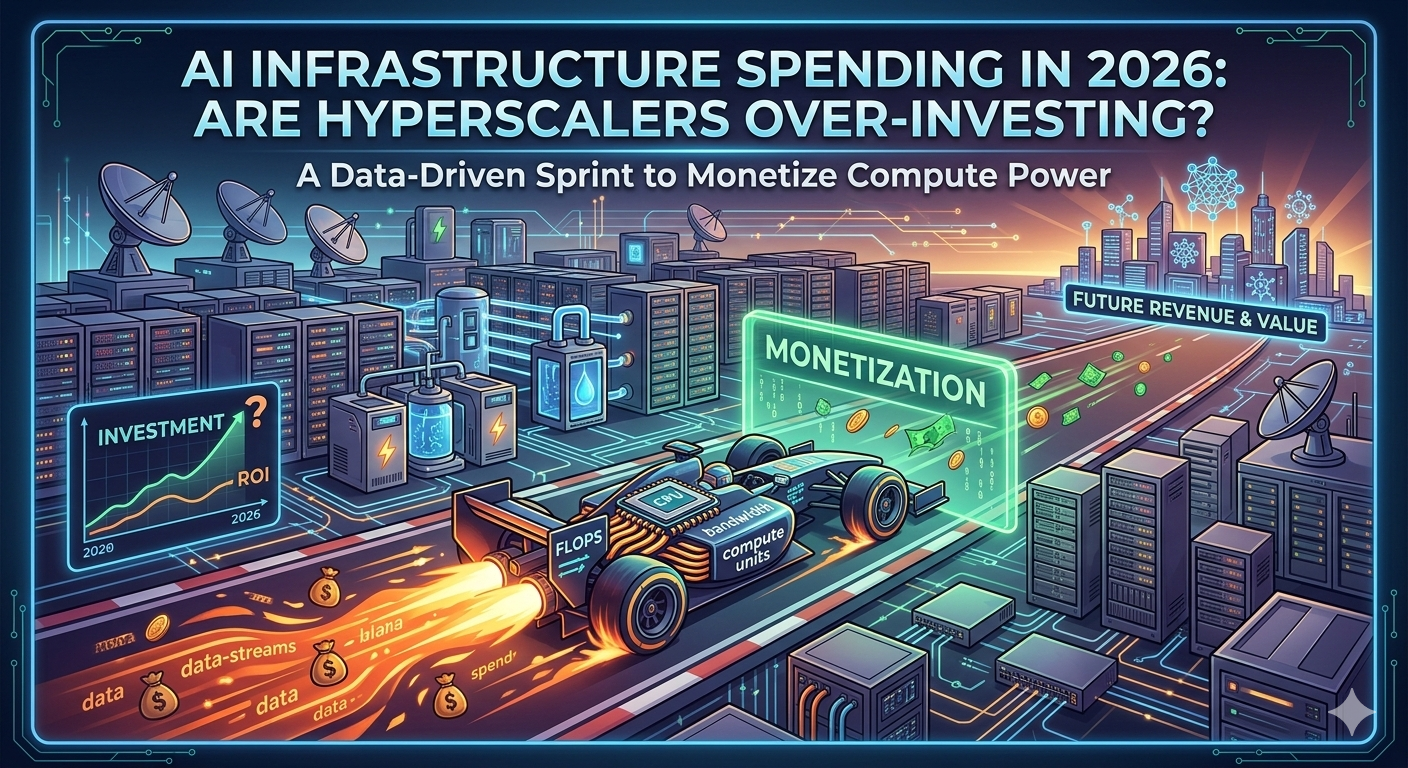
To illustrate this ongoing technological marathon, we’ve created a stylized image that captures the dynamic and competitive landscape. The artwork shows a futuristic datacenter where a race car, built from stylized AI chips and marked with powerful compute symbols (like 'TF' for TeraFLOPS), powers along a data highway. This car, representing the hyperscalers' investment, is overtaking older, bulkier hardware racks and breaking through a "monetization barrier" toward a distant city built of glowing algorithms and insights. The background glows with a mix of tech blues and oranges, and the sky is a matrix of data points and potential.