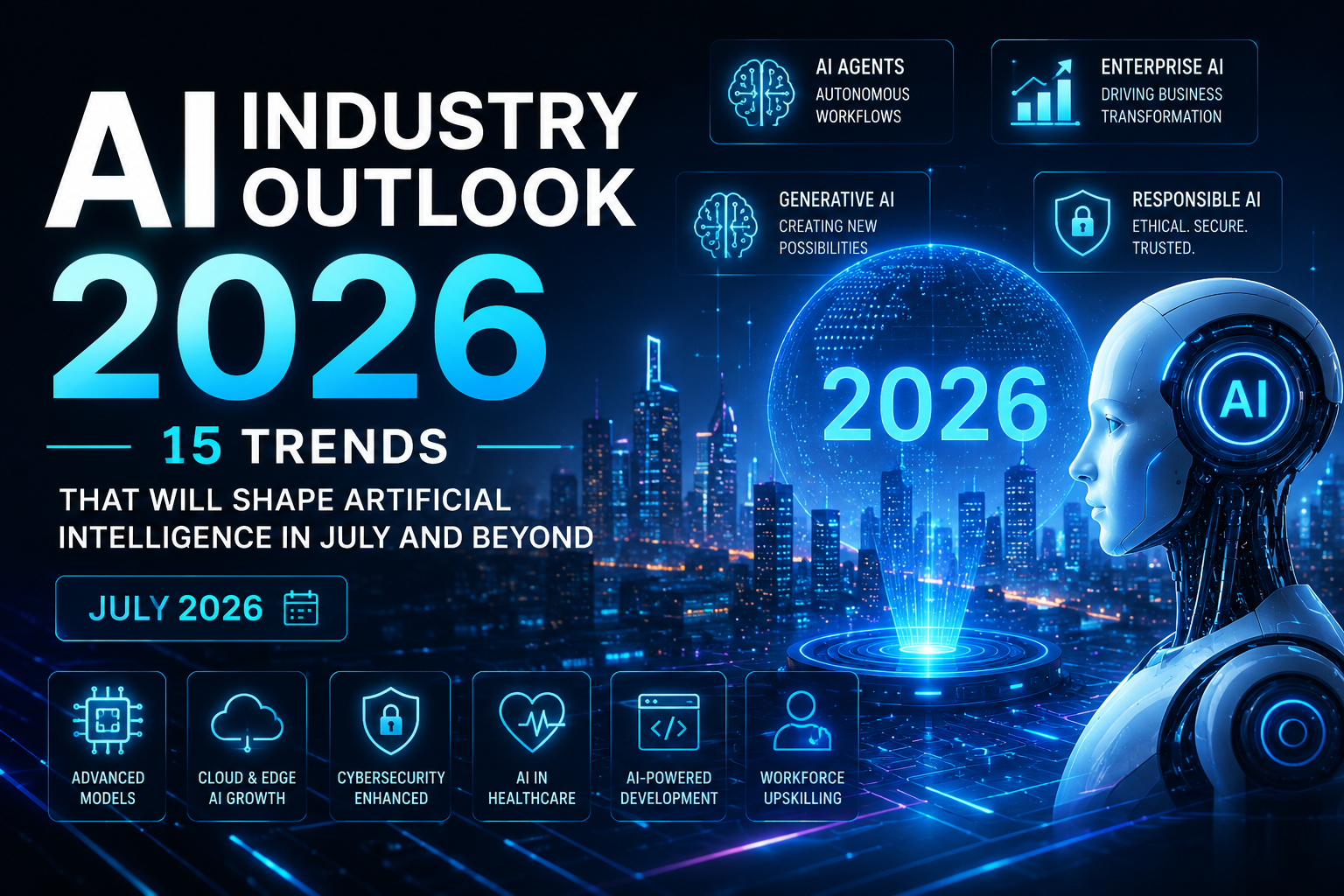
AI Industry Outlook 2026: 15 Trends That Will Shape Artificial Intelligence in July and Beyond
Artificial intelligence continues to evolve at an unprecedented pace. As we move into July 2026 and the second half of the year, AI is becoming more deeply integrated into businesses, healthcare, education, finance, software development, manufacturing, and everyday life. Organizations are investing heavily in AI-driven automation, while governments are introducing new policies to ensure responsible development.
This article explores the top AI trends expected to shape the industry throughout July 2026 and beyond. Whether you're a business owner, developer, investor, or technology enthusiast, understanding these developments can help you stay ahead in the rapidly changing AI landscape.
1. AI Agents Become Everyday Business Tools
AI agents are evolving beyond simple chatbots. They can now perform multi-step tasks such as scheduling meetings, generating reports, analyzing data, managing projects, and interacting with multiple software platforms.
Businesses are increasingly adopting AI agents to improve productivity, reduce manual work, and streamline operations.
Key Benefits:
Improved workflow automation
Faster customer support
Reduced operational costs
Increased employee productivity
2. Generative AI Expands Across Industries
Generative AI is no longer limited to text generation. Organizations are using AI to create:
Images
Videos
Marketing campaigns
Software code
Product designs
Educational content
Companies are integrating generative AI into daily business processes, making content creation faster and more efficient.
3. AI Regulation Continues to Evolve
Governments worldwide are introducing policies focused on AI transparency, privacy, accountability, and ethical development.
Organizations are placing greater emphasis on:
Responsible AI
Data protection
Bias reduction
Model transparency
Human oversight
Compliance is becoming an essential part of AI implementation.
4. Smaller AI Models Gain Popularity
While large language models remain powerful, smaller specialized AI models are becoming increasingly attractive.
Advantages include:
Lower operating costs
Faster response times
Better privacy
Easier deployment
Reduced energy consumption
Many businesses now prefer domain-specific AI models tailored to their unique needs.
5. AI-Powered Search Continues to Transform SEO
Traditional keyword-focused search is evolving toward AI-generated answers and conversational search experiences.
Businesses are adapting by creating:
Helpful content
Expert-driven articles
Structured data
Comprehensive guides
User-focused information
SEO increasingly rewards quality, authority, and user satisfaction.
6. AI Coding Assistants Become Standard Development Tools
Software developers are using AI assistants for:
Code generation
Bug detection
Documentation
Testing
Optimization
Code reviews
Rather than replacing developers, AI enhances productivity and accelerates software development.
7. Multimodal AI Gains Wider Adoption
Modern AI systems can process multiple types of information simultaneously, including:
Text
Images
Audio
Video
Documents
This enables more natural interactions and opens new possibilities for customer service, healthcare, education, and business intelligence.
8. Enterprise AI Investments Continue to Grow
Organizations are increasing investments in AI infrastructure to remain competitive.
Common enterprise AI applications include:
Predictive analytics
Customer support automation
Sales forecasting
Fraud detection
Supply chain optimization
Intelligent document processing
AI is becoming a core component of digital transformation strategies.
9. AI in Healthcare Advances Patient Care
Healthcare providers are using AI to support:
Medical imaging
Clinical decision support
Drug discovery
Administrative automation
Personalized treatment planning
While human expertise remains essential, AI continues to improve efficiency and assist healthcare professionals.
10. AI Cybersecurity Solutions Become More Sophisticated
As cyber threats grow increasingly complex, AI-powered security systems are helping organizations identify suspicious activities faster.
Modern cybersecurity solutions use AI for:
Threat detection
Network monitoring
Malware analysis
Identity protection
Risk assessment
AI enables faster response times and proactive defense strategies.
11. Personalized AI Experiences Continue to Improve
Consumers increasingly expect personalized digital experiences.
AI helps businesses deliver:
Customized recommendations
Personalized shopping
Individual learning paths
Targeted customer support
Intelligent financial advice
Better personalization often leads to improved customer satisfaction and engagement.
12. AI Hardware Innovation Accelerates
Growing demand for AI workloads is driving rapid innovation in hardware.
Manufacturers continue developing:
AI accelerators
Advanced GPUs
Energy-efficient processors
Edge AI chips
Improved hardware enables faster training and inference while reducing power consumption.
13. AI Education and Workforce Upskilling Expand
As AI adoption grows, professionals across industries are learning new AI skills.
Popular areas of focus include:
Prompt engineering
AI ethics
Machine learning
Data analysis
AI-assisted programming
Business automation
Continuous learning is becoming essential in the modern workforce.
14. Responsible AI Becomes a Business Priority
Organizations are increasingly focused on building AI systems that are:
Fair
Transparent
Secure
Explainable
Reliable
Privacy-conscious
Responsible AI practices help build customer trust while supporting regulatory compliance.
15. AI Collaboration with Humans Defines the Future
The future of artificial intelligence is centered on collaboration rather than replacement.
AI excels at:
Automating repetitive tasks
Processing large datasets
Generating insights
Enhancing creativity
Supporting decision-making
Human expertise remains vital for strategic thinking, creativity, ethical judgment, and complex problem-solving.
What Businesses Should Expect After July 2026
Looking ahead, AI is expected to become even more integrated into everyday operations. Businesses that invest in AI literacy, responsible implementation, and workforce training will be better positioned to adapt to future technological advancements.
Success will increasingly depend on balancing innovation with transparency, security, and human oversight. Organizations that embrace AI as a collaborative tool rather than a standalone solution are likely to achieve stronger long-term results.
Final Thoughts
Artificial intelligence is reshaping industries at a remarkable pace, and July 2026 marks another significant milestone in its evolution. From AI agents and multimodal systems to responsible AI practices and enterprise automation, the trends highlighted above demonstrate how AI is becoming an essential driver of innovation and productivity.
Whether you're a business leader, developer, marketer, or technology enthusiast, staying informed about these developments can help you make smarter decisions and capitalize on emerging opportunities. As AI continues to mature, the organizations that combine technological adoption with ethical practices and continuous learning will be best positioned for long-term success.
Frequently Asked Questions (FAQs)
What is the biggest AI trend in 2026?
AI agents capable of completing complex, multi-step tasks across different applications are among the most significant developments, alongside broader enterprise adoption of generative and multimodal AI.
How is AI affecting businesses?
AI helps businesses automate repetitive tasks, improve customer experiences, analyze data more effectively, strengthen cybersecurity, and increase overall operational efficiency.
Will AI replace human jobs?
AI is more likely to transform many roles by automating routine tasks while creating demand for new skills in AI management, data analysis, software development, and human-AI collaboration.
Why is responsible AI important?
Responsible AI helps ensure systems are fair, transparent, secure, and accountable, building trust with users while supporting compliance with evolving regulations.
How can businesses prepare for future AI trends?
Organizations can prepare by investing in AI education, adopting responsible AI practices, modernizing their technology infrastructure, and identifying opportunities where AI can improve productivity and decision-making.
Tags:
#AI #ArtificialIntelligence #AITrends #AI2026 #MachineLearning #GenerativeAI #AIAgents #EnterpriseAI #FutureOfAI #AIInnovation #Technology #Automation #DigitalTransformation #DeepLearning #DataScience #AITools #BusinessAI #ResponsibleAI #LLM #MultimodalAI#AIResearch #TechNews #FutureTech #BusinessTechnology #CloudComputing #BigData #PredictiveAnalytics #NLP #ComputerVision #EdgeAI #SoftwareDevelopment #Coding #DeveloperTools #Productivity #Innovation #Cybersecurity #HealthcareAI #FinTech #HealthTech #EdTech #SmartTechnology #BusinessGrowth #AIApplications #TechTrends #EmergingAI #AIIndustry #DigitalBusiness #IntelligentAutomation #AIInsights #SEO #ArtificialGeneralIntelligence #AGI #SmartBusiness #DataAnalytics #FutureOfWork #AutomationTechnology #NextGenAI #EnterpriseTechnology #TrendingTechnology #AI July2026 #2026 AI Trends