The Future of AI Search: Why Google, ChatGPT and Perplexity Are Changing the Internet
For over two decades, the internet operated on a simple, unspoken contract: You typed a few keywords into a search bar, a search engine gave you a list of blue links, and you clicked through to a website to find your answer.
In July 2026, that contract has officially been torn up.
We are living in the era of Generative Search. Driven by explosive mainstream adoption, roughly 37% of consumers now start their queries directly inside AI tools rather than traditional search boxes. Instead of pointing you to websites, AI platforms process the web in real-time, synthesize data, and answer your questions directly.
This fundamental shift is completely rewriting the rules of the internet. Here is an in-depth breakdown of how the three titans of search—Google AI Overviews, ChatGPT Search, and Perplexity AI—are reshaping digital discovery, and what it means for the future of online content.
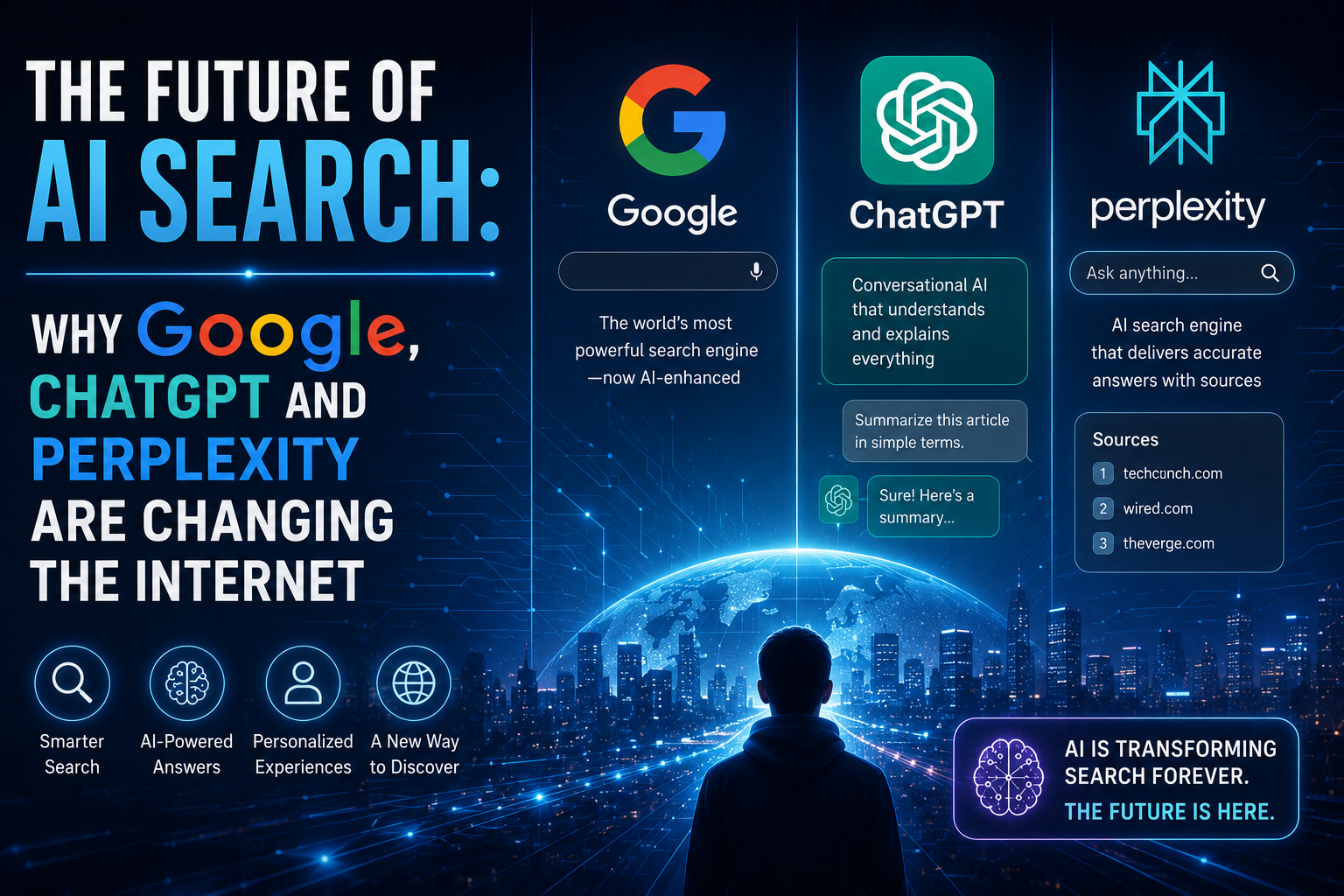
The Big Three: How They Source and Deliver Information
Traditional SEO used to treat search engines as a single entity (Google). Today, the market has fractured into three distinctly different AI search models, each relying on entirely different logic to choose which websites they recommend.
1. Google AI Overviews: The Scale King
Google still retains the lion's share of global search volume, but it has completely integrated generative AI into its primary interface. AI Overviews now appear on roughly 50% of all tracked Google queries, peaking even higher in specialized niches like healthcare, education, and B2B technology.
How it works: Google layers an advanced LLM over its existing, massive web index. It provides a brief synthesized summary at the very top of the page, pushing traditional organic results far below the fold.
The Catch: In 2026, research shows that only a small fraction of the links featured in Google's AI Overviews match the traditional top-10 blue links underneath. Google is prioritizing hyper-specific, direct passage relevance over historical site authority.
2. ChatGPT Search: The Conversational Gatekeeper
With ChatGPT boasting over 800 million weekly active users, OpenAI has transformed its flagship product from a casual chatbot into a major traffic gatekeeper.
How it works: ChatGPT Search relies on a highly selective, two-layer retrieval system. It scans multiple web sources but only actually cites a small portion of what it retrieves.
The Bias: ChatGPT heavily favors deep, definitive information clearinghouses (like Wikipedia) and major, tier-1 media brands. It is built for multi-turn conversations, meaning users ask a question, refine it three times, and get a tailored solution without ever seeing a standalone search engine results page.
3. Perplexity AI: The Direct-Response Challenger
Perplexity is the fast-growing, research-focused favorite of journalists, software engineers, and high-intent buyers. Approaching nearly a billion queries a month, it has become the gold standard for "answer engines."
How it works: Unlike models relying heavily on internal training data, Perplexity performs a real-time web search via multiple APIs for every single query. It generates a comprehensive, paragraph-by-paragraph answer supported by dense, clickable inline citations.
The Edge: Perplexity loves freshness and user-generated content (UGC). Content published within the last 30 days receives a massive boost in its discovery algorithm, and the engine frequently sources perspectives directly from platforms like Reddit and LinkedIn.
The "Zero-Click" Dilemma: Why Content Creators are Pivoting
The most disruptive side effect of AI search is the rise of the Zero-Click Search.
According to major 2026 industry tracking data, over 60% of search engine interactions now end without the user ever clicking through to an external website. If an AI can tell you how many grams of protein are in an egg, how to debug a line of Python code, or what the weather is like in Rome, you have no reason to visit a third-party blog.
While this sounds catastrophic for publishers, a massive silver lining has emerged: Conversion Rates.
Data shows that traffic arriving at a website via an AI citation converts at roughly 4x to 5x the rate of traditional Google organic traffic. Because users have already been vetted by the AI assistant, the traffic that does click through consists of highly motivated, high-intent buyers ready to sign up, buy, or download.
Enter GEO: How to Remain Visible in the AI Era
Because the traditional rules of SEO are losing their grip, digital marketers and content creators are shifting to GEO (Generative Engine Optimization) or AEO (Answer Engine Optimization).
To ensure your brand, business, or blog is cited and recommended by AI engines in 2026, your content strategy must adapt to these three foundational pillars:
💡 1. Implement the "BLUF" Protocol (Bottom Line Up Front)
AI scrapers do not want to dig through 1,000 words of introductory fluff to find an answer. Research indicates that over 44% of all LLM citations are extracted from the first 30% of a web page's text. Lead your articles with a direct, 2-to-3-sentence answer right underneath your main H2 headings.
📊 2. Prioritize Data, Statistics, and Expert Quotes
AI models are heavily incentivized to minimize hallucinations. They look for signals of absolute truth. Including hard numbers, proprietary statistics, named industry experts, and clear methodology makes your content highly attractive to an AI model looking for verifiable data to anchor its answer.
📅 3. Keep a High "Freshness" Cadence
Perplexity and Google AI Overviews penalize outdated specifications. Ensure your high-value content features clear, visible "Last Updated" signals. Updating critical pages every two to three months drastically boosts your chances of capturing a competitive AI citation slot.
Final Thoughts: The Internet is Becoming an Ecosystem of Agents
The future of search is no longer about matching keywords; it is about managing conversations. We are rapidly moving toward a web where human users tell an AI agent what they want, and that agent converses with your content on the user's behalf.
Traditional search isn't entirely dead, but it has been permanently decentralized. The brands, creators, and businesses that survive this shift will be the ones that stop trying to rank "Number 1 on Google" and start building content architectures designed to be the trusted source of truth for the world's AI.
Tags
#AISearch #SearchAI #AISearchEngines #GoogleSearch #ChatGPT #PerplexityAI #OpenAI #GoogleAI #ArtificialIntelligence #GenerativeAI #FutureOfSearch #SearchTechnology #AI2026 #TechTrends2026 #DigitalTransformation #InformationRetrieval #SearchInnovation #AIChatbots #ConversationalAI #LLMs #LargeLanguageModels #MachineLearning #WebSearch #SearchExperience #ContentDiscovery #SEO #SearchEngineOptimization #DigitalMarketing #ContentStrategy #EnterpriseAI #KnowledgeManagement #AIProductivity #AIInnovation #Technology #FutureTech #TechIndustry #Internet #WebTechnology #OnlineSearch #BusinessTechnology #CloudAI #AIInfrastructure #EmergingTech #Innovation #DataDriven #NextGenAI #SearchTrends #AICompetition #Google #Perplexity