Claude Haiku 5.5 Explained: Why Small AI Models Are Becoming Powerful Enough for Real Agents
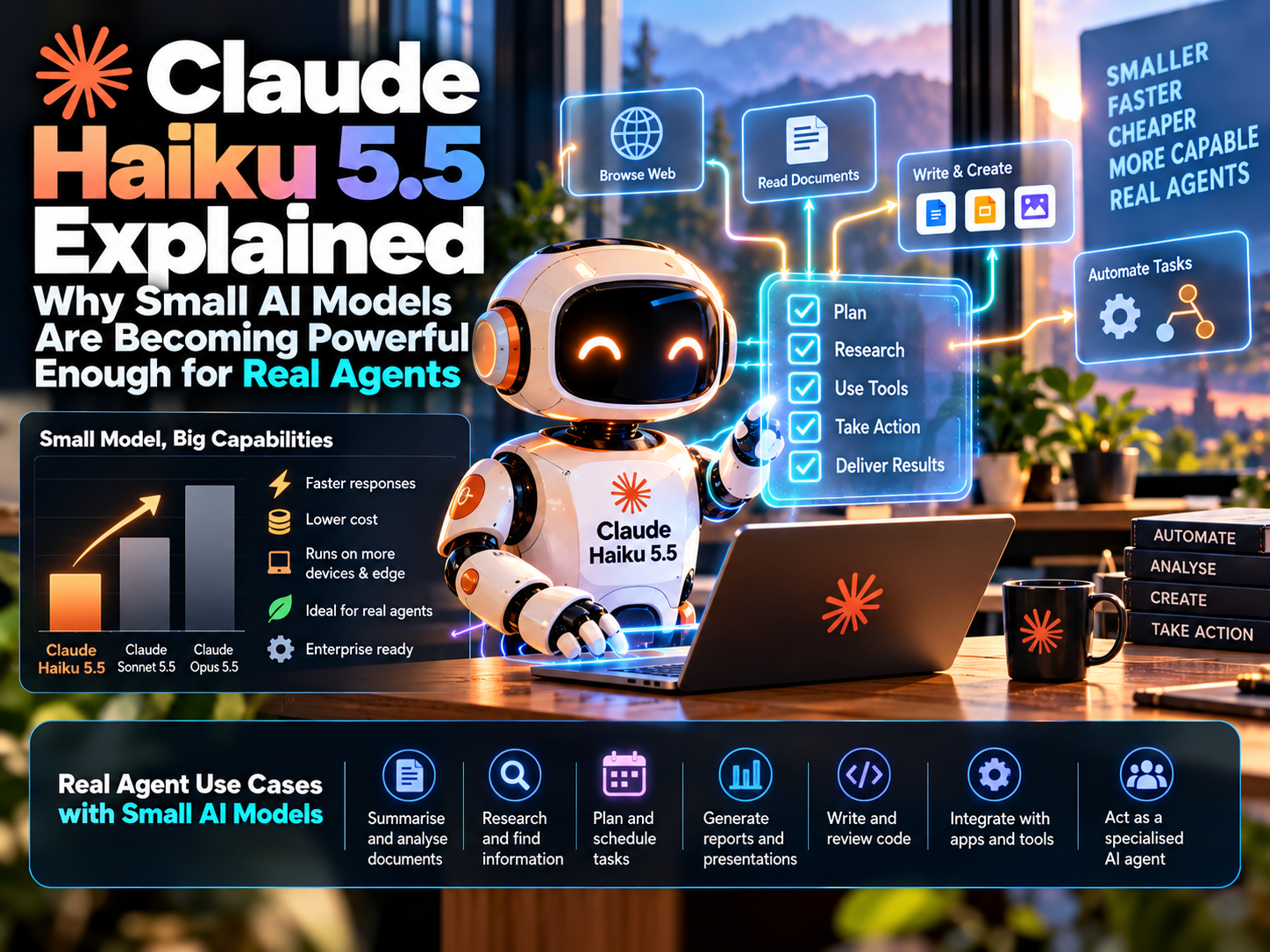
A useful AI agent spends much of its time reading, classifying, looking things up and calling tools. Anthropic’s new Haiku model makes those frequent steps cheaper and faster, provided teams choose the right tasks and keep the agent’s authority under control.
Quick Take
- Released October 7: Anthropic positions Claude Haiku 5.5 for high-volume, time-sensitive work and as a subagent alongside larger models.
- Agent appeal: faster, lower-cost calls can handle routing, extraction, retrieval and focused coding while a stronger model handles difficult planning.
- Pricing boundary: listed API rates start at $0.10 input and $0.50 output per million tokens for prompts up to 100,000 tokens; longer prompts use higher rates.
- Production test: compare completed-task quality, latency, tool calls and total spend, then limit permissions before enabling actions.
What Is Claude Haiku 5.5?
Anthropic’s October 7 release presents Claude Haiku 5.5 as its fast small model for tasks that occur frequently: sorting requests, extracting facts, summarizing short material and answering narrowly scoped questions. “Small” describes its place in the model family and deployment economics; Anthropic does not say that the model runs locally on a phone. It is available through the Claude API and several cloud platforms, with platform-specific terms to check before buying.
The official model specification lists model ID claude-haiku-5-5, a one-million-token context window, up to 128,000 output tokens in ordinary use and adaptive thinking that adjusts reasoning effort. A large context ceiling does not mean every agent should send a million tokens. Longer inputs can slow responses and cross an important pricing boundary.
Why Small Models Now Matter for Real Agents
An agent is more than one clever response. It may read a ticket, retrieve policy text, decide which tool to use, inspect the result, write a draft and check that the task actually finished. Even modest workflows can involve many model calls. If every routine step uses a premium model, the bill and response time can rise faster than the value delivered.
Haiku 5.5 can act as a worker for well-defined subtasks: pull an invoice number from an approved document, label a support request, find a matching knowledge article or propose a small code edit. A higher-capability model can plan, resolve ambiguity and review work that needs broader judgment. This routing pattern is a design choice, not proof that Haiku can complete all long-running tasks without supervision.
Speed also changes the user experience. An internal help desk agent can respond while a person is still engaged; a batch processor can review a large queue without making each item disproportionately expensive. Yet the critical metric is successful tasks per euro spent, including failures, retries and human corrections.
Claude Haiku 5.5 Pricing: The 100K-Token Catch
According to Anthropic’s official model specification, the Claude Platform charges by input and output tokens. Prices below are US dollars per one million tokens, before caching, tools, other platform fees and taxes. A prompt longer than 100,000 tokens moves to the higher rate for that request; it is not just the excess tokens that become more expensive.
| Prompt size | Input / 1M tokens | Output / 1M tokens | Practical implication |
|---|---|---|---|
| Up to 100K tokens | $0.10 | $0.50 | Best fit for short, repeated agent steps. |
| Over 100K tokens | $0.50 | $2.50 | Five times the base token rates for that request. |
Illustrative math: a 2,000-input-token request with a 500-token answer costs about $0.00045 at the short-prompt rates, or about $0.45 for 1,000 identical requests. A 120,000-token input with a 1,000-token output costs about $0.0625 at long-prompt rates. Those are model-token estimates, not quoted end-to-end operating costs.
Anthropic says its model typically costs around 75% less than Haiku 4.5 in its comparison. Real savings depend on prompt size, retries, cache behavior and the tokenizer: Anthropic’s migration notes notes that the same input text can count as roughly 30% more tokens than on Haiku 4.5. Measure your own requests before treating a list-price comparison as your budget.
Haiku 5.5 vs Sonnet 5.5 vs Opus 5.5
| Model | Reasonable starting role | Where to be cautious |
|---|---|---|
| Haiku 5.5 | Fast extraction, routing, simple tool work and parallel subtasks. | Ambiguous requests, complex coding changes and long prompts can erase cost benefits. |
| Sonnet 5.5 | Scoped analysis, multi-step implementation and higher-quality agent steps. | Still needs checks for data access, tool errors and business decisions. |
| Opus 5.5 | Difficult planning, deep coding or review of uncertain outputs. | Using it for every repetitive step may waste time and money. |
This is a suggested workflow split, not a universal ranking. Anthropic’s published agent and computer-use benchmarks indicate a substantial improvement from Haiku 4.5, but they use specific test settings and remain vendor-published results. Test the exact browser, tool or repository tasks your own team will run; a score on one benchmark cannot establish reliability on your customer data.
Three Practical Agent Designs
Haiku categorizes a ticket and retrieves approved guidance. A person or stronger model reviews uncertain cases before a reply is sent.
A lead model breaks a coding task into small edits; Haiku subagents inspect or update scoped files, with tests and developer review before merging.
Haiku extracts fields from authorized forms and flags missing values. A reviewer checks exceptions before records change.
Haiku searches or summarizes narrow source sets while a lead model checks conflicting evidence and prepares the final explanation.
Each design depends on an application around the model: tool permissions, source references, action logging, retry handling and a human escalation path. A model can propose a database query or fill a form; the surrounding software must decide whether it is allowed to run that query or submit that form.
What Developers Need to Recheck During Migration
Haiku 5.5 supports adaptive thinking by default. Anthropic’s migration notes warn that responses may begin with a thinking block, so integrations that assume the first content block is visible answer text need to parse block types. Older thinking blocks can also remain in multi-turn context and increase token counts. Review max_tokens, prompt caching and the model’s supported parameters before swapping the model ID in production.
For a fair evaluation, keep the same task set and acceptance tests across candidates. Track tool-call accuracy, completion rate, p95 latency, total tokens, escalation frequency and cost per accepted task. Anthropic’s cost and evaluation guidance recommends calculating costs from actual usage across the full agent loop, including cache writes and reads. Give small models the work they pass reliably; route tasks they fail to a stronger model or a person.
Security, EU AI Act and Copyright-Aware Use
A cheaper agent may be deployed far more widely, increasing the importance of permissions. Use read-only access first, separate draft creation from sending, log tool actions and require approval before payments, deletions or consequential record changes. Text retrieved from a webpage, PDF or support ticket must not be treated as authority to change the agent’s instructions or export information.
For European deployments, the European Commission summary of GDPR principles requires a lawful basis and attention to purpose, minimization, retention and security when personal data is processed. The European Commission guidance on AI interaction notices explains the transparency rules for AI systems that interact directly with people, including when they need to be informed that the counterpart is AI. Whether further AI Act duties apply depends on the specific purpose, particularly in areas such as employment or access to essential services. Keep humans responsible for material decisions and assess the actual workflow, not just the model name.
For document agents, use material your organization is entitled to process. Preserve citations and permissions when summarizing licensed reports or customer files; do not copy third-party text into public output without appropriate rights. Anthropic reports safety testing in its October 7 release, but vendor safeguards do not replace your own access controls or task-specific evaluation.
When Should a Team Choose Haiku 5.5?
Choose it first for high-volume, well-scoped tasks with a clear pass/fail check and mostly short prompts. Use a stronger model when the task demands subtle reasoning, sustained planning or high-quality final review. If a task has no reliable way to check success, narrow it before granting more autonomy.
A sensible pilot is 100–200 representative tasks from one workflow, including difficult cases and malformed inputs. Record baseline human time, the fraction of outputs accepted without correction, the cost of tool calls and the time to recover from errors. Expand only after permissions and performance hold up under ordinary production traffic.
MaGeN-AI View
The Takeaway
Haiku 5.5 shows why the agent economy may be shaped by model routing rather than one model doing everything. Smaller models become valuable when they complete common steps quickly, cheaply and consistently within controlled workflows. The winning design is the one that delivers a verified outcome at an acceptable total cost.
Frequently Asked Questions
When was Claude Haiku 5.5 released?
Anthropic introduced Claude Haiku 5.5 on October 7, 2026.
Can Claude Haiku 5.5 run AI agents?
It can handle scoped agent steps and tool use, especially high-volume subtasks; a complete agent still needs application logic, permissions and evaluation.
How much does Claude Haiku 5.5 cost?
Claude Platform list prices start at $0.10 input and $0.50 output per million tokens for prompts up to 100,000 tokens; longer prompts have higher rates.
Does Claude Haiku 5.5 run locally on a laptop?
Anthropic presents it as a fast small model available through hosted platforms; “small” does not mean a local offline version is offered.
Should agents use Haiku 5.5 instead of Sonnet or Opus?
Use Haiku for fast, repeatable work it can pass reliably. Route complex planning, ambiguous decisions and final reviews to a stronger model or a person.