What is "Tokenmaxxing"? How Developers Are Coding Entire Apps 100% Autonomously From Their Phones
The developer community is undergoing a massive paradigm shift. We have officially moved past the era of using AI simply as a "copilot" to write individual lines of code. This week, tech Twitter, GitHub, and developer forums are completely flooded with a new term: "Tokenmaxxing."
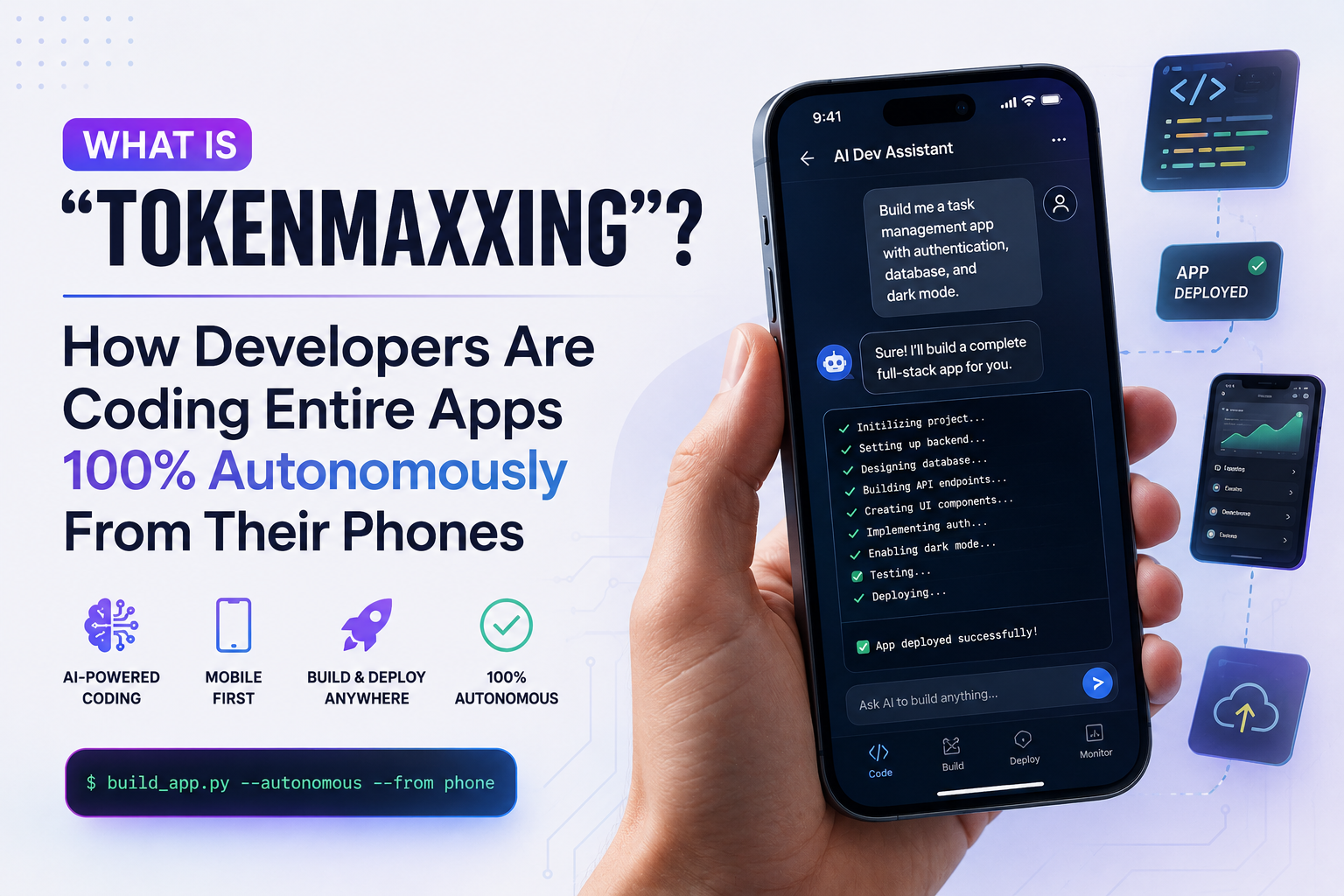
If you haven’t heard the term yet, get ready. It represents a wild new subculture of software engineering where developers are building entire production-ready applications completely autonomously—often straight from their smartphones while sitting in transit or working out at the gym.
Here is a breakdown of what Tokenmaxxing actually means, the tech stack making it possible, and why it’s changing software development forever.
1. Defining the Trend: What is "Tokenmaxxing"?
In the AI space, "tokens" are the basic units of data (pieces of words or code) processed by Large Language Models (LLMs). When you use an AI tool, you are restricted by its context window and cost-per-token limitations.
Tokenmaxxing is the practice of push-funding and optimizing autonomous AI coding agents to use the maximum possible token throughput 24/7 to build, test, and deploy software with zero human intervention.
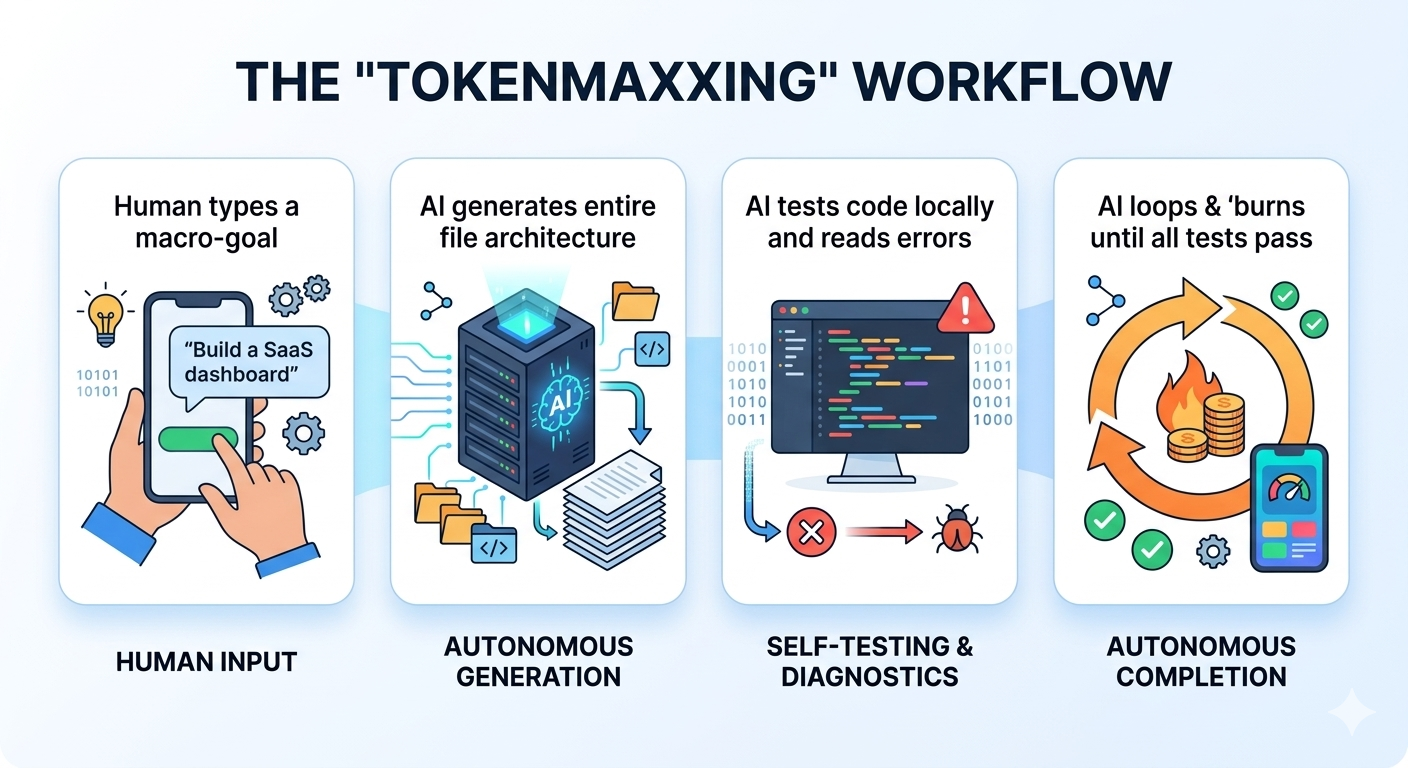
Instead of writing code, the developer acts purely as a Product Manager. You feed the AI agent a prompt on your phone, unleash it on a codebase, and let it burn through millions of tokens as it autonomously writes the frontend, configures the backend, fixes its own bugs, and deploys the final app to the cloud.
2. The "Mobile Developer" Tech Stack
How are engineers pulling this off from a smartphone screen? It comes down to a highly specific pipeline of new tools designed to automate the heavy lifting:
The Core Brain: Powerful LLM application interfaces (like ChatGPT Mobile or specialized Claude clients) running advanced models optimized for massive code reasoning.
Autonomous Orchestrators: Frameworks like Aider, Devika, or specialized mobile-friendly terminal hooks that allow AI to autonomously execute commands, create files, and read terminal errors.
The "Clawdmeter" Dashboard: A viral, open-source dashboard tool that developers are running in the background to track their token usage, API costs, and code generation speed in real-time from their mobile browsers.
               [Smartphone Prompt] ➔ [Autonomous Agent Engine] ➔ [Self-Debugging Loop] ➔ [Live Cloud Deployment]
                 ▲                                                                                                                                                                                    │
                  └─────────────────── [Monitored by "Clawdmeter"] ─────────────────────────────┘
3. The Autonomous Self-Debugging Loop
The reason Tokenmaxxing works so efficiently is due to the self-correcting runtime. Traditionally, an AI gives you code, it crashes, and you have to paste the error back to fix it.
With Tokenmaxxing pipelines, the agent is given terminal access. If the code it writes fails a compilation check or breaks a unit test, the agent reads the error log, rewrites the code, and tries again. It will loop through hundreds of thousands of tokens until the app works perfectly—all while the developer is asleep or away from their desk.
4. Why This is Exploding Right Now
This trend didn't happen by accident. It is the direct result of two massive shifts that hit the AI industry this year:
Plummeting Token Costs: Recent API updates have slashed the cost of deep-reasoning tokens by up to 40% to 50%, making it financially viable to let an AI write and rewrite code thousands of times over.
Massive Context Windows: With production models now easily handling millions of tokens of context, an AI agent can read an entire enterprise-grade codebase simultaneously without "forgetting" earlier code.
The Big Takeaway: The Era of the "Solo Tech Giant"
Tokenmaxxing proves that the barrier between having an idea and executing a fully realized software product has dropped to absolute zero.
We are quickly racing toward an era where a single individual, armed with nothing but a smartphone and a solid prompt pipeline, can build, scale, and maintain software architectures that used to require entire engineering teams. The future of programming isn’t about knowing syntax anymore—it's about knowing how to manage your tokens.
Tags:
#Tokenmaxxing #AutonomousAgents #AICoding #MobileDevelopment #SoftwareEngineering #TechTrends #CodingFromPhone #ChatGPT #GenerativeAI #Clawdmeter #AIOptimization #LLMs #DevOps #FutureOfWork #TechExplainer #AppDevelopment