The Internet of Agents: A Future Where AI Systems Talk Directly to Each Other
Introduction
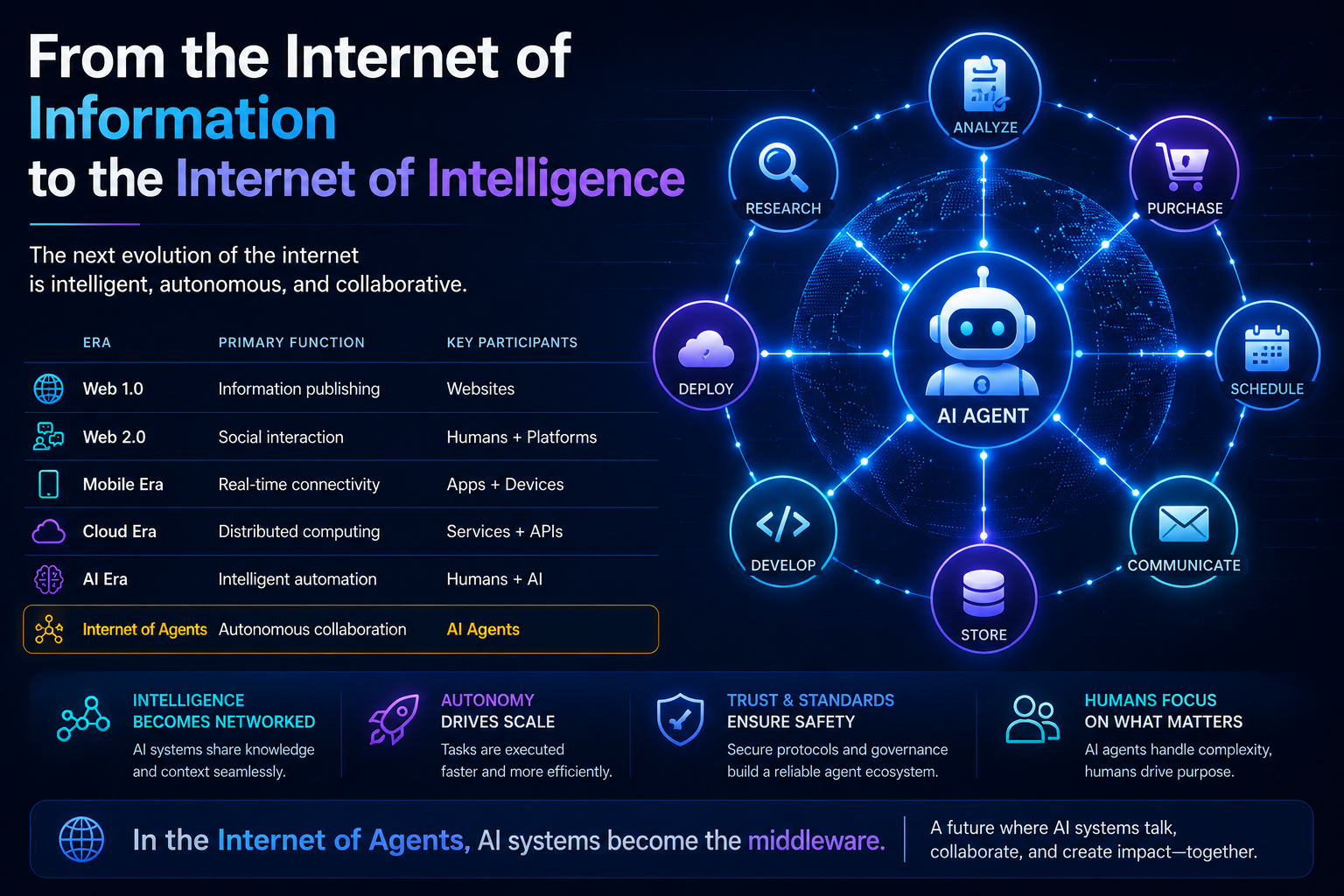
The internet changed the world by connecting people, businesses, and information. Smartphones then connected humans to services in real time. Now, a new transformation is beginning — one where AI systems no longer wait for humans to instruct every interaction.
Welcome to the era of the Internet of Agents.
In this future, AI agents will communicate directly with other AI agents, negotiate tasks, exchange information, coordinate actions, and solve problems autonomously. Instead of humans manually navigating apps, filling forms, comparing services, or coordinating workflows, intelligent agents will do it on our behalf.
This shift may become as important as the creation of the web itself.
What Is the Internet of Agents?
The Internet of Agents refers to a connected ecosystem where autonomous AI systems interact with each other using standardized communication protocols.
These agents are not simple chatbots. They are software entities capable of:
Understanding goals
Planning actions
Accessing tools and APIs
Negotiating with other systems
Learning from outcomes
Operating with varying degrees of autonomy
Instead of isolated AI applications, the Internet of Agents envisions a world where millions of specialized agents collaborate dynamically.
For example:
Your personal AI assistant could negotiate travel bookings with airline agents.
A supply chain agent could coordinate inventory automatically across manufacturers and retailers.
Healthcare agents could securely exchange patient insights between hospitals.
Smart city agents could optimize traffic, energy, and emergency response in real time.
Humans define intent. Agents handle execution.
How AI Agents Will Communicate
For agents to collaborate effectively, they need shared standards and protocols.
This is similar to how the internet relies on HTTP, TCP/IP, DNS, and APIs.
Future agent ecosystems may depend on:
1. Agent-to-Agent Protocols
Standard communication frameworks will allow AI agents to:
Identify themselves
Advertise capabilities
Request services
Exchange structured data
Verify trust and permissions
Negotiate outcomes
Emerging concepts such as Agent Communication Protocols (ACP), Model Context Protocol (MCP), and interoperable AI frameworks are early signals of this future.
2. Shared Semantic Understanding
Agents must interpret meaning consistently.
This requires:
Shared ontologies
Context-aware reasoning
Structured memory systems
Domain-specific knowledge representations
Without shared semantics, autonomous collaboration breaks down.
3. Identity and Trust Infrastructure
One of the biggest challenges is determining:
Which agents are trustworthy?
Who owns an agent?
What permissions does it have?
Can its actions be audited?
The future Internet of Agents may require:
Cryptographic identity
Verifiable credentials
Reputation systems
Agent authentication layers
Policy enforcement frameworks
Trust will become the foundation of autonomous interaction.
Real-World Scenarios
Personal Digital Concierge
Imagine telling your AI:
“Plan a three-day business trip to Berlin next month under $2,000.”
Your agent would:
Contact airline agents
Compare hotel agents
Coordinate transportation services
Align schedules with your calendar agent
Negotiate pricing and preferences
Present optimized options
Instead of browsing multiple websites, the task becomes intent-driven.
Autonomous Enterprise Operations
Inside enterprises, agents could coordinate across departments.
A procurement agent could:
Monitor inventory
Predict shortages
Negotiate supplier contracts
Coordinate logistics
Trigger payments automatically
Finance agents, compliance agents, and supply chain agents could collaborate continuously.
This creates a self-optimizing operational ecosystem.
Healthcare Collaboration
Healthcare systems often suffer from fragmented data.
Agent-based systems could securely coordinate:
Patient records
Lab results
Insurance approvals
Appointment scheduling
Drug interaction analysis
A patient’s health agent could communicate with hospital agents while preserving privacy and consent.
Smart Cities
Urban infrastructure could become highly adaptive.
Traffic management agents might coordinate with:
Public transportation agents
Weather prediction agents
Emergency response systems
Energy grid agents
The result could be cities that respond dynamically to changing conditions.
The Economic Impact
The Internet of Agents may reshape entire industries.
1. Reduced Friction
Many business processes exist because humans must manually coordinate systems.
Autonomous agents can eliminate:
Repetitive communication
Administrative delays
Manual approvals
Information silos
Inefficient workflows
This could significantly reduce operational costs.
2. New Digital Economies
Agents may eventually:
Buy services
Sell capabilities
Trade information
Negotiate contracts
Compete in marketplaces
A future economy may include billions of machine-to-machine microtransactions.
3. Shift in Human Work
Humans may move toward:
Strategic decision-making
Oversight and governance
Creative problem solving
Ethical supervision
Relationship-driven work
Routine coordination tasks may increasingly disappear.
Challenges and Risks
The Internet of Agents also introduces major concerns.
Security Risks
Autonomous systems communicating at scale create new attack surfaces.
Potential threats include:
Malicious agents
Identity spoofing
Data poisoning
Coordinated misinformation
Autonomous cyberattacks
Security frameworks must evolve rapidly.
Alignment and Control
What happens when agents pursue goals incorrectly?
Examples include:
Optimization without human context
Conflicting agent objectives
Unexpected emergent behavior
Excessive automation
Human oversight remains essential.
Privacy Concerns
Agent ecosystems may process enormous amounts of personal data.
Questions arise around:
Consent
Data ownership
Transparency
Surveillance risks
Behavioral profiling
Strong governance models will be critical.
Interoperability Problems
Without open standards, ecosystems may fragment.
Large technology companies could create isolated agent networks that cannot communicate effectively.
The success of the Internet of Agents may depend on open interoperability standards similar to those that enabled the modern web.
Technologies Powering the Internet of Agents
Several technologies are converging to make this future possible.
Large Language Models (LLMs)
LLMs provide the reasoning and language capabilities needed for flexible communication.
Multi-Agent Systems
Research into cooperative AI systems is accelerating rapidly.
These systems explore:
Task delegation
Swarm intelligence
Collaborative reasoning
Distributed problem-solving
APIs and Tool Use
Modern AI agents increasingly interact with:
Databases
Software platforms
Web services
Enterprise systems
Real-world devices
This expands their operational capabilities.
Edge Computing and IoT
Billions of connected devices can become agent-enabled.
Cars, factories, drones, sensors, and smart homes may all participate in autonomous ecosystems.
Blockchain and Decentralized Identity
Decentralized trust mechanisms may help verify:
Agent identity
Transaction integrity
Ownership rights
Reputation systems
Will Humans Stay in Control?
A common concern is whether humans will lose control over autonomous systems.
The likely future is not full replacement, but layered autonomy.
Humans will:
Define goals
Establish rules
Set ethical boundaries
Review high-impact decisions
Retain override authority
Agents will handle execution speed and complexity.
The challenge is designing systems where autonomy remains aligned with human values.
The Road Ahead
The Internet of Agents is still emerging, but the foundations are already visible.
We are seeing:
AI copilots integrated into workflows
Autonomous software agents
Multi-agent orchestration platforms
AI-to-tool communication frameworks
Early agent marketplaces
Increasing machine autonomy
Over the next decade, the transition may accelerate dramatically.
The companies that succeed may not simply build better AI models.
They may build the infrastructure, protocols, trust systems, and ecosystems that allow intelligent agents to collaborate globally.
Conclusion
The Internet of Agents represents a profound shift in how digital systems operate.
Instead of humans constantly navigating software, AI agents may coordinate directly with each other to accomplish goals efficiently and autonomously.
This future could redefine:
Business operations
Consumer experiences
Global commerce
Healthcare systems
Smart infrastructure
Human productivity
But it also raises critical questions about governance, trust, ethics, and control.
The next era of the internet may not simply connect people and information.
It may connect intelligence itself.
And when machines begin collaborating at global scale, the world could change faster than we expect.
Final Thoughts
The Internet of Agents is no longer science fiction.
The early building blocks already exist in today’s AI systems, APIs, cloud platforms, and autonomous workflows.
What comes next is the creation of a digital ecosystem where intelligent systems become active participants in economic, operational, and social interactions.
The question is no longer whether AI systems will talk to each other.
The question is how we ensure they do so safely, transparently, and in ways that benefit humanity.
Tags
#AI #ArtificialIntelligence #AIAgents #InternetOfAgents #AgenticAI #FutureOfAI #MultiAgentSystems #IntelligentAutomation #ConnectedIntelligence #AutonomousSystems #DigitalTransformation #GenerativeAI #FutureTechnology #EnterpriseAI #Innovation #TechTrends #MachineToMachine #SmartSystems #AIInfrastructure #FutureOfWork