The Rubin Revolution: Inside NVIDIA’s 3nm Vera Rubin Architecture
NVIDIA has been at the forefront of pushing the boundaries of computational power, driving innovation in gaming, professional visualization, and, most critically, artificial intelligence. With each new architecture, they've set new benchmarks, and the upcoming Vera Rubin architecture, fabricated on a cutting-edge 3nm process, promises to be nothing short of a revolution. Named after the pioneering astronomer Vera Rubin, whose work provided compelling evidence for dark matter, this architecture is poised to unveil new frontiers in AI and high-performance computing.
While official details remain under wraps, informed speculation and industry trends paint a compelling picture of what to expect from the Rubin architecture.
The Power of 3nm: A Foundation for Breakthroughs
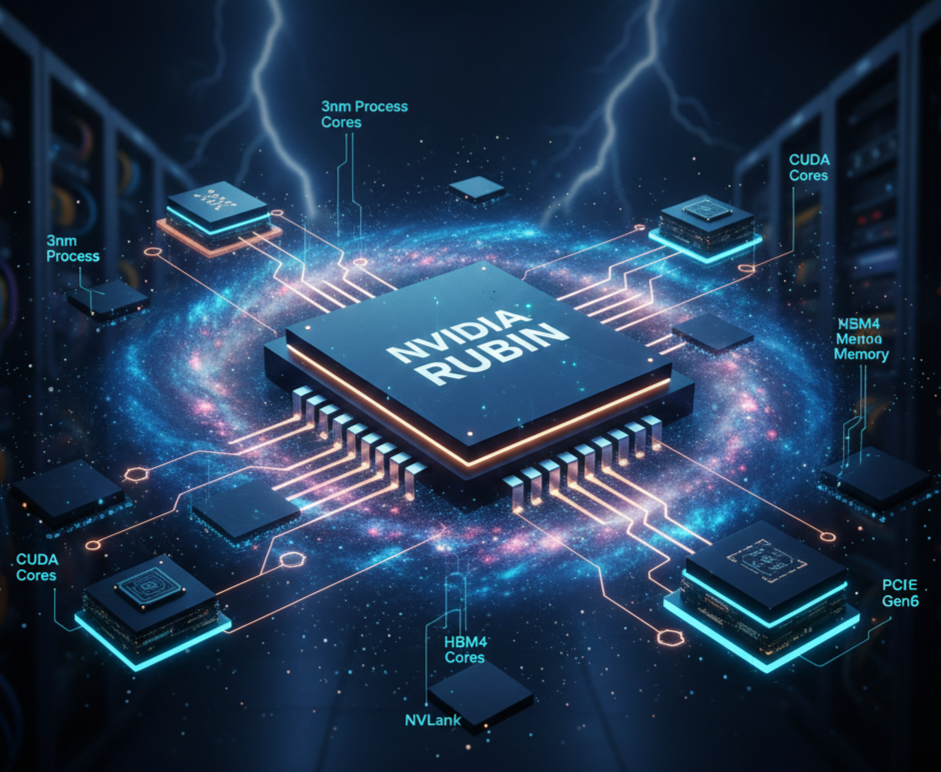
The transition to a 3-nanometer (3nm) manufacturing process is a monumental leap. Shrinking transistor sizes allows NVIDIA to:
Pack More Transistors: More transistors mean more processing units (CUDA Cores, Tensor Cores, RT Cores), leading to a significant increase in raw computational power for both graphics and AI workloads.
Greater Energy Efficiency: Smaller transistors generally consume less power and generate less heat per operation. This is crucial for sustaining performance in large data centers and for extending battery life in potential future mobile applications.
Higher Clock Speeds: The reduced distances for electrical signals can enable higher operating frequencies, further boosting performance.
This fundamental process improvement provides the bedrock upon which the architectural innovations of Vera Rubin will be built.
Key Innovations Expected in Rubin Architecture:
Next-Gen Tensor Cores: Expect a dramatic overhaul of NVIDIA's Tensor Cores, the specialized units for AI matrix operations. Rubin will likely introduce new data types, enhanced sparsity features, and significantly higher throughput for training and inference, especially for the ever-growing demands of Large Language Models (LLMs) and other complex AI architectures.
Advanced CUDA Cores: While Tensor Cores get much of the AI spotlight, the general-purpose CUDA Cores will also see substantial improvements in instruction execution, floating-point performance, and overall efficiency, benefiting traditional HPC simulations and graphics rendering.
Enhanced Interconnects (NVLink & PCIe Gen6): To feed the insatiable hunger of these powerful GPUs for data, Rubin will almost certainly feature upgraded NVLink inter-GPU communication, allowing for even faster and more scalable multi-GPU systems. We can also anticipate support for PCIe Gen6, doubling the bandwidth of the current Gen5, crucial for connecting to CPUs and other system components.
Massive Memory Bandwidth (HBM4?): Data access is a critical bottleneck. Rubin is highly likely to leverage the next generation of High Bandwidth Memory (HBM), possibly HBM4, offering exponentially higher memory bandwidth and capacity to keep the Tensor Cores and CUDA Cores continuously supplied with data.
Improved Ray Tracing (RT Cores): For graphics, we can expect significant advancements in the dedicated RT Cores, making real-time ray tracing even more realistic and performant, further blurring the lines between virtual and reality.
Focus on Power Efficiency and Cooling: With increased performance comes increased power draw, despite 3nm efficiency gains. NVIDIA will likely introduce innovative cooling solutions and power management techniques to sustain peak performance reliably.
Domain-Specific Accelerators: Given the trend towards specialized AI models (as discussed in the SLM blog), Rubin might also integrate or enhance specific accelerators for particular AI tasks, optimizing for common operations in areas like recommender systems, scientific computing, or advanced robotics.
The Impact: What Does Rubin Mean for the Future?
The Vera Rubin architecture isn't just another incremental upgrade; it represents a significant leap that will reshape several industries:
AI Breakthroughs: Faster training times, larger model capacities, and more efficient inference will accelerate research in foundation models, AI for science, and real-world AI applications.
Scientific Discovery: HPC workloads in fields like climate modeling, drug discovery, and astrophysics will see unprecedented acceleration, enabling more complex simulations and deeper insights.
Immersive Experiences: The advancements in graphics will push the boundaries of virtual reality, augmented reality, and photorealistic gaming.
Data Center Evolution: Rubin-powered data centers will become even more potent engines of computation, driving the next generation of cloud services and AI infrastructure.
Just as Vera Rubin’s observations unveiled the hidden universe of dark matter, NVIDIA's Vera Rubin architecture promises to unveil new realms of computational possibility, powering the next wave of human ingenuity and discovery. We eagerly await the official unveiling to witness the full scope of this revolution.