The Rise of Autonomous AI Agents in Enterprise Workflows
From Passive Assistants to Proactive Digital Colleagues
The enterprise world has been obsessed with "Copilots"—AI assistants that wait for a prompt to summarize a meeting or draft an email. But as we move through 2026, the narrative is shifting. We are entering the era of the Autonomous AI Agent.
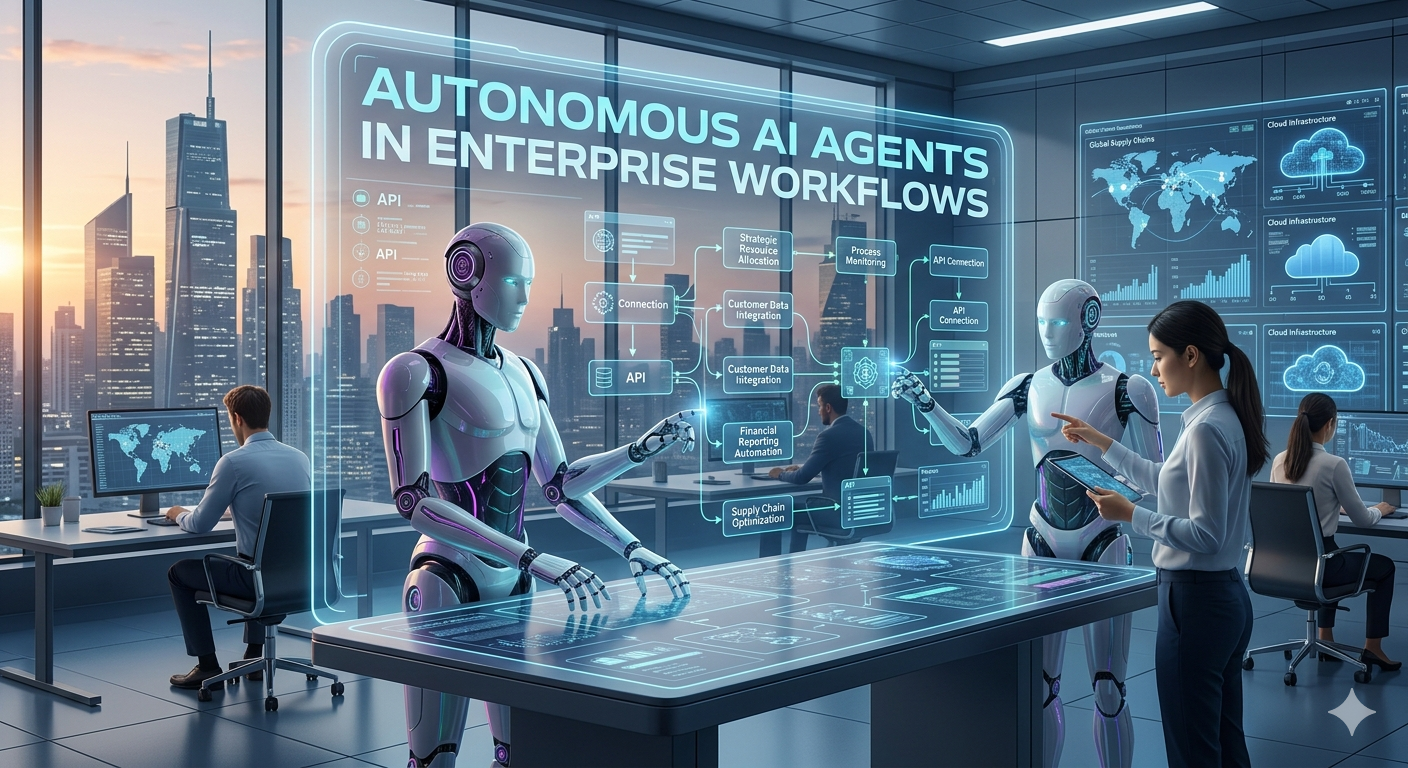
Unlike traditional chatbots that are reactive, AI agents are goal-oriented. They don't just "talk"; they "do." They can reason through multi-step goals, access internal tools, and execute complex workflows across different software platforms—often with minimal human intervention.
Chatbots vs. Agents: What’s the Difference?
While the terms are often used interchangeably, the technical and functional gap is significant:
FeatureGenAI Chatbot (2023-2025) Autonomous Agent (2026+)
Nature Reactive (Wait for prompt) Proactive (Pursue goals)
Workflow Single-turn tasks Multi-step orchestration
Tool Use Limited (Plugins/Browsing) Full Integration (APIs, ERP, CRM)
Memory Session-based (Context window) Persistent (Long-term learning)
Success Metric Plausible response Successful task completion
The "Multi-Agent" Orchestra: 2026's Breakout Trend
In 2026, the most sophisticated enterprises aren't just deploying single agents; they are building Multi-Agent Systems (MAS). Think of this as a digital department where specialized agents collaborate:
The Orchestrator: Receives a high-level goal (e.g., "Onboard the new regional sales director") and breaks it into sub-tasks.
The IT Specialist: Automatically provisions hardware, sets up security permissions, and creates software accounts.
The HR Specialist: Schedules orientation sessions, sends out the welcome kit, and updates payroll systems.
The Compliance Guard: Monitors every step to ensure data privacy laws and internal policies are strictly followed.
This "orchestra" approach allows AI to handle "long-running" tasks that might take days or weeks, rather than just seconds.
High-Impact Use Cases in the Enterprise
We are seeing agents move beyond experiments and into mission-critical operations:
Self-Healing Supply Chains: Agents monitor global shipping delays and automatically reroute orders, update inventory levels, and notify customers before a human even spots the bottleneck.
Autonomous Financial Reconciliation: Instead of accountants chasing mismatched invoices, agents scan disparate systems, spot anomalies, and only escalate the "tricky" exceptions to a human expert.
Agentic Software Engineering: Beyond just writing code snippets, agents are now being used to scan entire repositories for bugs, open pull requests, and run compliance checks autonomously.
The New Human Role: "Manager of Agents"
The rise of autonomous agents isn't necessarily about job replacement; it's about role evolution. In 2026, "AI Fluency" has become the most sought-after skill.
Human workers are shifting from being "builders" to "curators." Your value no longer lies in performing the task, but in framing the problem, defining the guardrails, and providing strategic oversight.
"In 2026, the primary human role is no longer hands-on execution, but orchestration. We are moving from being the drivers of the car to being the air traffic controllers of a digital fleet."
Challenges on the Horizon: Governance and "Workslop"
With great autonomy comes great risk. Enterprises in 2026 are grappling with:
Agent Hallucinations in Actions: A chatbot lying is annoying; an agent making an unauthorized $50,000 wire transfer is a catastrophe.
Workslop: The risk of agents generating high-volume, low-quality "noise" (emails, reports, code) that creates more work for humans to review.
Governance Gaps: Organizations are having to rewrite their security policies to treat AI agents like "digital employees" with specific permissions and audit trails.