NVIDIA GTC 2026: The Biggest Highlights in a Nutshell
NVIDIA GTC 2026 once again proved why it’s called the “Super Bowl of AI.” This year’s event wasn’t just about faster chips — it showcased a complete vision for the future of computing: agentic AI, next-gen infrastructure, and real-world robotics.
Here’s a quick breakdown of the biggest takeaways 👇
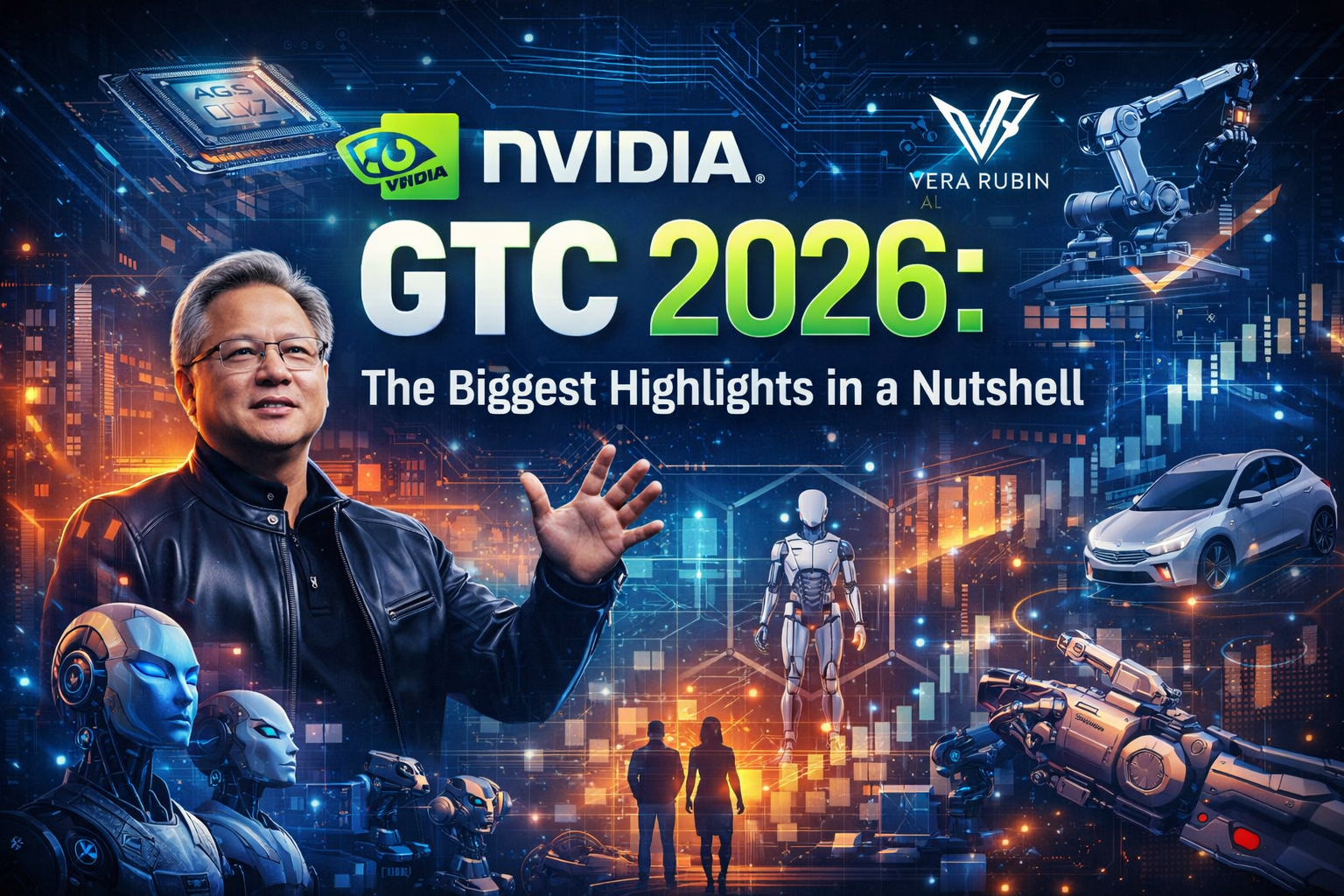
🚀 1. The Vera Rubin Era Begins
The headline announcement was the Vera Rubin platform, NVIDIA’s next-generation AI architecture.
Built for inference-heavy workloads (not just training)
Delivers massive performance gains and efficiency improvements
Combines CPU, GPU, networking, and memory into a unified system
This marks a shift toward AI factories — systems designed to generate tokens (AI outputs) at scale.
🤖 2. Rise of Agentic AI
NVIDIA is going all-in on AI agents.
Introduced OpenClaw & NemoClaw — an open, enterprise-grade AI agent framework
Compared to “Linux for AI agents”
Designed to power autonomous workflows across industries
This signals a move from chatbots → autonomous AI systems that can act, decide, and execute tasks.
🧠 3. AI Infrastructure Is the New Gold Rush
Jensen Huang made a bold claim:
AI infrastructure demand could hit $1 trillion by 2027
Driven by hyperscalers and enterprise AI adoption
Inference workloads are now overtaking training
NVIDIA is positioning itself as the backbone of global AI compute
⚡ 4. Breakthroughs in Chips, Memory & Storage
GTC 2026 showcased cutting-edge hardware innovations:
HBM4 / HBM4e memory with massive bandwidth gains
PCIe Gen6 SSDs for faster data pipelines
New Vera CPUs (88-core) with huge throughput improvements
Advanced AI storage architectures like BlueField-4 STX
All aimed at solving one core problem:
👉 Feeding data to AI models faster than ever before
🤖 5. Physical AI & Robotics Take Center Stage
AI is moving beyond software into the real world:
Robotaxi partnerships with major automakers
Over 100+ robots demonstrated at the event
Advances in simulation and digital twins
This is NVIDIA’s vision of “physical AI” — where AI interacts with the physical world at scale.
🎮 6. DLSS 5 and AI-Driven Graphics
NVIDIA introduced DLSS 5, pushing AI into graphics:
Uses generative AI for visual enhancements
Aims for more realistic rendering in games and simulations
However, early reactions show mixed feedback from developers and gamers, especially around artistic control.
🔮 7. AI Is Becoming a Utility
One of the biggest themes:
AI is evolving into a commodity like electricity or the internet
Tokens = the new economic unit
AI factories = the new data centers
Inference = the dominant workload
This signals a long-term shift in how computing is built and consumed.
🧾 Final Thoughts
GTC 2026 wasn’t just about new tech — it was about a paradigm shift:
From models → AI systems
From tools → autonomous agents
From compute → AI infrastructure at global scale
In one line:
👉 NVIDIA is no longer just building chips — it’s building the operating system of the AI era.