In 2024, the world was obsessed with "Prompt Engineering." We spent our days learning the perfect combination of words to make a chatbot behave. But as we move through 2026, the goalposts have shifted.
The novelty of talking to a machine has worn off. Today, the most valuable professionals aren't just "prompters"—they are AI Orchestrators. If you want to remain irreplaceable in an agentic economy, you need to look beyond the text box.
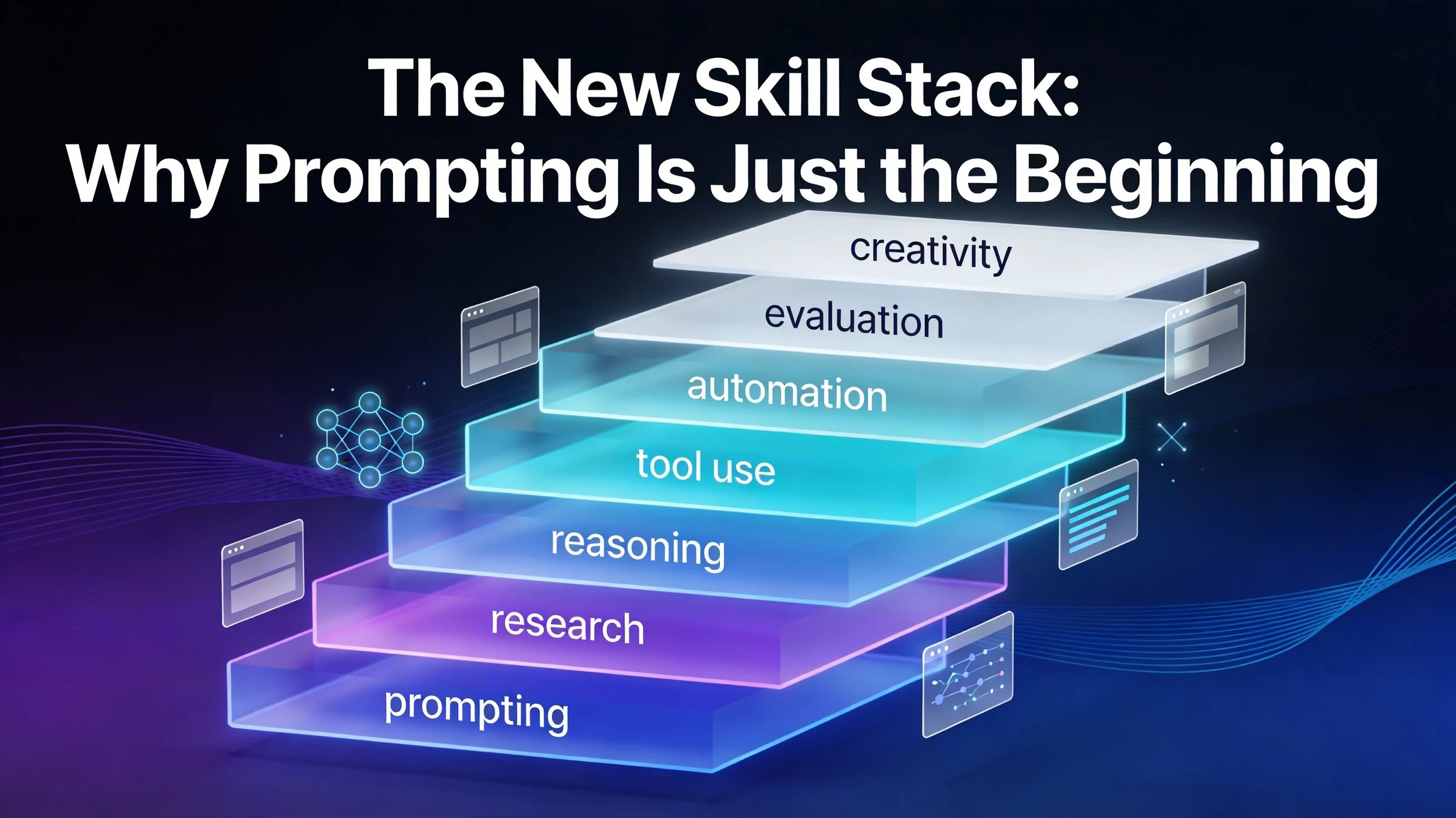
The Evolution of the AI Skill Set
The transition from a "Prompt-First" to an "Orchestration-First" mindset is the defining career move of this year. Here is how the skill stack has evolved:
From "Writing" to "Task Decomposition": It’s no longer about writing one long, perfect prompt. It’s about breaking a complex project (like "Launch a Marketing Campaign") into ten smaller, interconnected tasks that different AI agents can execute in sequence.
From "Creation" to "Curation and Verification": As AI generates more volume, your value lies in your domain expertise. Can you spot a subtle hallucination in a legal brief? Do you recognize "code smell" in an AI-generated script? The human role has moved from the writer's desk to the editor's chair.
From "Manual Work" to "Workflow Design": Instead of manually asking an AI to do something every morning, the new skill is building agentic workflows. This means setting up systems where one AI handles research, another handles drafting, and a third handles fact-checking—all without you touching a keyboard.
The Three Pillars of the 2026 Skill Stack
1. Strategic Oversight & Governance
Knowing how to use AI is common; knowing when to use it is rare. In 2026, leaders must manage "digital workforces" the same way they manage human teams: setting clear goals, establishing ethical guardrails, and knowing when a human must step back into the loop for high-stakes decisions.
2. Technical Fluency (The "No-Code" Architect)
You don't need to be a Python expert, but you must understand system architecture. Understanding how RAG (Retrieval-Augmented Generation) connects your company’s private data to an LLM is now as fundamental as knowing how to use an Excel formula.
3. Agentic Logic
We are moving into a world of multi-agent systems. Skills in platforms like LangChain or Microsoft AutoGen are becoming standard. Learning to manage "Agent Teams" that collaborate, debate, and refine each other's work is the high-water mark of modern productivity.
Why Prompting Is Still Important (But Not Enough)
Think of prompt engineering as literacy. In the 1900s, being able to read and write was a massive advantage. Today, it’s a baseline requirement.
Prompting is how you communicate with the machine, but Orchestration is how you create value. The real race isn't to see who can write the best sentence—it's to see who can build the best system.
The 2026 Mantra: Stop trying to work for the AI, and start building the systems that let the AI work for you.
Is your team still stuck in the "chatbox" phase, or are you building workflows? Let's discuss how your role has changed this year.